
Power Inverter 500 Watt: 5 Models Compared for Vehicles

500W Inverter with 36W USB-C is the best fit for most buyers who want 500W continuous output and a 36W USB-C port alongside AC outlets. Choose another model if you need a particular port mix or want a cigarette-lighter limit; the 500W rating alone does not mean every connection can supply that much power.
We earn a commission if you buy through links on this page. As an Amazon Associate I earn from qualifying purchases. Products are compared on manufacturer specifications, not hands-on testing.
- Best overall: 500W Inverter with 36W USB-C – It combines 500W continuous output with a 36W USB-C port and two AC outlets.
- Best for lighter-duty plug use: YSOLX 500W Vehicle Inverter – Its cigarette-lighter connection is specified for appliances under 150W.
- Best for display readouts: RUTNRIXA 500W Inverter with LCD – Its LCD shows input and output voltage, battery capacity and load capacity.
| Product | Best for | AC outlets | USB-C output | Shop |
|---|---|---|---|---|
| 500W Inverter with 36W USB-C | USB-C charging | 2 | 36W | Check Price on Amazon |
| RUTNRIXA 500W Inverter with LCD | LCD monitoring | 3 | 25W PD | Check Price on Amazon |
| MOVFFGGRM 500W Inverter, 4 USB Ports | Multiple USB devices | 3 | — | Check Price on Amazon |
| YSOLX 500W Vehicle Inverter | Lighter plug loads | 2 | 24W | Check Price on Amazon |
| MOVFFGGRM 500W Black Inverter | Compact dimensions | 2 | — | Check Price on Amazon |
500-watt power inverters
Compare the output connections and charging features that distinguish these 12V vehicle inverters.
500W Inverter with 36W USB-C

The 36W USB-C port separates this model from the other inverters here, alongside a 5V/3A USB port and two AC outlets. It converts 12V DC to 110V/120V AC and is rated for 500W continuous output with up to 1,000W peak power; the maker identifies it as modified sine wave. That combination suits vehicle or camping setups with compatible electronics and USB-C devices. The peak figure is not the continuous rating, so check a device’s running and startup demands against the inverter’s continuous capacity.
Bottom line: Choose this model if a 36W USB-C port matters alongside two AC outlets.
RUTNRIXA 500W Inverter with LCD

The LCD readout and three AC outlets distinguish this inverter; the display shows input and output voltage, battery capacity and load capacity. The maker specifies 500W continuous output, 1,000W peak power, 12V DC input, and a modified sine wave, plus two USB-A 2.4A ports and a 25W USB-C PD port. Six protection functions and two built-in 50A fuses are also identified. This setup can suit buyers who want several AC connections and on-device status readings. Its USB-C output is lower than the 36W option in this group, which matters if USB-C charging speed is the priority.
Bottom line: Pick it if an LCD and three AC outlets are more useful than faster USB-C output.
MOVFFGGRM 500W Inverter, 4 USB Ports
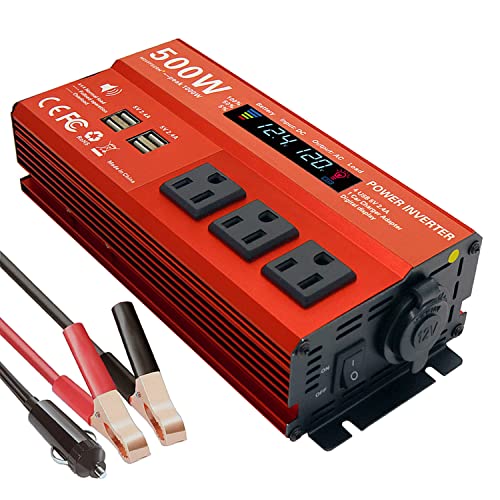
Four USB-A 2.4A ports set this model apart for charging several USB devices; it also has three AC outlets and a cigarette-lighter port. The maker specifies a modified sine wave, 500W continuous output and 1,000W peak power, with protection against overheating, voltage extremes, short circuits and overloads. Its aluminum body and silent fan are part of the heat-dissipation design. It can suit a vehicle setup with multiple USB devices and AC loads, but no USB-C port is identified, so it is a less direct match for buyers needing USB-C charging.
Bottom line: Choose it for its four USB-A ports and three AC outlets.
YSOLX 500W Vehicle Inverter

The 150W limit for its cigarette-lighter connection makes this model unusually clear about how to connect larger loads: the maker says appliances from 150W to 500W need the included alligator clips connected to the battery. It converts 12V DC to 110V AC and has two AC outlets plus two USB ports with 24W fast charging. That guidance suits buyers who want both connection methods and can use a battery connection when needed. The cigarette-lighter plug is not intended for the full 500W output, so buyers relying only on that socket should keep their load below 150W.
Bottom line: Pick it if you want a clearly stated 150W lighter-plug limit and battery clips for larger loads.
MOVFFGGRM 500W Black Inverter
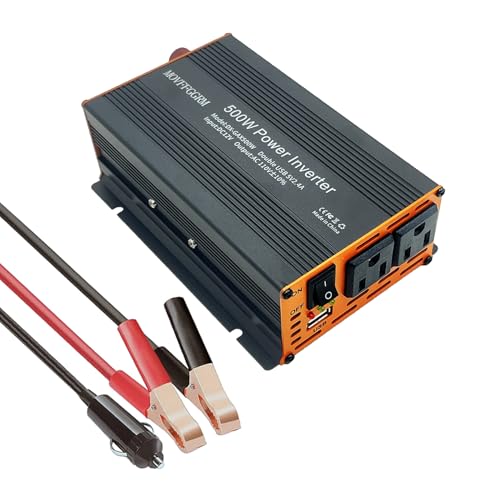
At 6.35 inches long, this is the shortest inverter in the group with a length measurement. It is a modified sine wave unit rated for 500W continuous output and 1,000W peak, with 12V input, two AC outlets and one USB output. The maker says to use the included clips for loads above 150W because the cigarette-lighter fuse is usually below that level. It can suit buyers seeking a shorter unit with both plug and clip connection options. Its single USB output is a simpler charging setup than the models with multiple USB ports.
Bottom line: Choose it if the measured short length and dual input methods fit your setup.
How to choose a 500-watt power inverter
Start with the inverter’s continuous output, not its peak figure: a 500W continuous model is meant for a combined running load up to 500W, while a 1,000W peak rating describes a brief surge. Add the wattage of everything you plan to run at once and leave headroom for equipment with motor or compressor startup surges. A 12V system supplying 500W draws about 42 amps even before conversion losses, so higher loads call for a battery connection rather than assuming a dash socket can handle them. Match AC outlets and USB ports to the devices you actually use, and check whether USB-C PD output meets the device’s charging requirement.
Vehicle connection limits and battery safety
A cigarette-lighter outlet may be fused for far less current than a 500W inverter requires. The products here explicitly distinguish lighter-plug use from battery-clip use; use the limit for the particular model and consult the vehicle manual for the outlet fuse rating. A 500W load at 12V is roughly 42 amps before losses, so connect larger loads with the proper supplied cables and clips, observing polarity; reversing polarity can cause damage. Keep the inverter dry, ventilated and away from flammable materials, and do not leave a running inverter unattended in a parked vehicle. Stop if cables or plugs become hot, and never exceed the inverter’s continuous rating.
Modified sine wave and device compatibility
Modified sine wave describes the shape of the AC output, not the amount of power available. Several models here identify that output type, so check the device maker’s guidance before using equipment that requires a pure sine wave. Many basic chargers, lamps and electronics can operate on modified sine wave power, but motor-driven appliances, sensitive audio equipment and some medical devices may run poorly, become noisy or be incompatible. A practical decision rule is to avoid connecting any device whose manual requires pure sine wave output; choose an inverter explicitly rated pure sine wave instead. Also check both the appliance’s running wattage and startup demand against the inverter’s continuous and peak ratings.
USB ports, outlets and fit in a vehicle
Port count and charging rate are separate considerations: four USB-A ports do not guarantee the same charging speed as a USB-C PD port, and a device must support the relevant charging standard to use its faster rate. Measure the available spot before choosing; the product dimensions range from 6.35 to 10 inches in length, while ventilation space is still needed around the inverter. Do not bury the unit under luggage or cover its fan openings. For multiple AC appliances, total their running wattage and keep the sum below 500W; reserve peak capacity for short startup surges rather than treating it as another continuous rating.
Frequently Asked Questions
Can a 500-watt inverter run from a car outlet?
Only if the outlet and inverter’s plug connection are rated for the load. One model here limits lighter-plug appliances to under 150W, and another advises battery clips above 150W; a full 500W at 12V draws roughly 42 amps before losses.
What does 1,000-watt peak power mean?
Peak power is a brief surge rating, not a continuous operating limit. Treat a 500W continuous rating as the limit for sustained combined load and check an appliance’s startup demand separately.
Will a modified sine wave inverter run a laptop?
Many laptops use an external power adapter, but compatibility depends on that adapter and its maker’s guidance. Check the adapter’s input requirements and keep its power demand within the inverter’s continuous rating.
How many amps does a 500-watt inverter draw?
At 12V, 500W corresponds to about 42 amps before conversion losses. Actual battery current is higher, so high loads need a suitable battery connection rather than an assumption that a vehicle accessory socket will support them.