
Onn Outdoor Motorized Antenna Alternatives Compared

The Onn outdoor motorized antenna is not among these options; the PBD 360-degree models are the closest alternatives, with remote rotation and dual TV outputs. Choose one of those for a 40- or 59-foot cable; consider another option if you need a four-way splitter or a nonmotorized setup.
We earn a commission if you buy through links on this page. As an Amazon Associate I earn from qualifying purchases. Products are compared on manufacturer specifications, not hands-on testing.
- Best overall: PBD Outdoor Antenna, 40 ft Cable – Remote 360-degree rotation, dual TV outputs and a 40-foot RG6 cable make this a close match.
- Best for longer cable runs: PBD Amplified Antenna, 59 ft Cable – Includes a 59-foot RG6 cable with motorized remote rotation and dual TV outputs.
- Best for multiple TVs: Five Star 5-TV Outdoor Antenna Kit – Includes a four-way splitter and supports up to five TVs.
| Product | Best for | Included cable | TV support | Shop |
|---|---|---|---|---|
| PBD Outdoor Antenna, 40 ft Cable | Standard cable reach | 40 ft RG6 | 2 outputs | Check Price on Amazon |
| PBD Amplified Antenna, 59 ft Cable | Longer cable runs | 59 ft RG6 | 2 outputs | Check Price on Amazon |
| McDuory 150-Mile Motorized Antenna | Tool-free assembly | 40 ft RG6 | 2 TVs | Check Price on Amazon |
| Five Star 5-TV Outdoor Antenna Kit | Several televisions | 40 ft RG6 | Up to 5 TVs | Check Price on Amazon |
Outdoor Motorized Antennas
Compare the rotation, cable length and connections to find an antenna that suits your installation.
PBD Outdoor Antenna, 40 ft Cable

The PBD outdoor antenna combines remote-controlled 360-degree rotation with a 40-foot RG6 cable, making it a direct fit for buyers seeking a motorized outdoor model. It has a built-in high-gain, low-noise amplifier and two TV outputs. PBD says its reception range is up to 150 miles; actual reception depends on terrain, tower distance and antenna height. The package includes a mounting pole, according to the product name. A 40-foot run may not reach a roof location far from the television, so measure the route before choosing.
Bottom line: Choose this if a 40-foot cable reaches your mounting spot.
PBD Amplified Antenna, 59 ft Cable

The PBD model’s defining difference is its 59-foot RG6 cable, giving more routing length than the other PBD option. The antenna also has remote 360-degree rotation, a built-in high-gain, low-noise amplifier and two TV outputs. PBD says the reception range is up to 150 miles; that figure is not a guarantee of channels at a particular address, since terrain and distance from broadcast towers matter. Its name also specifies a grounding block. Choose this version when the extra cable length is useful, but confirm the mounting route and grounding arrangement first.
Bottom line: Pick this for a longer cable route and dual-TV connection.
McDuory 150-Mile Motorized Antenna
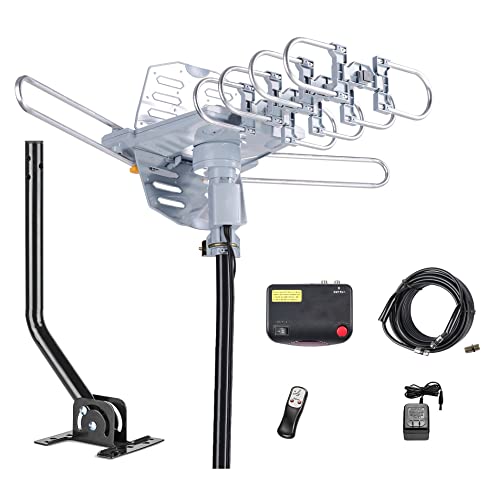
The McDuory stands out for tool-free assembly: its snap-on elements and included mounting pole avoid sourcing a separate pole for the mounting arrangement. It has an infrared remote, a built-in 360-degree motor rotor, an amplifier and a 40-foot outdoor coaxial cable. The product specifies VHF reception at 170–230 MHz and UHF at 470–860 MHz, and says it can feed two TVs without a splitter. Its 150-mile range is a manufacturer claim, not a reliable prediction for every location. Check that the included pole works with your intended mount.
Bottom line: Choose it if tool-free assembly and an included pole matter.
Five Star 5-TV Outdoor Antenna Kit
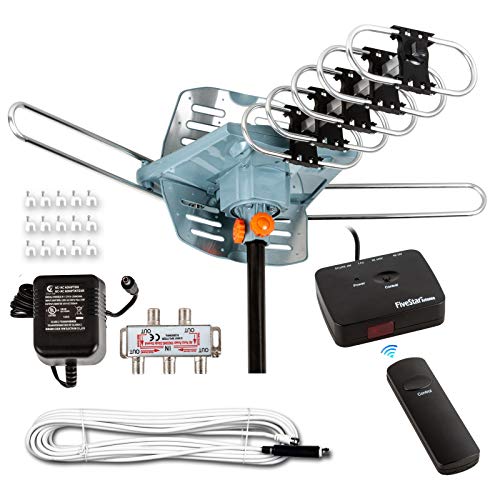
The Five Star kit is the option for distributing reception to more than two televisions: it includes a four-way splitter and supports up to five TVs. Its 360-degree motor is controlled by a wireless remote, and the package includes a 40-foot RG6 cable, control box and power supply. The antenna itself measures 24 by 29 by 10 inches, and the remote requires AAA batteries that are not included. A mounting pole is also not included, so buyers without an existing compatible mounting point need to account for that before installation.
Bottom line: Select it when the four-way splitter fits your TV setup.
How to Choose an Outdoor Motorized Antenna
Start with cable route and number of TVs, then compare rotation and reception bands. A motorized antenna turns toward a broadcast tower; remote rotation is useful when the antenna is mounted where it cannot be adjusted by hand. Most U.S. full-power over-the-air television broadcasts use UHF, while some stations still use VHF, so a UHF/VHF antenna can cover both bands. Choose a model with enough outputs or a splitter for the number of televisions. Splitters divide signal power, so long cable runs and several splits can reduce signal at each TV. If a route exceeds 40 feet, the 59-foot cable option offers more included reach; still measure the path, including bends and drops.
Outdoor Antenna Placement and Aiming
Height and a clear path toward transmitters often matter more than a large advertised range. Roof or mast placement can reduce obstructions, while hills, dense buildings and trees can weaken or block broadcast signals. Before mounting permanently, scan for channels at the planned location and rotate the antenna toward the tower direction; a compass or station locator can help identify the direction. Digital reception can fail abruptly at the signal threshold, so small changes in height or direction may restore a channel. Keep the antenna and mast clear of power lines: never install where a falling mast or antenna could contact electrical wires, and maintain safe separation during installation.
How Many TVs Can One Antenna Feed
Use the output count and splitter arrangement to match the number of televisions. A passive splitter sends the same antenna signal to multiple sets, but every split reduces signal strength; a four-way splitter typically introduces about 7 dB of loss per output before cable loss. Shorter coaxial runs and fewer splits preserve more signal. The table separates connection choices from aiming features; a claim of support for multiple TVs does not mean each television can watch a different broadcast channel at the same time. Each TV’s tuner selects its own channel from the shared antenna feed.
| Setup need | What to look for | Tradeoff |
|---|---|---|
| One TV | One direct coax run | Least splitting loss |
| Two TVs | Two outputs or a 2-way splitter | Signal divides between sets |
| Several TVs | Multiway splitter and adequate signal | More loss across branches |
Grounding and Weatherproof Installation
Outdoor antenna installations need attention to lightning and electrical safety, not just weather exposure. In the U.S., the National Electrical Code includes grounding and bonding requirements for antenna systems; a grounding block alone does not replace correct bonding of the mast and coaxial entry. Keep coax connections weather-protected with outdoor-rated fittings or seals, and route cable with a drip loop so water does not run into the building. Never work on an antenna near overhead power lines, and do not attempt installation during a storm. Check that the selected mast and mounting hardware are secure for the roof or wall surface and local wind exposure.
Frequently Asked Questions
Does a motorized antenna need to rotate constantly?
No. A rotor is used to aim the antenna toward a station group, then it can remain in that position while you watch. Stations in different directions may require repositioning, and one fixed aim may not serve every tower well.
How long can an outdoor antenna coax cable be?
Cable loss rises with length and frequency, so use the shortest practical run. A 40-foot cable is a common included length for these kits, while a longer route can call for a 59-foot cable and may need signal planning.
Can two TVs watch different channels from one antenna?
Yes, when each TV has its own tuner and the antenna feed is split to both sets. A two-output feed does not limit both televisions to the same selected channel, but weak signal can affect both.
Will a 150-mile antenna receive stations 150 miles away?
Not necessarily; range claims cannot account for terrain, transmitter power, obstructions or antenna height at your home. Broadcast signals generally travel line of sight, so distant reception is highly location-dependent.
Is a mounting pole included with every antenna?
No. The McDuory product specifies an included pole, and the Five Star kit says its mounting pole is not included. Confirm that your chosen mount can support the antenna and its exposure to wind.