
Battery Chargers for Gel Batteries: 5 Models Compared

The E-FAST charger is a flexible choice for gel batteries if you need selectable current and 12V or 24V support. Pick a different model if you need a 6V setting, a 10A option, or a charger limited to 12V batteries.
Gel batteries use sealed lead-acid chemistry, so they need a charger with a compatible charging profile rather than a generic unregulated supply.
We earn a commission if you buy through links on this page. As an Amazon Associate I earn from qualifying purchases. Products are compared on manufacturer specifications, not hands-on testing.
- Best overall: E-FAST 25A Smart Charger – Offers selectable 2A, 8A, 20A, and 25A settings plus Auto mode and 12V/24V support.
- Best for 6V batteries: Schumacher SC1280 15A Charger – Supports 6V and 12V batteries and includes a 3A trickle-charge function.
- Best for 10A charging: NEXPEAK NC201 10A Charger – Provides 10A output for 12V batteries and 5A for 24V batteries.
| Product | Best for | Battery voltage | Maximum charging current | Shop |
|---|---|---|---|---|
| E-FAST 25A Smart Charger | Selectable current | 12V, 24V | 25A (12V); 15A (24V) | Check Price on Amazon |
| TowerTop 25A 12V Charger | 12V gel batteries | 12V | 25A | Check Price on Amazon |
| Schumacher SC1280 15A Charger | 6V compatibility | 6V, 12V | 15A | Check Price on Amazon |
| 20A 12V/24V Smart Charger | 24V charging | 12V, 24V | 20A (12V); 10A (24V) | Check Price on Amazon |
| NEXPEAK NC201 10A Charger | Moderate current | 12V, 24V | 10A (12V); 5A (24V) | Check Price on Amazon |
Battery Chargers for Gel Batteries
Compare voltage support and charging current, then match the charger to your battery and intended use.
E-FAST 25A Smart Charger

Five current choices distinguish this charger: 2A, 8A, 20A, 25A, and Auto mode. The charger supports 12V and 24V batteries, and the maker says it is compatible with gel, AGM, flooded lead-acid, and LiFePO4 batteries. The maker also describes an automatic voltage-detection function. This is a fit for buyers who want to choose a lower current for smaller batteries or a higher setting for larger ones. Its limitation is that the feature set gives no 6V option, so choose a different unit for a 6V battery.
Bottom line: Choose it if you need multiple current settings and 12V/24V coverage.
TowerTop 25A 12V Charger

This charger is a 12V-only choice with four current settings: 2A, 10A, 25A, and Auto. The maker identifies gel, AGM, standard, and deep-cycle batteries as compatible and describes engine-start, desulfation, battery-repair, and winter modes. Its 25A maximum suits buyers who want a high-current setting for a compatible 12V battery. The limitation is voltage coverage: unlike the 12V/24V models, it is not a match for a 24V battery, and its settings do not include 6V batteries.
Bottom line: Pick it for a 12V gel battery when 2A, 10A, or 25A settings suit your needs.
Schumacher SC1280 15A Charger

Support for 6V batteries sets this charger apart from the 12V/24V alternatives. The SC1280 handles 6V and 12V batteries, with 15A charging and a 3A trickle-charge function; the maker also identifies gel, AGM, standard, and deep-cycle batteries as compatible. Its microprocessor control and automatic voltage detection are aimed at buyers maintaining power-sport, automotive, or marine batteries. The tradeoff is that it does not cover 24V batteries, so it is unsuitable when the battery system requires 24V.
Bottom line: Choose it if you need a gel-compatible charger that also supports 6V batteries.
20A 12V/24V Smart Charger
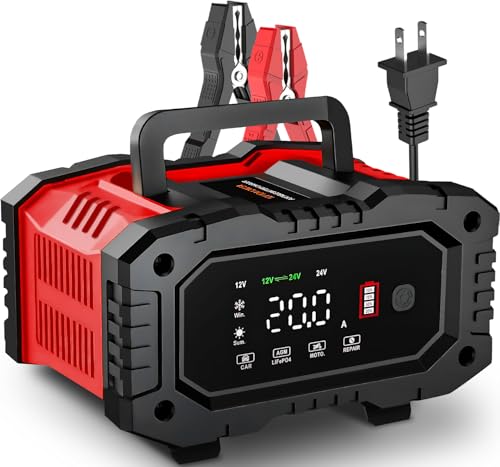
This model provides 20A at 12V and 10A at 24V, with gel compatibility among its lead-acid battery types. The maker also describes LiFePO4 support and functions for charging, maintaining, and desulfating. Its 12V/24V coverage suits buyers with compatible batteries across automotive, powersports, or marine equipment. The maximum output is lower than the 25A 12V setting on some alternatives, so buyers prioritizing the highest 12V current should compare those models instead.
Bottom line: Pick it for gel batteries when 20A at 12V or 10A at 24V fits your charging needs.
NEXPEAK NC201 10A Charger
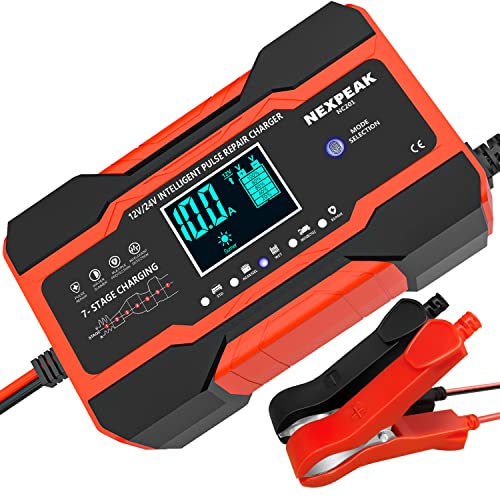
The NC201 offers a lower maximum current than the 20A and 25A choices, with 10A output at 12V and 5A at 24V. The maker identifies gel, AGM, SLA, flooded, and deep-cycle lead-acid batteries as compatible, and describes a seven-stage charging process and temperature compensation. This is a reasonable match for buyers who want 12V/24V coverage without selecting a model around a 20A or 25A maximum. Its limitation is slower charging potential compared with higher-current options when the battery and charging conditions allow those currents.
Bottom line: Choose it if its 10A/5A output suits your battery and charging schedule.
How to Choose a Gel Battery Charger
Match the charger voltage to the battery first, then choose a current appropriate to its capacity and the time available. These models support different combinations of 6V, 12V, and 24V; a charger set for the wrong system voltage can damage a battery. For lead-acid batteries, a common planning range is about 10% to 20% of the battery’s amp-hour capacity in charging current, subject to the battery maker’s limit. For example, a 100Ah battery often pairs with roughly 10A to 20A. A practical rule: if the battery label specifies a maximum charge current below a charger’s available setting, select a lower setting or use another charger.
Gel Battery Charging Voltage and Profile
Gel batteries need a regulated charging profile, and their absorption voltage is typically lower than that used for some flooded lead-acid batteries. Common 12V gel charging guidance is about 14.1V to 14.4V for absorption and roughly 13.5V to 13.8V for float at room temperature, but the battery manufacturer’s limits take precedence. Gel electrolyte can be permanently damaged by overcharging, so use a charger mode explicitly compatible with gel batteries and avoid equalization modes unless the battery maker specifically permits them. Check the battery label or manual for the permitted absorption voltage and temperature correction before charging.
Charger Current and Typical Charging Time
Charging time depends on battery capacity, its starting state of charge, and how much current the battery can safely accept. A rough estimate is amp-hours to replace divided by charging amps, then add time for the slower absorption stage; replacing 50Ah at 10A therefore takes longer than five hours in practice. The 10A and 20A settings can suit smaller or medium battery banks, while 25A can shorten charging time only when the battery permits that current. High current is not automatically better: exceeding the battery’s maximum charge rate can shorten service life or cause damage.
| Battery need | Choice to compare | Deciding factor |
|---|---|---|
| 6V gel battery | Schumacher SC1280 15A Charger | 6V support |
| 12V or 24V system | E-FAST 25A Smart Charger, 20A 12V/24V Smart Charger, or NEXPEAK NC201 10A Charger | Available current setting |
| 12V battery only | TowerTop 25A 12V Charger | 12V-only system is sufficient |
Safe Charging and Battery Care
Charge lead-acid batteries in a ventilated area because charging can release hydrogen, which is flammable. Keep sparks, flames, and smoking materials away, and connect clamps with the charger unplugged when its instructions call for that sequence. For batteries that spend long periods in storage, a properly regulated float or maintenance mode helps avoid repeated deep discharge; inspect terminals for corrosion and keep connections secure. Do not charge a frozen, cracked, leaking, or visibly swollen battery. Stop if a battery becomes unusually hot or gives off a strong odor, and have its condition checked before charging again.
Frequently Asked Questions
Can I use an AGM charger on a gel battery?
Use it only if the charger explicitly supports gel batteries or has a gel charging mode. AGM and gel are both sealed lead-acid types, but their preferred charging voltages can differ; gel charging commonly uses about 14.1V to 14.4V absorption for a 12V battery.
How many amps should a gel battery charger have?
A common starting guideline is charging current around 10% to 20% of battery capacity in amp-hours, if the battery maker allows it. For a 100Ah battery, that is roughly 10A to 20A; use a lower limit if the battery specifies one.
Can a gel battery stay on a trickle charger?
A gel battery can remain connected to a charger designed for maintenance only if it provides a regulated float mode compatible with that battery. Typical 12V float guidance is about 13.5V to 13.8V at room temperature, so verify the battery’s permitted float voltage.
What voltage should a 12V gel battery charge at?
A typical 12V gel battery absorption range is about 14.1V to 14.4V at room temperature. Battery specifications vary, so use the battery maker’s voltage limit rather than assuming every gel battery accepts the top of that range.
Should I charge a gel battery at 25 amps?
Only if the battery’s capacity and manufacturer permit 25A charging. A rough guideline of 10% to 20% of amp-hour capacity means 25A may suit a battery around 125Ah to 250Ah, but the individual battery’s maximum charge rate controls.