
Chicken Express Pressure Fryer: 5 Models Compared

No Chicken Express-branded pressure fryer is among these options; for a 16L electric chicken fryer, ERZODA 16L 3kW Pressure Fryer stands out for its 3kW heating, 8 PSI rating and separate timer and temperature controls. Choose another model if its dimensions, power draw or controls better suit your kitchen.
A pressure fryer cooks food in hot oil inside a sealed vessel, so pressure management and safe depressurizing matter as much as capacity.
We earn a commission if you buy through links on this page. As an Amazon Associate I earn from qualifying purchases. Products are compared on manufacturer specifications, not hands-on testing.
- Best overall: ERZODA 16L 3kW Pressure Fryer – Its 3kW heater, 8 PSI rating and separate mechanical timer and temperature controls make the operating setup clear.
- Best for pressure monitoring: BEILOCKERY 16L 2400W Pressure Fryer – It specifies 8 PSI and a real-time pressure gauge with a safety relief valve.
- Best for compact depth: HQHAOTWU Numerical Control 16L Fryer – Its depth is 15.35 inches, shorter than the other options with dimensions provided.
| Product | Best for | Capacity | Power | Temperature range | Shop |
|---|---|---|---|---|---|
| ERZODA 16L 3kW Pressure Fryer | Controlled batch frying | 16 L | 3 kW, 110V | Up to 392°F | Check Price on Amazon |
| BEILOCKERY 16L 2400W Pressure Fryer | Visible pressure readings | About 16 L | 2.4 kW, 110V | 122–392°F | Check Price on Amazon |
| HQHAOTWU Numerical Control 16L Fryer | Shorter depth | 16 L | 2.4 kW | — | Check Price on Amazon |
| WYDDDARY 16L 2.4kW Pressure Fryer | Included accessories | 16 L | 2.4 kW, 110V | — | Check Price on Amazon |
| PreAsion 16L Electric Pressure Fryer | Overpressure mechanism | 16 L | 110V | 32–392°F | Check Price on Amazon |
Chicken Express Pressure Fryers
These are generic electric pressure fryers rather than Chicken Express-branded equipment; compare their controls, power and footprints before choosing.
ERZODA 16L 3kW Pressure Fryer

ERZODA 16L 3kW Pressure Fryer distinguishes itself with a 3kW heater and an 8 PSI operating rating, plus separate timer and temperature knobs. Its 16L tank and 9.6 × 8.3-inch lift-out basket are aimed at batch frying, while the front drain valve and spout simplify oil draining. The weighted valve, pressure relief valve, gauge and sealing ring are specified as pressure-management features. The unit measures 18.5 inches long, 15 inches wide and 20.9 inches high. Its 110V, 3kW load is the key limitation: confirm the kitchen circuit can support it before ordering.
Bottom line: Pick this if you want the most clearly specified power and pressure combination and can support its electrical load.
BEILOCKERY 16L 2400W Pressure Fryer
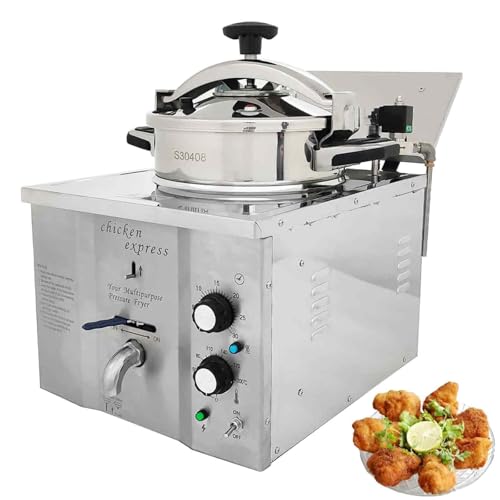
BEILOCKERY 16L 2400W Pressure Fryer is the option that pairs a 8 PSI operating pressure with a real-time pressure gauge and lid-mounted safety relief valve. Its 16L capacity, 2.4kW ceramic heater and 50–200°C temperature control cover a range of frying tasks, and the stainless-steel construction includes an oil drain. At 17.1 inches long, 15.4 inches wide and 20 inches high, it has a slightly different footprint from the other 16L machines. Its 2.4kW rating is lower than ERZODA 16L 3kW Pressure Fryer’s 3kW, so buyers prioritizing the heater wattage should compare that difference.
Bottom line: Choose this if a pressure gauge and relief valve are your priority over the highest wattage.
HQHAOTWU Numerical Control 16L Fryer

HQHAOTWU Numerical Control 16L Fryer has the shortest depth among these fryers at 15.35 inches, which can help when counter depth is tight. The 16L tank is paired with a lifting basket, front oil-drain faucet and rotating cover handle; its stainless-steel body is described as corrosion-resistant and easy to wipe clean. The dimensions are 15.35 inches deep, 17.13 inches wide and 20.08 inches high, and its weight is 56 pounds. The features focus on construction and handling rather than giving a pressure rating or temperature range, so it is a weaker match for buyers who need those operating figures to be explicit.
Bottom line: Pick this for a shallower counter footprint if the missing operating figures are not essential to your selection.
WYDDDARY 16L 2.4kW Pressure Fryer

WYDDDARY 16L 2.4kW Pressure Fryer is notable for its specified set of included components: a fitted timer, variable thermostat, drain tap, fryer basket, pressure valve, pressure gauge and rubber feet. It measures 15.35 inches long, 17.13 inches wide and 20.08 inches high, making its footprint easy to compare against HQHAOTWU Numerical Control 16L Fryer. Its stainless-steel body and real-time pressure monitoring support clear observation during frying.
Bottom line: Choose this if a timer, gauge and drain tap are the combination you need and you can confirm its operating range.
PreAsion 16L Electric Pressure Fryer

PreAsion 16L Electric Pressure Fryer uses an elastic beam support device that the maker says automatically releases during overpressure, alongside thermal overload protection and a thermostat. Its temperature control is listed as 0–200°C, and the round basket is said to accommodate 3–5 chickens. The body is 304 stainless steel, and the machine measures 16.7 inches long, 14.7 inches wide and 20.87 inches high.
Bottom line: Pick this if the automatic overpressure-release design and stated chicken capacity suit your workflow.
How to choose a chicken pressure fryer
Choose by electrical load, pressure controls and counter fit before comparing nominal tank capacity. A 110V fryer rated at 2.4kW draws about 21.8 amps; a 3kW model draws about 27.3 amps, so verify the circuit, plug and installation requirements with a qualified electrician before purchase. A 16L tank describes volume, not the safe amount of oil or food to load; use the vessel’s marked fill limits and avoid crowding the basket. Pressure gauges show vessel pressure, while a relief valve is a separate safety feature. If your operation requires a defined pressure or temperature window, select only a unit whose specifications give those values.
Counter space and electrical fit
Measure the fryer footprint and allow additional room for the lid to open, the basket to lift, and staff to drain oil without reaching over hot surfaces. Among these choices, listed lengths run from 15.35 to 18.5 inches and widths from 14.7 to 17.13 inches; leave working clearance beyond those dimensions rather than treating them as the full installation space. Electrical load is a separate fit test: even 2.4kW at 110V is more than a typical 15-amp circuit’s capacity. Do not assume a standard outlet is sufficient; confirm the equipment nameplate, circuit rating and plug match before use. Keep cords and controls away from splashing oil.
Pressure fryer safety and operation
Keep the lid locked during pressurized cooking and never force it open; wait for pressure to fall and use the maker’s specified release procedure. Hot oil can cause severe burns, and adding wet or frozen food can trigger dangerous splattering, so load dry food carefully and keep hands and face clear of the lid and valve. Pressure controls are not interchangeable: a gauge indicates pressure, while a relief valve is intended to vent excess pressure. Keep valves and seals clean and unobstructed, and stop operation if a seal is damaged or pressure readings behave unexpectedly. Use the fryer only on a stable, heat-resistant surface with appropriate kitchen ventilation and fire protection.
Pressure fryer features compared
The useful differences are the operating figures and the hardware each option specifies, not the shared 16L capacity. A defined PSI value helps buyers compare pressure-based cooking setups, while stated wattage helps assess electrical fit. Gauge and relief-valve presence matter for monitoring and pressure management, but neither replaces safe depressurization or correct operation. Use this chart to shortlist by the detail your kitchen cannot compromise on; verify compatibility before committing to a model whose operating numbers are not provided.
| Need | Specification to prioritize | Why it matters |
|---|---|---|
| Known pressure target | Stated PSI rating | Supports comparison to a defined process |
| Power planning | Wattage and voltage | Indicates approximate electrical demand |
| Pressure monitoring | Gauge plus relief valve | Gauge reads pressure; valve provides pressure relief |
| Tight counter depth | Measured depth and operating clearance | Allows placement and safe access |
Frequently Asked Questions
How much oil should a pressure fryer hold?
Use the fryer tank’s marked minimum and maximum oil lines rather than filling by nominal capacity. Oil expands and bubbles during frying, so keep it below the maximum mark and never exceed the maker’s loading limit.
Can a 110V pressure fryer use a regular outlet?
Do not assume so: a 2.4kW load at 110V is about 21.8 amps, above a typical 15-amp circuit rating. Confirm the fryer nameplate and required circuit with a qualified electrician.
When is it safe to open a pressure fryer?
Open it only after pressure has fully released and the manufacturer’s release procedure is complete. Never force the lid; hot oil and residual pressure can cause serious injury.
Why does a pressure fryer need a relief valve?
A relief valve is designed to vent excess pressure, while a pressure gauge lets the operator see the vessel reading. Keep the valve clean and unobstructed, and do not operate a fryer with a damaged seal or malfunctioning control.
How much counter space should I leave around a fryer?
Allow more space than the body dimensions alone: the lid needs opening room and the basket needs lifting clearance. Keep the fryer stable and leave a safe working area for handling hot oil and draining.