
Bed Frame No Screws: Joinery Models Compared

For a bed frame with no screws, the FLEXISPOT Hako G2 is the closest match because its Japanese joinery assembles without screws, tools, or metal parts. The Thor also uses Japanese joinery, while the Mellow and Cozy City rely on conventional assembly methods, so choose one of those only if a screw-free build is not essential.
A screw-free bed frame uses interlocking components rather than conventional fasteners; confirm room clearance and mattress fit before ordering.
We earn a commission if you buy through links on this page. As an Amazon Associate I earn from qualifying purchases. Products are compared on manufacturer specifications, not hands-on testing.
- Best overall: FLEXISPOT Hako G2 Queen – Japanese joinery is designed to assemble by hand without screws, tools, or metal parts.
- Best for walnut finish: Thor Japanese Joinery Queen – Solid wood frame in walnut with Japanese joinery and a 20-minute setup.
| Product | Best for | Material | Assembly | Queen dimensions | Shop |
|---|---|---|---|---|---|
| FLEXISPOT Hako G2 Queen | Tool-free joinery | Solid rubberwood | Japanese joinery; no tools | 84.84 × 64.65 in | Check Price on Amazon |
| Thor Japanese Joinery Queen | Walnut finish | Solid wood | Japanese joinery; 20-minute setup | 85.43 × 65.74 in | Check Price on Amazon |
| Mellow Naturalista Classic Queen | Pine platform | Solid pine | Easy assembly; method unspecified | 79.5 × 59.5 in | Check Price on Amazon |
| Cozy City Queen Steel Platform | Steel platform | Steel | Labeled parts; conventional assembly | 80 × 60 in | Check Price on Amazon |
Bed Frames No Screws
The key distinction is whether the frame uses interlocking joinery or conventional assembly.
FLEXISPOT Hako G2 Queen

The Hako G2 is the most direct match for a bed frame with no screws: its solid rubberwood components use Japanese joinery and the maker says they slide together by hand without tools or metal parts. The Queen frame measures 84.84 inches long, 64.65 inches wide, and 14.17 inches high. The maker also gives a 1,500-pound capacity and a 10-year warranty. This suits buyers who prioritize a fully tool-free build and want to take the frame apart for a move. Its footprint is wider than a standard 60-inch Queen mattress, so check available floor space.
Bottom line: Choose this if you want a Queen frame designed to assemble and disassemble without screws or tools.
Thor Japanese Joinery Queen
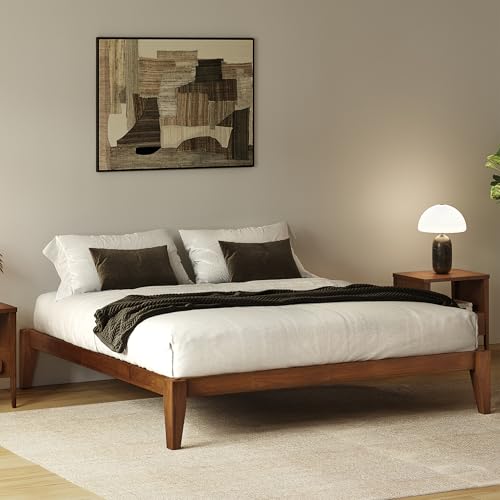
The Thor differs from the Hako G2 with its walnut finish and hybrid construction featuring Thorlock Japanese joinery. The maker says setup takes about 20 minutes; its Queen frame measures 85.43 inches long, 65.74 inches wide, and 14 inches high. Plywood slats and a solid wood center support rail are intended to distribute mattress weight, and a box spring is not required. The maker calls the structure quiet and sturdy, but the hybrid construction means buyers seeking a frame made entirely from interlocking wood parts should verify the assembly method suits them. Its width also calls for careful room measurement.
Bottom line: Choose this for a walnut Queen frame with Japanese joinery and a quick setup.
Mellow Naturalista Classic Queen

The Mellow is a conventional Queen platform frame rather than a Japanese-joinery design, making it a fallback when a no-screw build is not a requirement. It uses a 3.5-inch solid pine frame and wooden slats with non-slip tape; the maker gives a 1,000-pound maximum weight recommendation and says no box spring is needed. Its footprint is 79.5 by 59.5 inches and it stands 12 inches high. This option suits buyers who want a compact pine platform and straightforward assembly. Because the assembly method is not identified as screw-free, do not choose it if avoiding screws is essential.
Bottom line: Pick this if a pine platform matters more than screw-free assembly.
Cozy City Queen Steel Platform

The Cozy City is the only steel frame here, not a no-screw joinery bed; its assembly uses labeled parts and a video guide. Its 14-inch height provides 14 inches of under-bed clearance, and the maker gives a 3,500-pound capacity. The Queen footprint is 80 by 60 inches, with scratch-proof foot pads and a reinforced steel slat system. That makes it a practical alternative for buyers who want storage clearance and a steel platform rather than an all-wood interlocking frame. The tradeoff is that conventional assembly does not meet the search for a genuinely screw-free construction.
Bottom line: Choose this only if steel construction and under-bed clearance outweigh screw-free assembly.
How to choose a bed frame with no screws
Start by distinguishing true screw-free joinery from tool-free or easy assembly. Interlocking joints fit shaped wood components together; a frame can still be advertised as easy to assemble while using conventional fasteners. Ask whether any metal hardware or screws are used if avoiding them is a firm requirement. Also compare the frame’s outside dimensions with your room: Queen mattresses are 60 by 80 inches, but frames extend beyond those measurements. Leave room to walk around the bed and open nearby doors or drawers. A measurable rule helps: if the frame width leaves less than 24 inches of walking space on the side you use, measure again or consider a narrower footprint.
Queen bed frame dimensions and room fit
Queen mattresses measure 60 inches wide by 80 inches long, while the frame footprint includes its rails and headboard. Here, the two joinery frames exceed mattress dimensions by several inches in both directions, while the steel and pine frames are closer to mattress size. Measure wall-to-wall space, then account for nightstands and door swings before choosing a footprint. A frame’s height also changes how easy it is to get in and out of bed and how much storage can fit underneath. The Cozy City specifies 14 inches of clearance; overall frame height alone does not tell you the usable space below every bed. Use the clearance figure, not just the height, when planning storage bins.
The table compares construction and fit at a glance.
| Construction | Assembly approach | Best fit |
|---|---|---|
| Japanese joinery | Interlocking parts | Buyers avoiding screws and tools |
| Wood platform | Easy assembly | Buyers prioritizing wood and slats |
| Steel platform | Labeled-part assembly | Buyers prioritizing steel and clearance |
Joinery versus conventional bed-frame assembly
Japanese joinery connects shaped components through fitted joints rather than relying on conventional metal fasteners. That makes the assembly method materially different from a frame that simply arrives with labeled parts or is called easy to assemble. The Hako G2 specifies no screws, tools, or metal parts; the Thor identifies Japanese joinery with hybrid construction, so its exact hardware approach matters to buyers requiring a fully metal-free frame. Conventional slatted platforms can still offer useful features such as non-slip tape, a center rail, or under-bed clearance, but those do not make their construction screw-free. Decide first whether the requirement is no tools, no screws, or no metal parts: those are distinct conditions.
Slats, mattress support, and weight limits
Slats support a mattress across the frame, and a center rail helps carry load toward the floor on wider beds. The Thor specifies plywood slats with a solid wood center support rail, while the Mellow uses wooden slats with non-slip tape. Capacity figures apply to the frame as a whole rather than proving that every mattress type is compatible. Compare the maker’s capacity with the combined load of sleepers and mattress, and check the mattress maker’s required slat spacing before purchase. Do not assume a platform needs a box spring: the Thor and Mellow explicitly say one is not needed, but confirm the mattress itself is intended for a slatted foundation.
Frequently Asked Questions
Are Japanese joinery bed frames truly screw-free?
Some are, but the term alone does not guarantee that every component avoids screws or metal hardware. The Hako G2 explicitly says it uses no screws, tools, or metal parts; verify the construction when those conditions matter.
What size is a standard Queen mattress?
A standard US Queen mattress measures 60 by 80 inches. Bed frames are often larger, so compare the frame’s outside footprint with the room rather than measuring for the mattress alone.
How much space should I leave around a bed?
Aim for about 24 inches of walking clearance along the side used most often. Measure around nightstands, doors, and drawers, since those can reduce usable clearance.
Can a slatted bed frame support a foam mattress?
Many foam mattresses use slatted foundations, but the mattress maker may set a maximum gap between slats. Check that spacing requirement before placing the mattress on a frame.
Does a platform bed need a box spring?
A platform frame with supportive slats often works without a box spring. The Thor and Mellow specify that no box spring is needed; confirm your mattress is approved for a slatted base.