
Cycling Rear Red-Blue Lights Compared by Modes and Power

For cycling rear red-blue lights, Red-Blue Dual-Color COB Tail Light is the strongest fit for riders who want a dedicated red-and-blue rear light with five modes. Choose YUERWOVER Red+Blue Tail Light 2-Pack instead if you want a two-light set, or Solar USB-C 7-Mode Tail Light if solar and USB-C charging matter more than a simpler setup.
Red and blue lights can be regulated differently by state or locality, so check local rules before riding with blue illumination; a rear light also does not replace required reflectors.
We earn a commission if you buy through links on this page. As an Amazon Associate I earn from qualifying purchases. Products are compared on manufacturer specifications, not hands-on testing.
- Best overall: Red-Blue Dual-Color COB Tail Light – It combines red and blue colors with five lighting modes and a silicone strap.
- Best for a two-light set: YUERWOVER Red+Blue Tail Light 2-Pack – The package is a two-pack and its maker specifies 100 lumens and 240-degree visibility.
- Best for flexible charging: Solar USB-C 7-Mode Tail Light – It supports solar and USB-C charging and offers seven lighting modes.
| Product | Best for | Color | Modes | Charging | Shop |
|---|---|---|---|---|---|
| Red-Blue Dual-Color COB Tail Light | Five-mode choice | Red and blue | 5 | USB rechargeable | Check Price on Amazon |
| YUERWOVER Red+Blue Tail Light 2-Pack | Two-light set | Red and blue | 5 | USB rechargeable | Check Price on Amazon |
| Solar USB-C 7-Mode Tail Light | Dual charging | Red, blue, white | 7 | Solar and USB-C | Check Price on Amazon |
| USB Rechargeable Red+Blue+White Rear Light | White-light option | Red, blue, white | 5 or 6 | USB rechargeable | Check Price on Amazon |
Cycling Rear Red-Blue Lights
Compare color options, lighting modes, and charging methods to match a rear light to your ride and local rules.
Red-Blue Dual-Color COB Tail Light
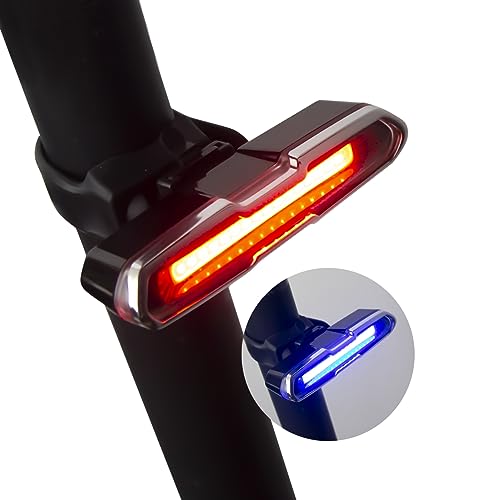
Unlike a two-light bundle or a multi-color light, this model is a single red-and-blue COB light with five modes. Its silicone strap is designed to attach to a bike frame, helmet, or backpack, offering more mounting options than a seat-only setup. The maker describes it as usable at the front or rear, though its red-and-blue output is specifically relevant to riders seeking those colors. It suits someone who wants a compact light with alternating-color and flashing choices. The specifications do not establish a battery runtime or waterproof rating, so riders who need either figure should confirm it before choosing.
Bottom line: Choose this if you want one red-blue light with multiple flash patterns and flexible strap mounting.
YUERWOVER Red+Blue Tail Light 2-Pack

For riders who want two lights rather than one, this set is the clear distinction: it includes two COB rear lights. The maker gives a 100-lumen output, a 240-degree viewing angle, a 500 mAh battery, and a 2-to-6-hour runtime after a 1-to-2-hour charge. Five modes are advertised, with named examples including solid red, solid blue, and red fast strobe. The runtime makes this a reasonable pick for shorter rides between charging opportunities. The mode list is incomplete in the specifications, so riders who need a particular pattern should verify the available modes before buying.
Bottom line: Pick this when having two lights and the lumen and runtime figures matter most.
Solar USB-C 7-Mode Tail Light

Solar plus USB-C charging sets this light apart from the USB-only choices. Its seven modes mix red, blue, and white output, including red-blue flashing and several combinations with white illumination. Three reflective stickers are included, adding passive reflective elements alongside the powered light. This is a fit for riders who want multiple color patterns and a way to recharge from either sunlight or a Type-C cable. The specifications give no battery capacity or runtime, so a rider planning long outings should confirm endurance rather than assume the solar panel alone will keep the light charged.
Bottom line: Choose this for solar and USB-C charging with a broader set of color patterns.
USB Rechargeable Red+Blue+White Rear Light

White illumination distinguishes this red-blue-white rear light from the red-and-blue-only alternatives. It includes a rubber fixing band with adjustable sizing, and its maker describes five or six modes; the specifications do not resolve which count applies. The shell is PC, and the maker gives an IP43 rating. This option suits a rider who wants white among the available colors and a rubber-band mount. The mode count is unclear, so anyone choosing based on a specific number of modes should verify that point before buying. Its ingress rating is also a factor for riders comparing weather exposure.
Bottom line: Pick this if white output and an adjustable rubber-band mount are priorities.
How to choose a red-blue rear light
Choose by legal fit, visibility pattern, and charging needs rather than by color count alone. Rear lights are active lamps that emit light; reflectors return light from a vehicle’s headlamps and remain useful when a battery is dead. Do not assume a flashing mode is permitted everywhere: rules for blue illumination can vary by state and locality, and blue may be reserved for emergency vehicles. Check your local bicycle equipment rules before using blue on public roads.
For visibility, prefer a rear-facing mount that is unobstructed by a bag, clothing, or seat pack. A light with a wide viewing angle can help from off-axis positions, but angle and mounting height matter in practice. If you ride longer than the runtime between charging opportunities, choose a product whose power approach fits your routine and keep a charged backup light.
Red and blue lights versus reflectors
A powered rear light and a reflector serve different purposes: a lamp produces light, while a reflector needs another light source to be seen. Keep any required bicycle reflectors in place even when using an LED tail light. Federal bicycle safety requirements for new bicycles include reflectors, while state and local rules govern road use; verify the requirements where you ride rather than treating a light as a substitute.
Blue output deserves particular caution because traffic laws may reserve blue lights for emergency use. If local rules do not clearly allow a blue bicycle lamp, use a legally compliant rear-light color instead. A red-blue pattern can also look different from a conventional red rear signal, so avoid assuming that more colors always mean better recognition.
Charging and runtime for bike tail lights
Battery runtime is the key practical limit: plan the charge interval around the maker’s runtime and your longest ride, not just the commute average. The two-light set gives a 2-to-6-hour runtime, while other options here use USB, USB-C, or solar charging without a duration in their specifications. Solar charging can supplement power but does not guarantee a full charge after shade or nighttime storage.
Flashing modes often draw power differently from steady modes, so runtime can change with the selected pattern; use the product’s duration as a range rather than a promise for every mode. Recharge before a long ride and check that the indicator or switch behavior confirms the light is working. Carrying a second charged lamp is sensible when the planned ride could exceed the run time.
Mounting and weather considerations
Mount the rear light where it faces backward and remains visible from behind; a strap that fits a helmet or backpack may still leave the lamp angled or covered. Silicone straps and rubber bands accommodate different attachment points, but check that the light cannot rotate or slip on a bumpy ride. A light mounted low behind a seat bag may be hidden from drivers approaching at a distance.
Water resistance ratings are not interchangeable: an IP43 rating indicates a different level of protection from IPX7, and neither phrase should be treated as permission to submerge a device unless its rating supports that use. After wet rides, inspect the charging port and mount for moisture or looseness. Do not charge a wet light, and follow the maker’s care guidance for its battery and port.
Frequently Asked Questions
Are blue bicycle rear lights legal everywhere?
No; blue light restrictions vary by state and locality, and some jurisdictions reserve blue for emergency vehicles. Check the rules where you ride before using a blue mode on public roads.
Do bike tail lights replace rear reflectors?
No, an active tail light and a reflector work differently. Keep required reflectors installed and check local bicycle equipment rules for your route.
How long should a rechargeable bike light last?
Runtime depends on the light and selected mode; the two-light set here gives a maker-stated range of 2 to 6 hours. Choose a light with enough stated runtime to cover your longest ride between charges.
Can I attach a bike tail light to a helmet?
Some strap-mounted lights are described for helmet attachment, but the fit depends on the helmet shape and strap tension. Confirm the lamp faces backward, stays secure, and is not blocked while riding.
What does an IP43 rating mean for a bike light?
IP43 is an ingress protection rating, not an indication that a light can be submerged. Treat it as distinct from an IPX7-rated product and avoid submerging a light unless its rating explicitly permits that use.