
Best Air Compressor Tire Nozzle Options Compared

The LUMITECO closed-flow ball-foot chuck is the best air compressor tire nozzle for most people because its shut-off valve passes air only when engaged with a tire valve. Choose a gauge inflator instead if you want to measure and adjust pressure with one tool.
A tire nozzle connects an air hose or inflator to a valve stem; match the chuck style and connector to your setup before use.
We earn a commission if you buy through links on this page. As an Amazon Associate I earn from qualifying purchases. Products are compared on manufacturer specifications, not hands-on testing.
- Best overall: LUMITECO Ball-Foot Air Chuck Set – The closed-flow ball-foot chuck has a built-in shut-off valve and a 300 PSI maximum.
- Best for night use: DigitPro Digital Tire Gauge Inflator – The digital gauge inflates, deflates, and checks pressure, with an LCD light mode.
- Best for hard-to-reach valves: Spurtar Dual-Head Tire Gauge Inflator – Its dual-head chuck includes forward and reverse heads for inner and outer wheels.
| Product | Best for | Pressure range or limit | Gauge | Connection or chuck | Shop |
|---|---|---|---|---|---|
| LUMITECO Ball-Foot Air Chuck Set | Closed-flow chuck | Up to 300 PSI | No | 1/4-inch FNPT | Check Price on Amazon |
| DigitPro Digital Tire Gauge Inflator | Backlit pressure checks | 3–250 PSI | Digital | Quick-connect coupler | Check Price on Amazon |
| Spurtar Dual-Head Tire Gauge Inflator | Tight valve access | 10–120 PSI | Gauge | Dual-head chuck | Check Price on Amazon |
| FYPower 10-Piece Air Accessories Kit | Multiple air tasks | 100 PSI inflator | Gauge | 1/4-inch NPT | Check Price on Amazon |
| AstroAI Digital Tire Gauge Inflator | Ergonomic gauge use | 3–250 PSI | Digital | Quick-connect coupler | Check Price on Amazon |
Air Compressor Tire Nozzles
Compare chuck style, pressure range, and gauge functions to find the right fit for your compressor setup.
LUMITECO Ball-Foot Air Chuck Set

Unlike the gauge inflators, this set is a dedicated closed-flow chuck: its shut-off valve lets air pass only when the chuck engages a tire valve. The package has two ball-foot chucks, two male quick plugs, and Teflon tape; the inlet is 1/4-inch FNPT. The maker says it is compatible with most tire inflators, wheel pressure gauges, and compressor accessories, and suitable for Schrader valves on vehicles and bikes. Its 300 PSI maximum is higher than the limits given for the other options. It does not include a pressure gauge, so pair it with one if you need a reading.
Bottom line: Pick this if you want a dedicated closed-flow chuck and already have a way to check tire pressure.
DigitPro Digital Tire Gauge Inflator
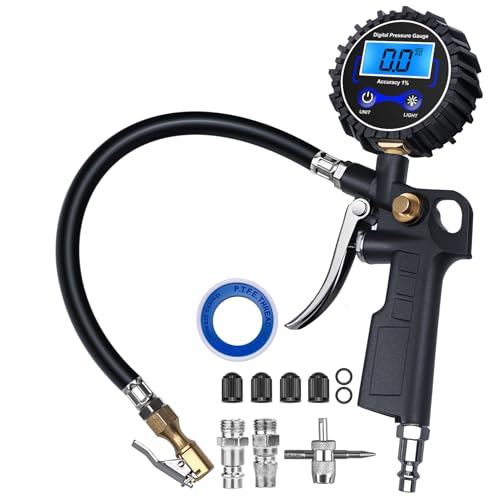
Unlike the dedicated chucks, this tool combines a digital pressure gauge with inflation and deflation controls. The maker says it measures from 3 to 250 PSI with 0.1 PSI resolution and within 1% of exact pressure; its display has a light mode for nighttime use. Stainless steel and corrosion-resistant brass components, a rubber hose, and a quick-connect coupler round out the setup. It suits drivers who want to read pressure and adjust it with one tool. It is a gauge inflator rather than a simple nozzle, so it may be more tool than needed if you only need a hose-end chuck.
Bottom line: Choose this if a digital readout and built-in inflation and deflation functions matter more than a standalone chuck.
Spurtar Dual-Head Tire Gauge Inflator

The dual-head chuck is the distinguishing feature here: the maker describes a 30-degree forward head for inner or hard-to-reach valves and a reverse chuck for outer wheels. This is a gauge inflator, not a standalone tire nozzle, and its range is 10 to 120 PSI. The maker says it is calibrated to ANSI B40.1 Grade B (2%) and can be used with an air pump or compressor. It may suit users working with wheel positions that are awkward to reach. Its 10 PSI lower limit and 120 PSI upper limit are narrower than the ranges on the digital gauge inflators.
Bottom line: Pick this if the dual-head shape suits your wheel access and its 10–120 PSI range covers your needs.
FYPower 10-Piece Air Accessories Kit

Unlike the single-purpose chuck and gauge tools, this kit combines a tire inflator with a blow gun, nozzles, inflation needles, and adaptors. Its inflator has a gauge and a 100 PSI rating; the kit uses 1/4-inch NPT. The maker says the included accessories cover vehicles ranging from cars and motorcycles to RVs, along with other compressor tasks. It suits someone assembling a varied set of air tools rather than seeking only a tire nozzle. The inflator’s 100 PSI rating is lower than the maximum ranges on the dedicated digital gauge inflators, so check that it matches the pressure work you have in mind.
Bottom line: Choose this if you need several compressor accessories in addition to a tire inflator.
AstroAI Digital Tire Gauge Inflator

This digital gauge inflator pairs a 3–250 PSI range with 0.1 PSI resolution and a calibration tolerance of ±1%, according to the maker. Its controls inflate with the trigger and deflate with a button, so it combines pressure adjustment and checking without a separate tool. The maker also advises seating the chuck fully on the valve stem and locking the lever for a secure connection. It suits buyers who prefer a digital, all-in-one inflator. The maker notes that readings can differ by about 2 PSI within normal measurement tolerance, so compare readings on the same tire using the same unit.
Bottom line: Pick this if you want a digital gauge inflator with trigger inflation and button-operated deflation.
How to Choose an Air Compressor Tire Nozzle
Choose a chuck by matching its valve connection, hose fitting, and function to your setup. A Schrader tire valve is the common push-in type on cars, motorcycles, and many bicycles; a dedicated chuck connects to it, while a gauge inflator also measures pressure. Closed-flow chucks shut off air until engaged, while gauge inflators add controls for reading, inflating, or deflating. Compare the compressor-side fitting as well: 1/4-inch NPT and 1/4-inch FNPT refer to threaded fittings, and male and female threads must mate. If the compressor hose ends in a quick plug, confirm the nozzle or coupler is compatible before assembling it. Choose a gauge inflator when you lack a separate pressure gauge; otherwise, a standalone chuck can be simpler.
Pressure Range and Tire Fit
Set tire pressure from the vehicle placard, not the maximum pressure molded into the tire sidewall. Many passenger-car tires call for roughly 30–35 PSI when cold, but the correct value depends on the vehicle, load, and tire setup. A useful decision rule is to select a gauge whose operating range covers the target pressure with room above it; for a 35 PSI target, a tool rated to at least 50 PSI covers the basic range. Tire pressure changes as tires warm, so check before driving or after the vehicle has been parked for several hours. Use the same gauge and unit for repeat checks, since small differences can reflect gauge tolerance rather than a meaningful pressure change.
Closed Chucks and Gauge Inflators
A closed-flow chuck and a gauge inflator solve different parts of the tire-filling task. A closed-flow chuck controls air at the valve, while a gauge inflator adds pressure measurement and inflation or deflation controls. The table compares the options by their primary role, so choose based on whether you already own a pressure gauge.
| Tool type | Main job | Choose it when |
|---|---|---|
| Closed-flow chuck | Connect air to a valve | You have a separate pressure gauge |
| Digital gauge inflator | Read and adjust pressure | You want measurement and air control together |
| Accessory kit | Handle several air tasks | You also need blow-gun or adaptor accessories |
Keep pressure measurement separate from air delivery when precision matters: a chuck by itself does not report tire pressure. A gauge inflator combines those jobs, but the gauge range and chuck style still need to suit the tire and valve access.
Safe Tire Inflation and Common Mistakes
Inflate tires in short bursts and recheck pressure rather than leaving an air source connected unattended. Overinflation can exceed the vehicle’s recommended cold pressure, while underinflation can affect handling and tire wear; the door-jamb placard gives the vehicle-specific target. Secure the chuck squarely on the valve stem to reduce air loss, and stop if the connection leaks or the stem is damaged. Do not treat the tire-sidewall maximum as the normal fill target. A compressor regulator can deliver more pressure than a tire needs, so set it conservatively and use a gauge to verify the final reading. Check pressure when tires are cold, since heat from driving raises the reading.
Frequently Asked Questions
What tire pressure should I use with an air compressor nozzle?
Use the vehicle placard’s cold-pressure value, commonly around 30–35 PSI for passenger cars. The correct target varies by vehicle, load, and tire setup, so the sidewall maximum is not a substitute.
How does a closed-flow tire chuck work?
A closed-flow chuck blocks airflow until it engages a tire valve, then opens the air path. Seat it squarely on the valve stem and check for leaks before inflating.
Can I use a tire nozzle without a pressure gauge?
A standalone nozzle can deliver air but cannot tell you the tire’s pressure. Use a separate gauge and recheck after short inflation bursts, especially near the vehicle’s target pressure.
Why does tire pressure rise after driving?
Tires warm as they roll, and warmer air raises the pressure reading. Check tires before driving or after they have been parked for several hours to compare against the cold-pressure target.
What fitting size should I check before connecting a tire chuck?
Match the chuck’s compressor-side fitting to the hose or coupler; these options include 1/4-inch NPT and 1/4-inch FNPT threads. NPT describes tapered pipe threads, so verify that the male and female ends are compatible.