
Running Vests With Lights: 5 Options Compared

For a running vest with lights that illuminates the path as well as adds reflective coverage, Viccux 500LM Chest-Light Vest stands out for its 500-lumen chest-light and adjustable beam. Choose a simpler light-up vest if colored LEDs are your priority, or a pocketed style if you need phone storage.
Running vests with lights combine wearable illumination, reflective material, or both; reflective strips return light from an outside source, while LEDs produce their own light.
We earn a commission if you buy through links on this page. As an Amazon Associate I earn from qualifying purchases. Products are compared on manufacturer specifications, not hands-on testing.
- Best overall: Viccux 500LM Chest-Light Vest – Pairs a 500-lumen chest-light with an adjustable beam and reflective straps.
- Best for a bright chest light: Zacro 500LM Chest-Light RGB Vest – Combines a 500-lumen front light with three brightness levels and RGB modes.
- Best for phone storage: MOKURA Phone-Holder Light Vest – Adds a phone holder and shoulder pockets alongside reflective strips and a warning light.
| Product | Best for | Lighting | Fit | Weight | Shop |
|---|---|---|---|---|---|
| Viccux 500LM Chest-Light Vest | Path illumination | 500-lumen chest light; 7 modes | 31–51 in chest | 0.51 lb | Check Price on Amazon |
| Zacro 500LM Chest-Light RGB Vest | Brightness control | 500-lumen chest light; 3 brightness levels | 26–49 in waist | — | Check Price on Amazon |
| Zacro 5-Color LED Reflective Vest | Color visibility | 5 colors; 3 modes | 26–49 in waist | 0.35 lb | Check Price on Amazon |
| Ni-SHEN Front-Light Reflective Vest | Tilt adjustment | Front light; 2 brightness levels | — | — | Check Price on Amazon |
| MOKURA Phone-Holder Light Vest | Phone carry | Reflectors; 5-color rear warning light | Medium | 0.79 lb | Check Price on Amazon |
Running Vests With Lights Compared
Compare the light setup and fit style first, then choose the features that match your route and carry needs.
Viccux 500LM Chest-Light Vest

For runners who need to see the route ahead, this model adds a 500-lumen chest-light with a 45-degree adjustable beam, rather than relying only on colored LEDs or reflective trim. The brand says the light reaches 70 meters and offers floodlight and spotlight settings; reflective straps and a board add visibility from multiple directions. It suits night routes where both near-ground coverage and a focused beam matter. Its 31–51-inch chest sizing is the key fit check, and the 3.5–20-hour runtime varies by mode.
Bottom line: Choose this if adjustable path lighting matters more than storage or multiple color choices.
Zacro 500LM Chest-Light RGB Vest

This vest combines a chest lamp with selectable color lighting, giving buyers separate brightness and visibility options. The brand specifies a 500-lumen chest-light with high, medium, and low settings, plus five RGB colors and three light modes. That combination suits runners who want to adjust the front light while keeping colored LEDs available for visibility. The 26–49-inch fit range is described as a waist measurement, so compare it with your waist rather than a chest measurement. The specifications give no weight, which may matter to runners prioritizing the lightest kit.
Bottom line: Pick this when adjustable chest-light brightness and RGB modes are both useful.
Zacro 5-Color LED Reflective Vest

Unlike the chest-lamp options, this is a lightweight LED-and-reflector vest without a lumen rating, so its emphasis is being seen rather than lighting the ground ahead. The brand offers five colors and three modes: steady, single-color flashing, and a cycling multicolor pattern. At 0.35 pound, it is the lightest of the products with a weight. It suits runners who want color choices and a measured waist fit range.
Bottom line: Choose this for color-changing visibility and a lower stated weight, not path illumination.
Ni-SHEN Front-Light Reflective Vest

This model centers on an up-or-down adjustable front light, which distinguishes it from the RGB-focused vest and the pocketed design. The brand says its light has two brightness levels and adjusts through 85 degrees, useful for directing illumination toward a path or farther ahead. It suits runners who prefer a straightforward lamp adjustment over several color modes. Its reflective running-vest format also works for cycling and walking.
Bottom line: Pick this if an adjustable light angle is your main priority.
MOKURA Phone-Holder Light Vest
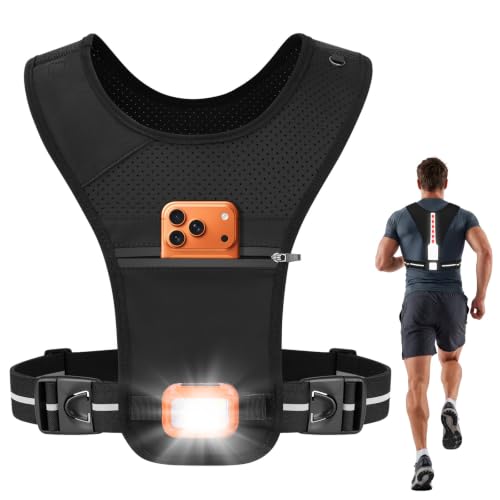
Storage is the defining feature here: the vest has a phone holder plus shoulder pockets for small items, unlike the simpler light-up designs. Reflective strips cover the front, shoulders, and back, and a rear warning light offers five colors. Its size is Medium and its weight is 0.79 pound. This suits runners who want to carry a phone and small essentials without adding a separate waist pack.
Bottom line: Choose this if phone and small-item storage matter as much as visibility.
Choosing a running vest with lights
Choose a vest with a forward-facing lamp when you need to see the ground, and prioritize reflective coverage when you mainly need drivers to notice you. Reflective material does not emit light; it returns light toward its source, so it works best when a headlight or streetlight reaches it. LEDs emit light themselves, but a colored visibility light is not automatically a useful route beam. Look for a lumen rating, beam angle, or selectable beam pattern when path illumination is important. A practical rule: for an unlit route with obstacles, favor a model with a chest-light output over a vest described only by colors or reflectors. Check that the beam points where you look without blocking your natural arm swing.
How the light types differ
Chest lights, colored LEDs, and reflective strips solve different visibility problems. Chest lamps aim light ahead and can help reveal the surface; a steady light can make the route easier to read than a flashing pattern. Colored LEDs help mark your position but their color count does not establish brightness or throw. Retroreflective strips are passive and depend on another light source striking them. The table separates those functions so the feature labels do not get treated as equivalent performance measures.
| Type | Main role | What to check |
|---|---|---|
| Chest lamp | Illuminate path ahead | Lumens, beam angle, runtime |
| Colored LEDs | Make wearer visible | Steady or flashing modes |
| Reflective trim | Return outside light | Coverage on front, sides, and back |
A vest can combine categories, but a color or reflective claim alone does not describe how far a runner can see.
Fit and movement for night runs
A running vest should stay close enough that its lamp does not bounce, while leaving room for normal breathing and shoulder movement. Compare the measurement type before choosing a size: a waist range cannot be substituted for a chest range. Tighten adjustable straps only enough to stabilize the vest; a compressed chest can make a run uncomfortable. Put the lamp in its intended position and jog briefly in a safe, well-lit area before relying on it at night. A 45-degree beam adjustment can change where light lands, so point it toward the route without aiming into approaching drivers’ eyes. Pocketed styles also need a loaded-fit check because a phone can shift the vest’s balance.
Using lights and reflectors safely
Wearable lights improve visibility but do not replace traffic awareness. In the United States, pedestrians should generally use sidewalks; when none are available, walk facing traffic and move as far from the roadway as practical. Runners should use a steady forward light to inspect the route and reflective coverage on more than the front, since drivers can approach from behind or from a crossing street. Flashing patterns may draw attention but can make distance and movement harder for others to judge. Keep the beam aimed down toward the ground, and use a separate light if the vest’s LEDs do not provide enough path illumination. Avoid assuming a visibility-distance claim means an obstacle will be visible at that distance.
Frequently Asked Questions
Are reflective strips enough for running at night?
Reflective strips need an outside light source, such as vehicle headlights, to return light toward its source. On a dark route without that illumination, use a forward-facing lamp to see the ground as well.
What does a 500-lumen running light mean?
Lumens measure total visible light output, not how far a beam reaches or how evenly it lights the ground. Beam shape, angle, and brightness setting also affect what a runner can see.
Should a running vest light flash or stay steady?
A steady forward beam is generally more useful for reading the path, while flashing modes can make a wearer conspicuous. Use a setting that does not compromise your ability to see terrain or others’ ability to judge your movement.
How should a running vest fit over clothes?
A running vest should stay stable without restricting breathing or arm movement. Compare chest measurements with chest ranges and waist measurements with waist ranges, allowing for any layers you will wear.
Can a vest light replace a headlamp?
A chest-light can illuminate the route, but its beam follows the torso rather than the direction of your eyes. On uneven or very dark paths, check that the vest’s beam covers the ground where you are looking and add a headlamp if it does not.