
5-Gallon Sponge Filters: 3 Options Compared by Fit

For a 5-gallon tank, AQUANEAT Small Sponge Filter is the clearest sponge filter match because its maker recommends it for aquariums up to 10 gallons. Choose Pawfly Nano Sponge Filter Kit if you want an air pump and controls included; NICREW Slim Aquarium Filter is a different filter style with a pre-filter sponge.
Sponge filters use air-driven bubbles to pull water through porous foam, where the foam traps particles and supports biological filtration.
We earn a commission if you buy through links on this page. As an Amazon Associate I earn from qualifying purchases. Products are compared on manufacturer specifications, not hands-on testing.
- Best overall: AQUANEAT Small Sponge Filter – Its maker recommends the sponge filter for tanks up to 10 gallons.
- Best for a bundled pump: Pawfly Nano Sponge Filter Kit – The kit includes a 40 GPH air pump, airflow valve, airline tubing, and check valve.
- Best for a slim hang-on filter: NICREW Slim Aquarium Filter – Its compact body is rated for tanks up to 5 gallons and offers adjustable flow.
| Product | Best for | Tank range | Air pump included | Filter style | Shop |
|---|---|---|---|---|---|
| AQUANEAT Small Sponge Filter | Simple sponge filtration | Up to 10 gallons | No | Air-driven sponge | Check Price on Amazon |
| Pawfly Nano Sponge Filter Kit | All-in-one aeration | 3–10 gallons | Yes, 40 GPH | Air-driven sponge | Check Price on Amazon |
| NICREW Slim Aquarium Filter | Compact waterfall filtration | 1–5 gallons | No | Hang-on filter with sponge pre-filter | Check Price on Amazon |
5-Gallon Sponge Filter Options
Compare tank fit, included equipment, and filtration style before choosing a filter for a 5-gallon aquarium.
AQUANEAT Small Sponge Filter

For a standalone sponge filter sized to cover a 5-gallon aquarium, AQUANEAT Small Sponge Filter is the most direct fit: its maker recommends it for tanks up to 10 gallons. The sponge provides mechanical and biological filtration, and the air-infusion chamber creates bubbles. Its soft foam and minimal current suit fry, shrimp, and other small fish, according to the maker. You will need an air pump and airline separately, so this choice is less convenient if you want a ready-to-run kit. To clean it, rinse and squeeze the sponge in removed tank water rather than under untreated tap water, which can disrupt beneficial bacteria.
Bottom line: Choose this if you want a standalone sponge filter for a small aquarium and already have an air pump.
Pawfly Nano Sponge Filter Kit
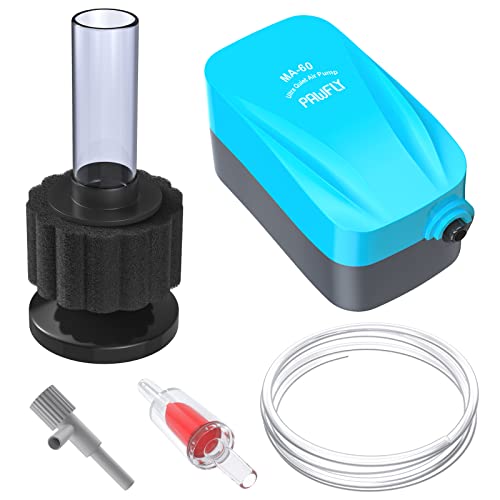
Unlike AQUANEAT Small Sponge Filter, Pawfly Nano Sponge Filter Kit pairs a nano sponge filter with its own air pump and airflow controls. The maker specifies a 40 GPH pump and a 1.5-inch-diameter by 3-inch-high sponge, plus airline tubing and a check valve. Twisting the valve adjusts airflow, which lets you tune bubble output for a small tank. The kit is intended for 3- to 10-gallon aquariums, so a 5-gallon tank falls within that range. The pump’s compact dimensions are 3.3 by 1.8 by 1.6 inches. The small sponge footprint may require more frequent cleaning than a larger foam filter when debris accumulates quickly.
Bottom line: Choose this if you need the air pump and airflow control alongside the sponge filter.
NICREW Slim Aquarium Filter

For a 5-gallon tank where a slim powered filter matters more than a true sponge filter design, NICREW Slim Aquarium Filter uses a waterfall outlet and includes a 15 PPI sponge on the intake. Its maker rates the filter for 1- to 5-gallon aquariums and specifies 42 GPH flow with adjustable output. The body measures 7.3 inches high by 3.5 inches long by 2.9 inches wide, and the package includes an intake tube, extension tube, and filter cartridge. This is not an air-driven sponge filter, so skip it if you specifically need a sponge as the primary filter or want to avoid an electrical filter.
Bottom line: Choose this only if a compact powered filter with an intake sponge suits your setup better than an air-driven sponge filter.
How to Choose a Sponge Filter for a 5-Gallon Tank
Start with the maker’s tank-size range, then decide whether you need to buy an air pump separately. Sponge filters use an airlift: bubbles rising through a lift tube draw water through foam, which traps debris and provides surface area for beneficial bacteria. The sponge’s pore structure and surface area influence how much debris it can hold, while airflow affects circulation and bubble output. For a 5-gallon aquarium, pick a filter whose recommended range includes 5 gallons; a filter rated only for larger tanks may create more current than small fish or shrimp need. If you keep fry or shrimp, favor gentle, adjustable airflow and a protected intake rather than relying on tank volume alone.
Airflow and Pump Setup for Sponge Filters
A separate air pump is required for a standalone air-driven sponge filter, while a kit may bundle one. Air tubing connects the pump to the filter; an air control valve can reduce or increase the bubble stream, and a check valve helps guard against water flowing back toward the pump if power stops. Place the pump above the aquarium waterline when practical, or use a check valve when the pump sits lower. Too much air can make the filter and tank noisy or create excessive current, so adjust the valve until the sponge bubbles steadily without pushing delicate livestock around. The pump’s GPH is its air rating, not the volume of tank water filtered per hour.
Sponge Filter Care and Cleaning
Rinse a sponge filter when visible debris restricts its flow, rather than cleaning it on an arbitrary weekly schedule. Squeeze the foam gently in water removed during a water change; untreated tap water may contain disinfectants that can damage the beneficial bacteria living in the sponge. Avoid replacing all biological media at once, because the established filter bacteria help process fish waste. A clogged sponge can reduce circulation and aeration, so watch for a weaker bubble stream or debris buildup between cleanings. Sponge filters do not remove dissolved waste by themselves: regular partial water changes and monitoring water quality remain necessary, even when the foam looks clean.
Sponge Filter Versus a Powered Aquarium Filter
An air-driven sponge filter prioritizes gentle flow and simple mechanical and biological filtration; a powered hang-on filter pulls water through an intake and usually directs it back through an outlet. The choice turns on the setup, not just the 5-gallon capacity. A sponge filter suits fry, shrimp, or a tank where a soft intake is useful, but it needs an air pump and airline. A powered filter may offer a compact body and adjustable flow, but it uses electricity and its intake needs protection for very small animals. In either case, match the tank range and control current. A flow number on an air pump describes air delivery, whereas a water filter’s GPH refers to water movement.
Frequently Asked Questions
Do sponge filters need an air pump?
Yes, an air-driven sponge filter needs an air pump and airline to move water through the foam. A kit may include those parts, but a standalone filter may not.
How often should I clean an aquarium sponge filter?
Clean the sponge when debris visibly builds up or the bubble-driven flow weakens. Gently squeeze it in removed aquarium water to avoid exposing beneficial bacteria to untreated tap water.
Can I use a sponge filter for shrimp or fry?
A sponge filter can suit shrimp and fry because its foam-covered intake is less likely to draw in small animals than an unprotected intake. Keep airflow gentle enough that tank current does not push the animals around.
Does an air pump’s GPH show water filtration rate?
No, an air pump’s GPH describes air delivery, not gallons of aquarium water filtered each hour. Water flow through a sponge filter also depends on the pump, tubing, lift tube, and foam resistance.
Can a sponge filter be the only filter in a 5-gallon tank?
A properly sized sponge filter can provide mechanical and biological filtration in a 5-gallon aquarium. It does not remove dissolved waste, so partial water changes and water-quality checks are still needed.