
Replacement Buckles for Backpacks: 4 Options Compared

For a backpack with 1-inch webbing, 1-Inch Side-Release Buckles, 6-Pack is the closest match because it is a direct replacement side-release buckle sized for that strap width. Choose Sea to Summit 20 mm Two-Pin Buckles instead for 3/4-inch webbing and a two-pin repair, or BEYOURD 1-Inch Webbing and Buckle Set if the webbing itself needs replacing.
We earn a commission if you buy through links on this page. As an Amazon Associate I earn from qualifying purchases. Products are compared on manufacturer specifications, not hands-on testing.
- Best overall: 1-Inch Side-Release Buckles, 6-Pack – A 1-inch side-release replacement buckle pair-in-pack option for existing compatible webbing.
- Best for strap rebuilds: BEYOURD 1-Inch Webbing and Buckle Set – Includes 6 yards of 1-inch nylon webbing plus buckles and tri-glides.
- Best for metal hardware: LXLVOUEG 1-Inch Aluminum G-Hooks – Uses aviation aluminum alloy and an adjustable spring door for 1-inch webbing.
- Best for 3/4-inch webbing: Sea to Summit 20 mm Two-Pin Buckles – A three-pack of 20 mm two-pin repair buckles.
| Product | Best for | Webbing width (inches) | Material | Pack contents | Shop |
|---|---|---|---|---|---|
| 1-Inch Side-Release Buckles, 6-Pack | Direct buckle swaps | 1 inch | Polypropylene | 6 buckles | Check Price on Amazon |
| BEYOURD 1-Inch Webbing and Buckle Set | Full strap repairs | 1 inch | Nylon and plastic | 6 yd webbing, 6 buckles | Check Price on Amazon |
| LXLVOUEG 1-Inch Aluminum G-Hooks | Metal strap hardware | 1 inch | Aviation aluminum alloy | 4 G-hooks | Check Price on Amazon |
| Sea to Summit 20 mm Two-Pin Buckles | Narrow strap repairs | 0.79 inches (20 mm) | — | 3 buckles | Check Price on Amazon |
Replacement buckles for backpacks
Match the replacement hardware to the webbing width and the way the strap is attached.
1-Inch Side-Release Buckles, 6-Pack
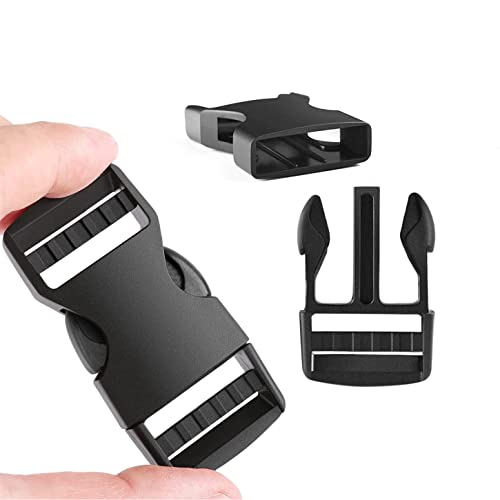
For a direct 1-inch side-release replacement, this six-pack keeps the repair to the buckle when the existing webbing and attachment points are intact. Each buckle is polypropylene, measures 2.7 inches long, and has a tensile capacity of 150 pounds. The dual-adjustable design can work on both strap ends. It suits backpack waist or accessory straps using 1-inch webbing, but not narrower 3/4-inch straps; width must match for the buckle to thread and hold correctly.
Bottom line: Choose this when a broken side-release buckle sits on intact 1-inch webbing.
BEYOURD 1-Inch Webbing and Buckle Set

Unlike a buckle-only repair, this set supplies the strap material too: six yards of 1-inch nylon webbing, six adjustable side-release buckles, and 12 tri-glide slides. That makes it useful when a backpack strap is frayed, cut, or missing hardware and needs rebuilding rather than just a clip swap. The connectors do not require sewing according to the maker. Its 1-inch width is the key limitation: it will not properly match 3/4-inch webbing or hardware designed for another width.
Bottom line: Pick this when both the webbing and the buckle need replacement.
LXLVOUEG 1-Inch Aluminum G-Hooks

These G-hooks replace a conventional side-release clip with metal hook-style hardware, making them the distinct option for a strap system built around G-hooks. The four-piece set includes two left and two right hooks for 1-inch webbing; each measures 44.5 × 38 × 2.9 mm. An adjustable spring door helps retain the webbing, and the maker identifies the alloy as aviation aluminum. This is not a plug-in substitute for a standard two-part side-release buckle, so choose it only when the strap design accepts G-hooks.
Bottom line: Choose these for compatible 1-inch straps designed for G-hook hardware.
Sea to Summit 20 mm Two-Pin Buckles
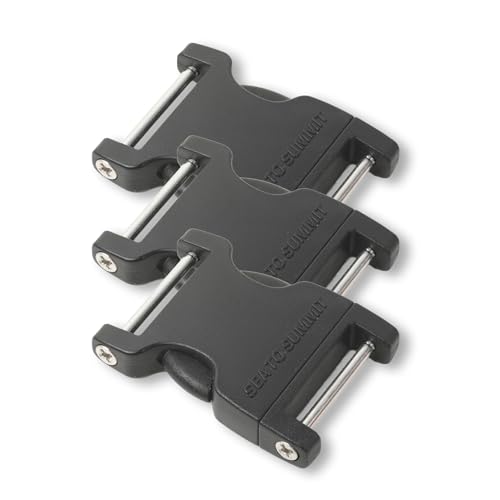
For a narrower backpack strap, this three-pack uses a 20 mm (3/4-inch) side-release format with two pins for field replacement. The pin design lets a repair buckle attach without unthreading a sewn strap end, which can be useful when the original buckle is broken but the webbing remains sound. It is the only option here sized below 1 inch. That makes it unsuitable for wider webbing; measure the strap before selecting it, since 20 mm and 1 inch are not interchangeable.
Bottom line: Pick this for a 3/4-inch strap where a two-pin repair suits the attachment.
How to choose a backpack replacement buckle
Start by matching the webbing width, then match the buckle style and attachment. Common backpack strap widths include 3/4 inch and 1 inch; a buckle sized for one width can slip, bind, or fail to thread on the other. Measure the flat webbing across its width, not around it. A side-release buckle needs compatible male and female halves, while a two-pin repair style is useful when a sewn strap end cannot be opened. A strap rebuild set makes sense only when the webbing also needs replacement. For a simple swap with sound webbing, avoid replacing more components than the repair requires.
Backpack strap width and buckle fit
Measure strap width to the nearest millimeter before choosing hardware: 20 mm is 3/4 inch, while 25 mm is approximately 1 inch. These sizes are close but not interchangeable because the buckle slot must fit the webbing without excess side play. Check the existing buckle’s type as well as its width; an adjustable side-release design and a G-hook attach differently. The table separates the main repair approaches by the condition that makes each relevant.
| Repair need | Suitable approach | Measure or check |
|---|---|---|
| Replace broken clip, webbing intact | Matching side-release buckle | Width and buckle style |
| Strap is damaged too | Webbing-and-hardware set | Width and strap length needed |
| Use metal hook-style attachment | Compatible G-hook | Width and left/right orientation |
| Narrow strap with sewn end | Two-pin repair buckle | 20 mm width and pin fit |
Side-release buckles, G-hooks, and repair pins
Side-release buckles connect with interlocking halves and are the usual choice when replacing a matching clip; they are not universal across widths or shapes. G-hooks catch onto webbing or a compatible loop rather than snapping into a matching buckle half, so swapping styles may require changing the strap arrangement. Two-pin repair buckles attach through the strap with pins, which can avoid undoing stitching during a field repair. Hardware type therefore matters as much as width. Before buying, compare the broken piece’s release mechanism, pin arrangement, and how each end is secured to the strap.
Safe buckle replacement and strap care
A backpack buckle’s load capacity is not the same as a safe working load for the complete strap; stitching, webbing wear, and load movement can be weaker points. Do not use a repaired backpack strap to secure a person or a load above people. After replacement, pull the strap firmly by hand and inspect whether the webbing lies flat, the buckle halves engage fully, and stitching shows no tearing. Dirt and grit can abrade webbing where it passes through hardware, so brush away debris and check frayed areas before reuse. Replace worn webbing rather than attaching new hardware to a damaged section.
Frequently Asked Questions
How do I measure backpack webbing for a buckle?
Measure the flat strap edge to edge in millimeters or inches. A 20 mm strap is 3/4 inch, while a 1-inch strap is about 25 mm, and the buckle slot should match that width.
Can I replace a buckle without sewing?
A two-pin repair buckle can attach without opening a sewn strap end when its pin arrangement fits the strap. For standard replacement buckles, whether sewing is needed depends on how the old buckle is attached.
Are 3/4-inch and 1-inch buckles interchangeable?
No; 3/4 inch is 20 mm and 1 inch is approximately 25 mm. The mismatch can leave the webbing loose or prevent it from passing through the buckle.
When should I replace the backpack webbing too?
Replace the webbing when it is cut, badly frayed, or no longer holds its shape through the hardware. A new buckle cannot restore damaged strap material or weakened stitching.
How can I check a repaired backpack buckle?
Pull the strap firmly by hand and verify that the buckle halves engage and the webbing remains flat. Inspect the surrounding stitching and strap for tears before carrying a load.