
Tomcat Rodent Repellent: 3 Options Compared by Use

Tomcat Ready-to-Use Spray, 1.33 Gal is the most versatile Tomcat rodent repellent choice because it is a ready-to-use spray for indoor and outdoor use with rain-resistant protection renewed every 30 days. Choose a different format if you want a compact continuous-spray can or an indoor plug-in refill rather than a spray container.
Rodent repellents use odor or taste cues to discourage entry, nesting, and foraging; they are not a substitute for sealing openings or removing food sources.
We earn a commission if you buy through links on this page. As an Amazon Associate I earn from qualifying purchases. Products are compared on manufacturer specifications, not hands-on testing.
- Best overall: Tomcat Ready-to-Use Spray, 1.33 Gal – A ready-to-use spray for indoor and outdoor use with a 30-day reapplication interval.
- Best for compact spraying: Tomcat Continuous Spray, 14 oz – A 14-ounce continuous-spray format for perimeter application.
| Product | Best for | Format | Shop |
|---|---|---|---|
| Tomcat Ready-to-Use Spray, 1.33 Gal | Broad spray use | Ready-to-use spray | Check Price on Amazon |
| Tomcat Continuous Spray, 14 oz | Compact spraying | Continuous-spray can | Check Price on Amazon |
| Tomcat Ready-to-Use Spray, 1 Gal, 2-Pack | Two-container supply | Ready-to-use spray, 2-pack | Check Price on Amazon |
Tomcat Rodent Repellent Options
Choose by application format first, then match the product’s intended setting and renewal schedule to the areas you need to cover.
Tomcat Ready-to-Use Spray, 1.33 Gal

Tomcat Ready-to-Use Spray, 1.33 Gal stands out for its ready-to-use format and indoor/outdoor designation, making it the broadest-use spray in this group. The 1.33-gallon container uses a garlic, peppermint, and cinnamon oil blend; the maker says its rain-resistant protection should be renewed every 30 days. The directions identify entry points such as doors, windows, cracks, crevices, pipes, and vents. Choose it for treating several perimeter areas with a larger container. A limitation is the fixed spray format: buyers who want a compact can or a plug-in diffuser should choose another option.
Bottom line: Choose this for ready-to-use spray application across indoor and outdoor areas.
Tomcat Continuous Spray, 14 oz
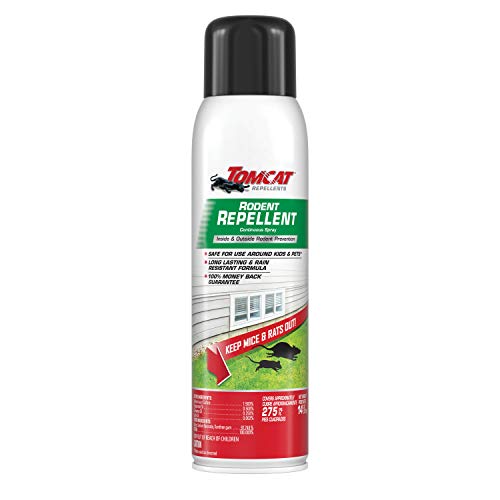
Tomcat Continuous Spray, 14 oz is the compact option, with a 14-ounce continuous-spray can instead of a larger ready-to-use container. Its cinnamon, garlic, and peppermint oil blend is intended to discourage rodents indoors and outdoors around the home perimeter. The maker says the formula is rain-resistant and calls for reapplication every 30 days; it also says it is safe around children and pets when used as directed. The can suits smaller areas or touch-up work. Its 14-ounce size is the tradeoff if you need to treat many entry points or a broad perimeter.
Bottom line: Pick this when a compact continuous-spray can suits the treatment area.
Tomcat Ready-to-Use Spray, 1 Gal, 2-Pack

Tomcat Ready-to-Use Spray, 1 Gal, 2-Pack differs by supplying two one-gallon ready-to-use containers rather than one large jug or a compact can. The spray combines peppermint, cinnamon, and garlic oils and is intended for indoor and outdoor rodent prevention. The maker says the spray is rain-resistant and should be reapplied every 30 days; it also says the formula is safe around children and pets when used as directed. This format suits buyers who prefer two separate containers. A two-pack is less convenient if you need a small amount in a compact hand-held can.
Bottom line: Choose the two-container format when separate ready-to-use containers fit your routine.
How to choose a rodent repellent format
Choose a spray for targeted treatment of entry points and a plug-in refill for indoor diffusion. These formats work differently: sprays leave product on surfaces, while a warmer releases aromatic oils into a room. The spray options here call for renewal every 30 days, while the plug-in refill maker gives up to 60 days per bottle on low. Use the spray format when you can identify doors, cracks, vents, or other perimeter points; use plug-in refills only in rooms where an indoor outlet and compatible warmer are available.
Repellents are one layer of prevention, not a barrier. Rodents can enter through gaps around pipes and doors, so pair any scent-based approach with closing openings and removing accessible food. For children and pets, follow the product directions and keep them away from wet or freshly treated surfaces.
Spray coverage and reapplication
Spray coverage depends on the amount applied and the number of entry points, so match container format to the area rather than assuming a specific square-foot range. A larger ready-to-use container is suited to more treatment points; a 14-ounce can is easier to handle for a smaller zone. Product makers call for renewed spray application every 30 days, and rain resistance does not mean a treatment lasts indefinitely.
Concentrate on likely access routes such as door and window edges, pipe penetrations, cracks, crevices, and vents. Do not treat food-contact surfaces or areas where the product label does not permit use. Record the application date and revisit the treated points at the 30-day mark; after heavy cleaning or changes to the treated surface, check the label for the appropriate next step.
Sprays and plug-in refills compared
Sprays are intended for directed application, while plug-in refills are an indoor-only diffusion option that requires a separate warmer. The spray blend and refill blend are not identical: the ready-to-use options use garlic, peppermint, and cinnamon oils, while the refill includes lemongrass alongside cinnamon and peppermint. Use this table to match method to setting.
| Need | Suitable format | Key condition |
|---|---|---|
| Treat entry points | Ready-to-use spray | Renew every 30 days |
| Handle a smaller spray area | 14-ounce continuous spray | Limited container size |
| Diffuse oil indoors | Plug-in refills | Requires compatible warmer |
Never substitute an indoor plug-in device for outdoor perimeter treatment, and do not assume that a spray and a diffuser have the same application rules.
Use and safety around children and pets
Read and follow the product directions before applying a rodent repellent around children or pets. Two spray formulas are described by their maker as safe for use around children and pets when used as directed; that condition matters, so keep people and animals away during application and until label directions allow re-entry. Essential-oil ingredients do not make a product automatically harmless if swallowed or contacted improperly.
Use each product only in its designated setting: sprays are described for indoor and outdoor use, while the plug-in refill is for indoor use with its warmer. Keep refills and warmer out of reach, and avoid placing plug-in equipment near water or where it can be knocked over. For any exposure, use the package’s first-aid guidance and contact poison control or a veterinarian as appropriate.
Frequently Asked Questions
How often should Tomcat rodent spray be reapplied?
The spray makers call for reapplication every 30 days. Renew treatment at that interval, and use the product directions for surface-specific application guidance.
Can rodent repellent spray be used outdoors?
The ready-to-use and continuous-spray options are identified for indoor and outdoor use. The plug-in refill is intended for indoor spaces and should not be used as an outdoor perimeter treatment.
How long do Tomcat plug-in refills last?
The maker says each refill lasts up to 60 days on the low setting. Two refills can therefore provide up to 120 days total under that setting.
Are essential oil rodent repellents safe around pets?
The makers of the 14-ounce spray and two-gallon pack say they are safe around children and pets when used as directed. Keep pets away during application and follow the specific label directions; do not assume every essential-oil product has the same conditions.
Do rodent repellents replace sealing entry gaps?
No; a scent-based repellent is not a physical barrier. Seal gaps around pipes, vents, doors, and windows and remove accessible food so rodents have fewer routes and incentives to enter.