
ECO-WORTHY Lithium Batteries: 4 Models Compared

For a 48V home-storage system, ECO-WORTHY Cubix100 48V Rack Battery is the ECO-WORTHY battery to consider because it is a 51.2V, 100Ah rack model; RV and other 12V systems need a 12.8V option instead.
LiFePO4 batteries store energy for DC systems, but voltage, capacity, physical fit and compatible charging equipment all matter. Choose among ECO-WORTHY EnergyRock 12V 314Ah, ECO-WORTHY 12V 314Ah Bluetooth Battery and ECO-WORTHY 12V 100Ah Group 24 according to the space and energy needs of your 12V setup.
We earn a commission if you buy through links on this page. As an Amazon Associate I earn from qualifying purchases. Products are compared on manufacturer specifications, not hands-on testing.
- Best overall: ECO-WORTHY Cubix100 48V Rack Battery – The 51.2V, 100Ah rack format is the option here for a 48V home-storage system.
- Best for metal enclosure: ECO-WORTHY EnergyRock 12V 314Ah – Its metal case and one-touch safety switch distinguish this 12.8V, 314Ah model.
- Best for status display: ECO-WORTHY 12V 314Ah Bluetooth Battery – The 314Ah battery has SOC and status LED indicators as well as Bluetooth monitoring.
- Best for compact fit: ECO-WORTHY 12V 100Ah Group 24 – The 12.8V, 100Ah battery measures 10.24 by 6.61 by 8.43 inches.
| Product | Best for | Voltage | Capacity | Dimensions (L × W × H) | Shop |
|---|---|---|---|---|---|
| ECO-WORTHY Cubix100 48V Rack Battery | 48V home storage | 51.2V | 100Ah | 22.09 × 19.02 × 5.63 in | Check Price on Amazon |
| ECO-WORTHY EnergyRock 12V 314Ah | Metal case preference | 12.8V | 314Ah | 8.7 × 17.2 × 10.3 in | Check Price on Amazon |
| ECO-WORTHY 12V 314Ah Bluetooth Battery | Visible battery status | 12.8V | 314Ah | 16.3 × 8.5 × 10.2 in | Check Price on Amazon |
| ECO-WORTHY 12V 100Ah Group 24 | Group 24 replacement | 12.8V | 100Ah | 10.24 × 6.61 × 8.43 in | Check Price on Amazon |
ECO-WORTHY lithium batteries compared
Match the battery voltage to your system first, then compare capacity and the available installation space.
ECO-WORTHY Cubix100 48V Rack Battery
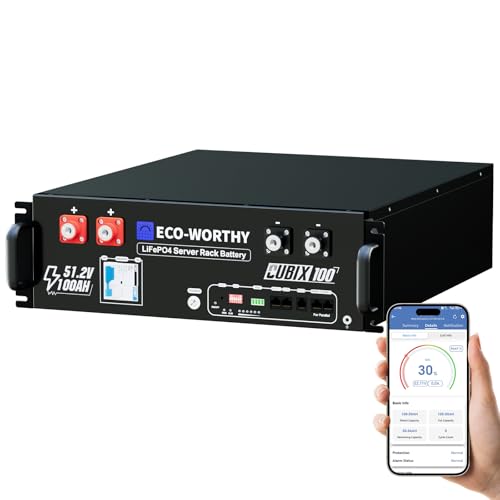
Unlike the 12.8V batteries here, this model is designed for a 48V-class storage system. It is a 51.2V, 100Ah LiFePO4 rack battery with 5,120Wh energy and measures 22.09 by 19.02 by 5.63 inches. ECO-WORTHY says it supports Bluetooth and Wi-Fi and offers closed-loop communication; the manufacturer also identifies UL9540, UL1973 and CEC listing. Those features make it the relevant option for a compatible home-storage setup. Its 103-pound weight and rack dimensions make it a poor match for buyers who need a compact RV battery or a 12V replacement.
Bottom line: Choose this for a compatible 48V-class home-storage system with room for its rack dimensions and weight.
ECO-WORTHY EnergyRock 12V 314Ah
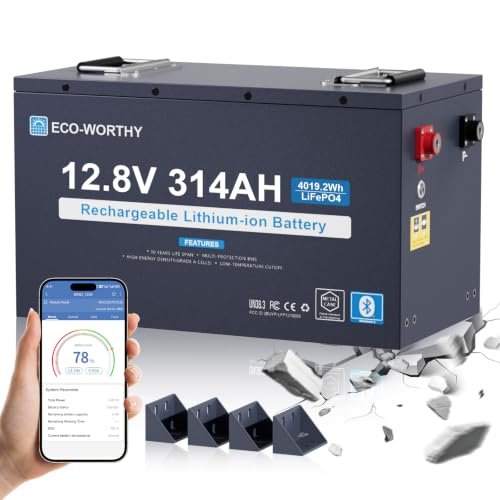
The metal enclosure and one-touch output switch set this 12.8V, 314Ah battery apart from the other 12V choices. It weighs 70.4 pounds and measures 8.7 by 17.2 by 10.3 inches. ECO-WORTHY says the battery has low-temperature protection, a built-in 200A BMS and a maximum energy rating of 3,584Wh. Its large capacity suits an off-grid or RV setup designed for this battery’s voltage and dimensions. The main limitation is its size and weight: it is not the compact Group 24 option, so check the available battery bay before choosing it.
Bottom line: Choose this for a 12V system where the metal case, switch and larger capacity suit the installation.
ECO-WORTHY 12V 314Ah Bluetooth Battery

On-battery status LEDs distinguish this 12.8V, 314Ah model from the other large-capacity option, which has a metal case and safety switch. This battery measures 16.3 by 8.5 by 10.2 inches and weighs 60.4 pounds. ECO-WORTHY says its display shows state of charge and status, and that Bluetooth enables monitoring through its app; the maker also gives a 4,019Wh rating and a 200A BMS. It suits buyers who want visible status information in an RV, solar or off-grid setup. Its 314Ah capacity requires more installation space than the 100Ah Group 24 battery.
Bottom line: Choose this when a 12V, 314Ah battery with onboard status indicators fits your available space.
ECO-WORTHY 12V 100Ah Group 24

The Group 24 form factor makes this 12.8V, 100Ah battery the compact choice among the 12V models here. Its dimensions are 10.24 by 6.61 by 8.43 inches, and it weighs 23.15 pounds. ECO-WORTHY says it has Bluetooth 5.1 monitoring, low-temperature protection and a built-in 100A BMS; its maximum energy rating is 1,280Wh. This size and capacity suit buyers replacing a compatible Group 24 battery in a boat, RV or other 12V system. Its 100Ah capacity is substantially lower than the two 314Ah options, so it may not meet a higher energy demand.
Bottom line: Choose this for a compatible Group 24 installation that needs a lighter 12V battery.
How to choose an ECO-WORTHY lithium battery
Start by matching battery voltage to the system, not by comparing amp-hours alone. The options here are 51.2V for a 48V-class rack system and 12.8V for 12V-class equipment; those are different electrical systems, not interchangeable sizes. Within a voltage class, amp-hours indicate charge capacity, while watt-hours account for voltage as well: multiply volts by amp-hours for an approximate energy comparison. A 12.8V, 100Ah battery is about 1,280Wh, while a 12.8V, 314Ah battery is about 4,019Wh. Next, measure the battery compartment and allow for cable access and ventilation. If the available space is narrower than 8.5 inches, the 16.3-inch-long 314Ah model will not fit by its dimensions.
12V and 48V battery fit and compatibility
Battery voltage must suit the inverter, charger and DC equipment already in the system. A 12.8V battery belongs in a compatible 12V-class setup; the 51.2V rack battery is for a compatible 48V-class setup. Do not connect batteries in series or parallel unless their maker permits that arrangement and the system components support it. LiFePO4 charging profiles differ from lead-acid profiles, so verify the charger’s chemistry setting before connecting a replacement. For physical fit, compare all three dimensions and weight against the compartment, tray and mounting limits. A Group 24 designation is a useful size clue, but measure the actual space and terminal clearance rather than relying on the label alone.
Understanding LiFePO4 capacity and battery management
LiFePO4 cells have a nominal voltage of about 3.2V each; a typical 12.8V battery uses four cells in series, while a 51.2V battery uses sixteen. A battery management system (BMS) monitors and manages battery operation, but it does not make mismatched voltage or charging equipment compatible. Use watt-hours to estimate energy needs: divide the equipment’s watts by system volts to estimate current, then multiply current by hours of use for amp-hours before allowing for conversion losses. For example, a 120W load on a 12V-class system draws roughly 10A, so 4 hours of operation requires about 40Ah before losses. Actual runtime changes with load and system efficiency.
Cold-weather charging and safe installation
Charging lithium batteries below freezing can damage cells, so low-temperature charging protection matters when the battery may be exposed to cold. The maker identifies low-temperature protection on the 12V options, but buyers should confirm that the protection covers charging in their conditions. Secure a battery against movement, protect terminals from accidental short circuits and use wiring sized for the system’s current. A 200A BMS rating is not a wiring recommendation: wire, fuse and equipment ratings must be selected for the actual current and installation. Keep battery terminals away from conductive objects, and isolate power before servicing connections. In an enclosed or mobile installation, follow applicable electrical and vehicle requirements.
Frequently Asked Questions
How many watt-hours does a 12V 100Ah battery provide?
A 12.8V, 100Ah battery has about 1,280Wh of nominal energy, calculated as volts multiplied by amp-hours. Usable energy and runtime depend on the load, conversion losses and operating conditions.
Can I use a 51.2V battery in a 12V system?
No, a 51.2V battery is for a compatible 48V-class system, not a 12V-class system. Match the battery voltage to the inverter, charger and connected equipment.
Can LiFePO4 batteries be charged in freezing weather?
Charging below 32°F can damage lithium cells unless the battery has suitable low-temperature charging protection. Confirm the protection behavior and temperature limits for the conditions where the battery will be installed.
How much space does a Group 24 battery need?
The ECO-WORTHY Group 24 option measures 10.24 by 6.61 by 8.43 inches. Allow additional room for terminal clearance and cables, and measure the compartment before installation.
Can I connect two LiFePO4 batteries together?
Only connect batteries in series or parallel when the battery maker and connected equipment permit that configuration. Batteries should be compatible in voltage and capacity, and the wiring and protection must be designed for the resulting current.