
RC Boat Fish Finder: 3 GPS Bait Boats Compared

For most anglers seeking an RC boat fish finder, SINJEE GPS RC Bait Boat with Sonar is the clearest fit because its sonar scans to 328 feet and its GPS saves 200 waypoints. Choose MechWingST V803 PRO GPS RC Bait Boat or SINJEE 3-Hopper Sonar GPS Bait Boat instead if its four hoppers or three-hopper layout better matches how you deliver bait.
An RC bait boat carries bait to fishing spots, while sonar uses sound reflections to show underwater information on a display.
We earn a commission if you buy through links on this page. As an Amazon Associate I earn from qualifying purchases. Products are compared on manufacturer specifications, not hands-on testing.
- Best overall: SINJEE GPS RC Bait Boat with Sonar – Sonar scans to 328 feet, and GPS stores 200 waypoints across four fishing zones.
- Best for four hoppers: MechWingST V803 PRO GPS RC Bait Boat – Four separately controlled hoppers support targeted baiting.
- Best for a three-hopper setup: SINJEE 3-Hopper Sonar GPS Bait Boat – Sonar, GPS autopilot and three hoppers suit anglers needing a simpler bait layout.
| Product | Best for | Waypoints | Hoppers | Shop |
|---|---|---|---|---|
| SINJEE GPS RC Bait Boat with Sonar | Long sonar scans | 200 | 4 | Check Price on Amazon |
| MechWingST V803 PRO GPS RC Bait Boat | Separate bait loads | 200 | 4 | Check Price on Amazon |
| SINJEE 3-Hopper Sonar GPS Bait Boat | Three bait hoppers | 2 | 3 | Check Price on Amazon |
RC boat fish finder bait boats
Compare the sonar and navigation features first, then match the hopper layout to your baiting routine.
SINJEE GPS RC Bait Boat with Sonar

SINJEE GPS RC Bait Boat with Sonar stands out for its sonar depth and saved-location capacity: the built-in 125/200 kHz sonar displays depth, water temperature, fish and bottom terrain, and GPS/Beidou can save 200 waypoints across four fishing zones. The maker says the boat offers up to 4 hours of runtime and a 546-yard control range, with return functions for low battery or signal loss. Its four hoppers and 6.6-pound capacity suit anglers carrying several bait loads. Its 23.6-inch length and 11.8-inch width matter when storage space is limited.
Bottom line: Pick this if deep sonar scans and many saved fishing spots are priorities.
MechWingST V803 PRO GPS RC Bait Boat
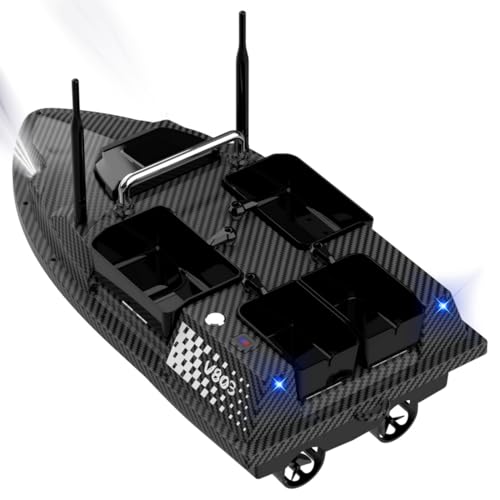
MechWingST V803 PRO GPS RC Bait Boat distinguishes itself with four independently controlled hoppers, useful when you want to release bait in separate loads rather than together. Its GPS supports cruise control, waypoint navigation, four fishing areas and 200 waypoints; a built-in gyroscope helps correct direction, according to the maker. Its 21.65-inch length is shorter than SINJEE GPS RC Bait Boat with Sonar.
Bottom line: Choose this for four separately controlled bait hoppers and GPS waypoint navigation.
SINJEE 3-Hopper Sonar GPS Bait Boat

SINJEE 3-Hopper Sonar GPS Bait Boat pairs sonar readings for water depth and temperature with GPS autopilot and return functions, but saves two waypoints rather than the 200 offered by SINJEE GPS RC Bait Boat with Sonar and MechWingST V803 PRO GPS RC Bait Boat. That makes it a practical fit for anglers who repeatedly target a small number of spots and prefer three hoppers. The maker says it can return on low battery or signal loss, and the included battery configuration is two 5200 mAh batteries. Its dimensions are 10.43 by 7.48 by 7.48 inches, substantially smaller than the other two boats; confirm those measurements suit your intended use.
Bottom line: Pick this if two saved spots and three hoppers cover your routine.
How to choose an RC boat fish finder
Choose by the information you need on the water: depth and bottom contour help locate changes in underwater terrain, while GPS waypoints help return to marked spots. A fish-finder display reports sonar returns; it does not identify a fish species with certainty. Compare the displayed depth range, saved waypoint count and control range as separate limits, since they measure different things. A long control range does not mean the sonar can scan equally far. For a few repeat visits, two saved spots may be enough; if you plan several zones, choose a boat with more waypoint capacity. Also compare hopper count with how many separate bait drops you intend to make.
A useful rule is to choose a model with at least as many waypoints as the fishing spots you need to save; with more than two regular spots, the two-waypoint setup is a poor match.
What sonar depth and fish readings mean
Sonar sends sound pulses into the water and interprets returning echoes to estimate depth and show underwater targets. Bottom contour changes can reveal slopes or drop-offs, while fish icons or marks are interpreted returns, not guaranteed species identifications. Water temperature readings describe the sensor’s local measurement rather than conditions throughout a lake. Sonar results can change with boat movement, water conditions and transducer placement, so use the display as a guide and compare readings while moving slowly over a spot. A maximum depth is a capability limit, not a promise of equally clear readings at every depth. Check that the display presents the measurements you will actually use before selecting a boat.
GPS waypoints and bait hoppers
GPS waypoints are saved positions that help a boat navigate back to chosen spots; waypoint capacity is not the same as the number of fishing zones. A multi-zone memory can organize marks, while the number of stored points determines how many locations can be saved. Hoppers are compartments that release carried bait, and separate controls allow drops to be made independently when provided. Match hopper count to the number of different loads or release points in your routine rather than assuming more compartments always help. Autopilot and return features can assist navigation, but they do not remove the need to monitor the boat, battery and surroundings. Keep a clear route between launch point and target.
Safe use around water
Keep an RC bait boat in sight and operate it only where motorized or remote-controlled craft are permitted. Small boats can be hard for swimmers and other boaters to notice, so avoid crowded swimming areas and keep clear of occupied vessels, wildlife and fishing lines. Wind, current and waves can move a small craft or interfere with a direct return path; choose sheltered water and maintain a manual route home. Treat low-battery and signal-loss return as backup functions, not substitutes for watching the boat. Before launch, verify battery charge, remote connection and a clear recovery route, and avoid sending the boat beyond a distance where you can safely retrieve it.
Frequently Asked Questions
Can an RC bait boat sonar identify fish species?
No, sonar returns show targets and underwater structure rather than reliably naming a species. Use marks as clues and confirm with your fishing knowledge and conditions.
How many GPS waypoints should a bait boat save?
Choose capacity based on the number of spots you revisit. A setup limited to two waypoints is unsuitable if you need to retain more than two locations at once.
Does a boat’s control range equal its sonar depth?
No, control range is the remote-to-boat distance, while sonar depth is the water depth the sensor can scan. Treat each specification as a separate limit.
What does a bait boat hopper do?
A hopper carries bait for release at a target spot. Separate controls, when provided, let you choose among compartments rather than releasing every load together.
Is it safe to rely on automatic return?
No, automatic return is a backup rather than a guarantee. Wind, current, obstacles or a depleted battery can affect recovery, so keep the boat in sight and within a safe retrieval distance.