
Flex Focus Adjustable Glasses Compared by Fit

Vi Shift Adjustable Glasses is the most versatile choice in this group because its manual lenses adjust from -6.00D to +3.00D independently for each eye. Choose one of the narrower-range pairs instead if your needs are limited to reading magnification.
Adjustable glasses use dials to alter lens power rather than provide one fixed prescription; they are not a substitute for an eye exam or custom prescription eyewear.
We earn a commission if you buy through links on this page. As an Amazon Associate I earn from qualifying purchases. Products are compared on manufacturer specifications, not hands-on testing.
- Best overall: Vi Shift Adjustable Glasses – Independent lens adjustment spans -6.00D to +3.00D for each eye.
- Best for reading range: PUDOEN Flex Focal 0D–3.5D – The adjustment range is 0D to +3.5D.
- Best for screen use: ASMZEN Adjustable Glasses – Its features include blue-light-blocking lenses and individual lens adjustment.
| Product | Best for | Adjustment range | Lens control | Shop |
|---|---|---|---|---|
| Vi Shift Adjustable Glasses | Broad power range | -6.00D to +3.00D | Separate per eye | Check Price on Amazon |
| PUDOEN Flex Focal 0D–3.5D | Positive reader power | 0D to +3.5D | Two side dials | Check Price on Amazon |
| ASMZEN Adjustable Glasses | Screen tasks | 0D to +3.5D | Individual adjustment | Check Price on Amazon |
Flex Focus Adjustable Glasses Compared
Compare the adjustment ranges and controls to match the glasses to the way you view near and far objects.
Vi Shift Adjustable Glasses

Vi Shift Adjustable Glasses spans the widest power range here, from -6.00D to +3.00D on each lens. Separate side dials let you tune each eye independently, which is useful when the two eyes need different settings. The PC lenses and 91.3 g design are specified, and a black pouch and vision chart are included. It suits someone seeking manual control across both positive and negative powers. Its 91.3 g weight may matter for buyers who prioritize a very light frame.
Bottom line: Choose this pair if you want independently adjustable lenses across a broad power range.
PUDOEN Flex Focal 0D–3.5D
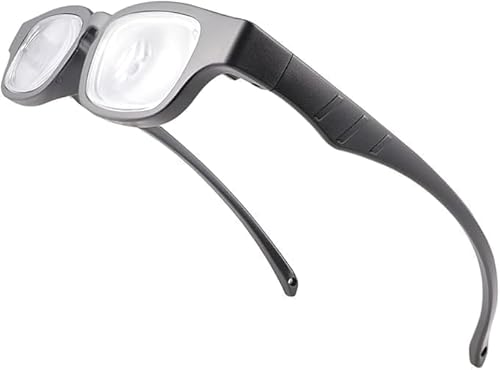
PUDOEN Flex Focal 0D–3.5D covers a positive-power range from 0D to +3.5D, aimed at near-reading magnification rather than negative correction. The product features describe a dial on each side of the frame for adjusting focus. Black is the color. The maker says the newer model is clearer and more durable than an earlier generation; that is a maker claim, not a measured comparison. This pair suits readers who need adjustable positive power. The range does not extend below 0D, so it is not the option for negative-power needs.
Bottom line: Choose it for adjustable reading magnification within a positive-only range.
ASMZEN Adjustable Glasses

ASMZEN Adjustable Glasses combines individual lens adjustment with blue-light-blocking claims, giving it a screen-oriented angle among the positive-power readers. Its range is 0D to +3.5D, and the features mention use for reading, gaming, television and computer work. This choice may suit someone who wants a spare adjustable pair for varied household tasks. The range remains positive-only, so it will not meet a need for negative correction.
Bottom line: Pick this pair if individual adjustment and screen-use features are priorities.
How to choose adjustable glasses by power
Start with the lens power range: positive diopters add magnification for near tasks, while negative diopters are used for distance correction. Vi Shift Adjustable Glasses is the only pair here with a negative-to-positive span, from -6.00D to +3.00D; the 0D to +3.5D ranges on PUDOEN Flex Focal 0D–3.5D and ASMZEN Adjustable Glasses are positive-only. A dial-adjustable pair is not a custom prescription, and it cannot diagnose why vision is blurry. Use this simple rule: if you require any negative power, choose only an option whose range explicitly includes negative diopters, then confirm suitability with an eye-care professional. For near-only reading, compare the upper positive limit and independent adjustment instead of assuming that all dials work the same way.
How separate lens dials affect fit
Independent adjustment matters when the two eyes need different power; a frame with separately tunable lenses lets each side be set without forcing the same setting. Vi Shift Adjustable Glasses and ASMZEN Adjustable Glasses explicitly describe individual adjustment, while PUDOEN Flex Focal 0D–3.5D describes a dial on each side. Frame fit matters too: bridge width, temple length and lens width affect stability and comfort, but those measurements are not supplied for these options, so check them before ordering if fit is a concern. Adjustable lenses also do not ensure a correct prescription or alignment for every face. Stop using eyewear that causes persistent headache, dizziness or eye strain, and seek an eye-care professional for persistent symptoms.
Manual and automatic focus compared
Manual-focus glasses use a user-turned dial to alter lens power; automatic-focus glasses claim to shift focus without that manual adjustment. Use the table to decide which control style matches your task, then compare actual power range separately: automatic operation does not establish that a particular prescription range is covered.
| Need | Control style | Key check |
|---|---|---|
| Set power yourself | Manual dial | Confirm the lens range and whether each eye adjusts separately |
| Shift focus automatically | Automatic claim | Confirm the power range before relying on it |
| Negative as well as positive power | Range-specific choice | Look for a negative diopter limit |
Task labels such as reading, computer use or distance viewing do not replace a diopter range. Choose by the range and control method, not by a broad claim that one pair handles every situation.
What to know before using adjustable readers
Adjustable readers are most useful for temporary or changing near tasks when a fixed reader strength is inconvenient; they are not a replacement for prescription eyewear when an eye condition requires correction. Reading distance changes the power that feels comfortable: a typical reading distance is about 14 to 16 inches, while computer monitors are often farther away and may need a different focal setting. Turn each control gradually and stop at the clearest comfortable view rather than pushing to the dial limit. Never use an uncertain power setting for driving or other safety-critical distance tasks. If vision changes suddenly or one eye differs substantially from the other, arrange an eye exam rather than relying on adjustable lenses.
Frequently Asked Questions
What does a diopter range mean on adjustable glasses?
A diopter measures lens power: positive values add magnification for near work, while negative values indicate diverging power commonly used for distance correction. A span from -6.00D to +3.00D covers both signs, unlike a 0D to +3.5D span.
Can adjustable glasses replace prescription glasses?
No, adjustable glasses do not establish a custom prescription or diagnose an eye problem. A new or changing vision problem, or persistent headaches with eyewear, warrants an eye-care professional’s assessment.
Should each eye be adjusted separately?
Separate adjustment helps when the eyes need different power; set each side independently only if the design supports it. Vi Shift Adjustable Glasses and ASMZEN Adjustable Glasses explicitly describe individual adjustment, and a comfortable setting is not proof of a correct prescription.
Are adjustable glasses safe for driving?
Do not rely on an uncertain dial setting for driving; road use requires clear, stable distance vision and any correction required by law. Use adjustable readers for controlled tasks and consult an eye-care professional if distance vision is unclear.
What reading distance should I use to set the focus?
A typical reading distance is about 14 to 16 inches, so set the lenses while holding reading material at the distance you normally use. A computer screen is usually farther away, so its clearest setting can differ from close reading.