
Best Large Format Tile Cutter: 3 Models Compared

The 110-inch manual cutter from 110-Inch Manual Tile Cutter suits most people because its 110-inch cutting length and 4–12 mm tile range give a clear fit for oversized work. Choose 128-Inch Manual Large Format Cutter if its 128-inch model size matches your needs, or a 48-inch cutter if your tiles are shorter.
Manual tile cutters score a glazed tile surface and snap it along the scored line; they are for straight cuts, not curves or notches.
We earn a commission if you buy through links on this page. As an Amazon Associate I earn from qualifying purchases. Products are compared on manufacturer specifications, not hands-on testing.
- Best overall: 110-Inch Manual Tile Cutter – Its 110-inch length and 4–12 mm thickness range make its intended capacity clear.
- Best for longest format: 128-Inch Manual Large Format Cutter – Its name identifies a 128-inch manual cutter, though no tile thickness range is provided.
- Best for interchangeable wheels: 110-Inch Large Format Cutter – Its three-head system offers three interchangeable blades for different ceramic materials.
| Product | Best for | Cutter size | Tile thickness | Scoring system | Shop |
|---|---|---|---|---|---|
| 110-Inch Manual Tile Cutter | Clear capacity range | 110 in | 4–12 mm | Rotary 3-blade | Check Price on Amazon |
| 128-Inch Manual Large Format Cutter | Long-format work | 128 in | — | — | Check Price on Amazon |
| 110-Inch Large Format Cutter | Wheel versatility | 110 in | 4–12 mm | Interchangeable 3-head | Check Price on Amazon |
Large Format Tile Cutters
Compare the cutter sizes and scoring features, then verify the working capacity against your tile dimensions before starting a cut.
110-Inch Manual Tile Cutter

110-Inch Manual Tile Cutter gives the clearest capacity among these large format cutters: a 110-inch cutting length and tiles 4–12 mm thick. Its maker describes a rotating three-blade system for ceramic materials, with suction cups, tile pliers, rollers, and a precision bite track. That combination suits a buyer cutting long porcelain, ceramic, or stone tiles who wants several wheel options.
The thickness range is relatively narrow, so verify tile thickness before choosing it; a manual score-and-snap tool also cannot replace a wet saw for curves or cutouts.
Bottom line: Choose this when your tile fits the 110-inch length and 4–12 mm thickness range.
128-Inch Manual Large Format Cutter
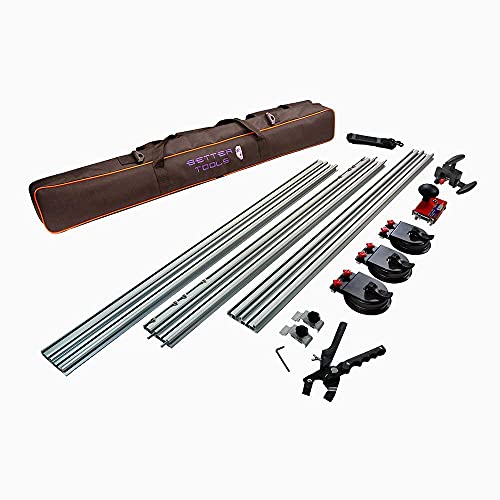
128-Inch Manual Large Format Cutter stands out by its 128-inch model size, the longest dimension named among the options. The product facts identify three suction cups used to lock onto the tile, a feature relevant to keeping the cutting setup anchored during alignment. This is a candidate for buyers working with unusually long-format tile who want a manual tool.
The product facts do not give a tile thickness range or scoring-wheel configuration, so confirm that the actual cutting capacity covers your tile before buying. A large cutter length alone does not establish that it can handle every tile size or material.
Bottom line: Choose this for projects where the 128-inch model size is the deciding requirement.
110-Inch Large Format Cutter

110-Inch Large Format Cutter is distinguished by its three interchangeable scoring blades, intended to accommodate different ceramic materials. Its thickness range is 4–12 mm, and its name identifies a 110-inch cutter. The maker describes wear-resistant rollers and a precision bite track, which may suit a buyer who prioritizes swapping wheel types for material-specific scoring.
The product facts also describe a 71-inch tile length, which conflicts with the 110-inch model size. Confirm the usable cutting length before committing to a particular tile; the thickness and blade details do not resolve that discrepancy.
Bottom line: Choose this if interchangeable scoring blades matter and you can verify the usable length.
How to Choose a Large Format Tile Cutter
Match cutter capacity to the tile’s actual dimensions and thickness before comparing accessories. A manual score-and-snap cutter uses a wheel to score the face, then pressure to break the tile along that line; it is generally suited to straight cuts in compatible ceramic and porcelain. Tile length is only one constraint: wheel type, thickness, tile body, and support all affect whether a clean snap is realistic. Measure the tile and check its thickness at the edge, then compare both measurements with the maker’s range. For a tile longer than 48 inches, prioritize a cutter whose usable cutting length is explicitly confirmed for that span. A mismatch in capacity can leave the score line incomplete or the break uncontrolled.
Large Format Tile Cutter Length and Fit
Use the tile’s required cut length, not the tool’s overall footprint, as the key fit measurement. A cutter described as 110 inches may refer to its model size rather than its confirmed usable cutting length, so resolve any disagreement between those figures before purchase. Keep the tile fully supported along the scoring path; flex or unsupported edges can lead to a wandering score or break outside the intended line. Oversized tile is awkward to position alone, so plan a stable, level work surface and a helper for handling long pieces. For tile below 48 inches, a shorter cutter may be sufficient if its actual capacity covers the cut and thickness. For longer pieces, measure twice and dry-position the cutter with the tile before scoring.
Manual Tile Cutter Versus Wet Saw
A manual cutter is designed for straight score-and-snap cuts, while a wet saw uses a blade and water to make cuts that a snap tool cannot manage. Choose manual scoring when the tile material and thickness are compatible and the cut is straight; choose a wet saw for curves, notches, narrow strips, or cuts that need to pass through a hard or textured tile reliably. Porcelain can be denser and more difficult to snap cleanly than many ceramic tiles, so test an offcut when possible rather than assuming a wheel will behave the same across materials. A wet saw creates water and slurry, so its work area and cleanup differ substantially. Neither tool removes the need to support a large tile across its full span.
Safe Scoring and Snapping Technique
Wear eye protection and cut-resistant gloves when scoring or snapping tile because sharp chips and broken edges can fly or cut skin. Secure the cutter and tile on a stable surface, align the wheel with the intended line, and make one steady score rather than repeatedly tracing the same groove; repeated scoring can make the break less predictable. Keep hands clear of the snapping point and support both sides of the tile as pressure is applied. Never force a tile that is outside the cutter’s thickness or material capability. Large tile is heavy and difficult to control, so use a helper when lifting or positioning it, and clear loose fragments before the next cut.
Frequently Asked Questions
Can a manual tile cutter cut porcelain tile?
A manual cutter can cut porcelain when its wheel, tile thickness, and tile body are compatible. Porcelain is often denser than ceramic, so test an offcut and use a wet saw if the score does not snap cleanly.
How thick a tile can a large format cutter handle?
The capacity depends on the specific cutter; one model here gives a 4–12 mm range. Measure tile thickness at the edge and compare it with the cutter’s confirmed limit before scoring.
Why does my tile break away from the score line?
A break can stray when the score is incomplete, the tile flexes, or the snap pressure is uneven. Support the tile fully, score in one steady pass, and avoid forcing a material or thickness the cutter is not designed for.
Do manual tile cutters make curved cuts?
No; manual score-and-snap cutters are intended for straight cuts. Use a wet saw or another suitable tile-cutting method for curves, notches, and cutouts.
What safety gear should I wear when cutting tile?
Wear safety glasses and cut-resistant gloves because tile chips can fly and broken edges are sharp. Stabilize the work surface and keep hands clear of the snap point.