
Best Black Seed Oil Brands Compared by Form and Use

Amazing Herbs Premium Black Seed Oil is the best fit for most people seeking an oral liquid, with an 8-fluid-ounce bottle and a cold-pressed process. Choose a capsule instead if you want a pre-measured format, or a topical oil if your main use is hair and skin care.
Black seed oil is made from Nigella sativa seeds; products here range from single-ingredient liquids to capsules and a blend with oregano, so match the format and intended use before choosing.
We earn a commission if you buy through links on this page. As an Amazon Associate I earn from qualifying purchases. Products are compared on manufacturer specifications, not hands-on testing.
- Best overall: Amazing Herbs Premium Black Seed Oil – An 8-fluid-ounce cold-pressed liquid intended for oral use.
- Best for capsules: Cold-Pressed Black Seed Oil Softgels – 120 softgels with 500 mg per capsule and vitamin E.
- Best for topical care: HBNO Organic Black Seed Oil – A 4-fluid-ounce organic liquid marketed for hair, skin, face, body, and lips.
| Product | Best for | Form | Size or count | Notable distinction | Shop |
|---|---|---|---|---|---|
| Amazing Herbs Premium Black Seed Oil | Oral liquid users | Liquid | 8 fl oz | Cold pressed | Check Price on Amazon |
| Cold-Pressed Black Seed Oil Softgels | Capsule convenience | Softgels | 120 count | 500 mg each; vitamin E | Check Price on Amazon |
| HBNO Organic Black Seed Oil | Topical routines | Liquid | 4 fl oz | USDA certified organic | Check Price on Amazon |
Black Seed Oil Brands Compared
Choose by whether you want an oral liquid, a capsule, or an oil intended for topical routines.
Amazing Herbs Premium Black Seed Oil

Among these choices, this is the largest single-ingredient oral liquid bottle, at 8 fluid ounces. Amazing Herbs says the oil is cold-pressed in the USA using screw-type presses; the product is described as containing omega fatty acids and 5× thymoquinone. The brand also describes its seeds as organically grown, pesticide-free, and non-irradiated.
This format suits someone who wants oil rather than capsules. The limitation is the liquid form: buyers who dislike oil’s taste or measuring may prefer softgels instead.
Bottom line: Choose this if you want a cold-pressed oral liquid in an 8-fluid-ounce bottle.
Cold-Pressed Black Seed Oil Softgels

This is the only capsule-only black seed oil option among the single-ingredient choices, with 120 softgels and 500 mg per capsule. The maker says each capsule also contains natural vitamin E and that the product is manufactured in the USA. Its softgel format avoids measuring liquid and is intended to avoid the oil’s taste.
It suits buyers who prioritize a pre-measured format.
Bottom line: Pick this for a measured softgel format with vitamin E.
HBNO Organic Black Seed Oil
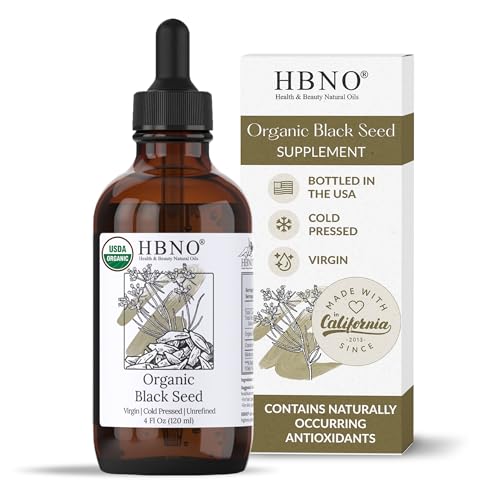
HBNO is the clearest topical-use choice here: the maker names hair, skin, face, body, and lips, and says it can be added to shampoo or conditioner. It comes in a 4-fluid-ounce glass bottle and is described as USDA certified organic, cold-pressed, and hexane free. The oil is Nigella sativa, also known as black cumin or kalonji oil.
This suits buyers focused on topical care who want an organic-certified liquid. Its 4-fluid-ounce size is half the oral liquid pick’s bottle volume, and its product text emphasizes topical routines rather than oral use.
Bottom line: Choose this for an organic-certified oil for topical routines.
How to choose a black seed oil format
Choose the format around how you plan to use black seed oil: liquids allow measuring or topical application, while softgels are pre-measured. Cold pressing extracts oil mechanically rather than using solvent extraction; the process alone does not establish organic certification or purity. For topical use, select a product whose maker names that purpose, and patch-test a small area before broader application because plant oils can irritate sensitive skin. For oral supplements, compare the serving amount on the label rather than assuming one capsule equals a serving. If you want black seed oil by itself, avoid combination products such as oregano blends.
What cold-pressed and organic mean
Cold-pressed describes an extraction approach, while organic certification concerns how agricultural ingredients are produced; these are separate attributes. USDA organic certification is a regulated label, so look for the certification mark and certifier rather than treating “natural” or “pesticide-free” language as equivalent. Hexane-free specifically addresses solvent use, not every possible measure of purity. This distinction matters when comparing oils: one may name a cold-press method, another may carry an organic certification, and some products provide both claims. Choose the attribute that matters to your use, and do not infer purity or potency from bottle size or extraction language alone.
How to compare serving sizes and bottle volume
Liquid volume and capsule count are not interchangeable measures: 8 fluid ounces describes bottle capacity, while a capsule count says how many units are inside. Compare supplement servings using milligrams per serving and the number of capsules per serving on the label; a 500 mg capsule is not necessarily a 500 mg serving if the directions call for more than one. For topical routines, consider bottle volume and whether the product is explicitly intended for the area of use. When a supplement also mentions a supply duration, calculate it using the serving directions rather than the count alone.
| Need | Selection cue |
|---|---|
| Oral oil | Liquid explicitly intended for oral use |
| Pre-measured supplement | Softgels with a clear per-serving label |
| Topical routine | Oil expressly named for skin or hair use |
| Single-ingredient oil | Avoid formulas combining other oils |
Safety checks for black seed oil supplements
Dietary supplements are not substitutes for prescribed treatment, and a supplement’s health claims should not be taken as proof that it prevents or treats disease. Black seed oil may cause allergic reactions or stomach upset, and supplements can interact with medicines, including drugs that affect blood clotting or blood sugar. Ask a clinician or pharmacist before oral use if you take medication, are pregnant or nursing, or have a chronic condition. Keep oils and capsules secured from children, follow the product’s label serving directions, and stop use if a concerning reaction occurs. Topical users should first test a small patch of skin.
Frequently Asked Questions
Is black seed oil the same as black cumin oil?
Yes, black seed oil, black cumin oil, and kalonji oil commonly refer to oil from Nigella sativa seeds. Check the ingredient name on the product label to confirm the plant source.
How much black seed oil should I take daily?
There is no single established daily amount that applies to every product and person. Follow the supplement label, and ask a clinician or pharmacist before use if you take medication or have a health condition.
Can black seed oil be applied to skin?
Some black seed oils are specifically marketed for topical use on skin, hair, or lips. Patch-test a small area first and stop if irritation develops.
Does cold-pressed mean black seed oil is organic?
No, cold-pressed describes how the oil is extracted, while organic refers to agricultural production and certification. Look for a recognized organic certification when that distinction matters.
Can black seed oil interact with medications?
Yes, supplements can interact with medicines, including some that affect blood clotting or blood sugar. Ask a clinician or pharmacist before adding an oral black seed oil supplement to a medication routine.