
Car Cover Hail Protection: 3 Covers Compared

For sedan and hatchback owners, Hail Protector 5-Layer Cover is the closest match because its padded cover fits vehicles up to 190 inches; choose another option if your car exceeds that range or you need an SUV fit.
Hail covers add cushioning between hail and the vehicle, but no cover guarantees protection from every storm.
We earn a commission if you buy through links on this page. As an Amazon Associate I earn from qualifying purchases. Products are compared on manufacturer specifications, not hands-on testing.
- Best overall: Hail Protector 5-Layer Cover – Its five-layer padded cover is sized for hatchbacks and sedans up to 190 inches.
- Best for longer sedans: SNKOL 7-Layer Sedan Cover – Its sedan fit range reaches 193 inches and its construction has seven layers.
- Best for SUVs: JOYTUTUS 5 mm EVA SUV Cover – Its 192–201-inch SUV cover uses 5 mm EVA padding over roof and window areas.
| Product | Best for | Vehicle fit | Padding | Layer construction | Shop |
|---|---|---|---|---|---|
| Hail Protector 5-Layer Cover | Hatchbacks and sedans | Up to 190 in. | Padded; thickness — | 5 layers | Check Price on Amazon |
| SNKOL 7-Layer Sedan Cover | Longer sedans | 186–193 in. | Soft cotton; thickness — | 7 layers | Check Price on Amazon |
| JOYTUTUS 5 mm EVA SUV Cover | 192–201-inch SUVs | 192–201 in. | 5 mm EVA | Multi-layer | Check Price on Amazon |
Car Cover Hail Protection Options
Match the cover to your vehicle’s body style and measured length before comparing padding and construction.
Hail Protector 5-Layer Cover

For a padded cover that fits a hatchback or sedan up to 190 inches, this option combines several materials rather than relying on a single outer shell. Its five-layer build includes 190T silver-coated fabric, a waterproof membrane, cotton padding, and inner layers. The cover is also designed with reflective strips, adjustable windproof buckles, and elastic hems. It suits owners prioritizing broad weather coverage alongside hail cushioning. The main limitation is fit: vehicles longer than 190 inches fall outside its range, and the padding thickness is not given, so buyers comparing cushioning depth cannot use thickness as a direct measure.
Bottom line: Choose this for a hatchback or sedan no longer than 190 inches.
SNKOL 7-Layer Sedan Cover

For a sedan near the upper end of the available fit ranges, this seven-layer cover is sized for vehicles 186 to 193 inches long. Its materials include PE and PEVA, reflective aluminum, and soft cotton; the maker says the cover is waterproof and offers hail and UV protection. A driver-door zipper, mirror pockets, reflective strips, and front and rear wind straps add practical access and fit features. This suits a sedan owner who wants those built-in details and a slightly longer fit window.
Bottom line: Pick this for a sedan measuring 186 to 193 inches.
JOYTUTUS 5 mm EVA SUV Cover
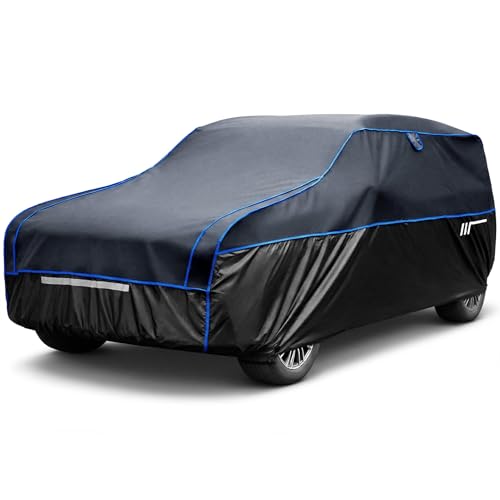
For an SUV rather than a sedan, this cover specifies 5 mm EVA padding over the roof and window areas, with a fit range of 192 to 201 inches. EVA cushioning distinguishes it from covers that give a layer count but no padding thickness. The maker says the cover can resist cherry-sized hail and also provides weather protection against rain, snow, UV rays, dust, and debris. It suits SUV owners whose vehicle falls within the length range. Its key limitation is vehicle fit: a sedan or an SUV outside that range needs a different size, and the cherry-sized hail claim is not a guarantee against larger stones.
Bottom line: Choose this for an SUV 192 to 201 inches long.
How to choose a hail-protection car cover
Start with fit, then compare the cushioning rather than relying on layer count alone. Measure the vehicle from bumper to bumper and check that its body style and length fall inside the cover’s range; a cover that is too loose can flap in wind, while a tight cover may not reach the lower body. Padding thickness is a more useful comparison when stated, but material and coverage area matter too. Check whether cushioning covers the roof and glass, where hail impact is most concerning, or extends across the whole vehicle. No padded cover can promise protection from every hailstone, so move a vehicle under solid shelter when a severe storm is forecast and safe shelter is available.
How to match cover length to your vehicle
Measure the full vehicle length before ordering, since even sedan covers can differ by several inches in their fit ranges. Use the manufacturer’s body style as well as the length: an SUV may have a different roofline, mirror position, or rear shape than a sedan with a similar bumper-to-bumper measurement. Leave fit tolerance to the cover’s sizing guidance rather than assuming a longer cover will work better; extra fabric can catch wind and shift. For a vehicle measuring 191 inches, for example, select only a cover whose range includes 191 inches. Also check how mirror pockets, hems, and straps align with the car so the cover can be secured without pulling hard on seams.
What padding and layer counts tell you
A layer count describes construction, not a universal level of hail resistance. Materials such as EVA foam or cotton padding can cushion impact, while an outer waterproof layer helps shed rain; neither property by itself establishes performance against a particular hail size. Prefer a thickness and an identified coverage area when comparing impact cushioning. A maker’s hail-size claim applies to that product’s claim, not to every storm condition. Hail size can vary widely, and stones around 1 inch in diameter can cause vehicle damage, so a cover should be treated as an added barrier rather than guaranteed storm protection. Secure the cover as intended, since wind can lift or shift loose material during a storm.
Frequently Asked Questions
Can a car cover prevent hail damage?
A padded cover can add a cushioning layer, but it cannot guarantee that hail will not damage a vehicle. Hailstones around 1 inch in diameter can damage cars, so seek solid shelter when a severe storm is forecast and it is safe to do so.
How should I measure my car for a hail cover?
Measure from the frontmost bumper point to the rearmost bumper point, then compare that length with the cover’s range and body style. Check mirror and roofline fit as well, since equal-length sedans and SUVs can have different shapes.
Does more cover layers mean better hail protection?
Compare the padding material, stated thickness, and coverage area, and treat any hail-size claim as specific to that cover.
Should I put a hail cover on a wet car?
A cover may trap moisture against paint if it remains in place, especially during extended storage. When practical, start with a clean, dry vehicle and remove the cover after a storm so the surface can dry.
Can wind blow a car cover off during a storm?
Strong wind can shift or lift a loose cover, which is why fitted hems and securing straps matter. Tighten the cover without overstretching it, and do not rely on a cover in conditions where securing it would be unsafe.