
Best Frankincense Oil for Skin: 3 Options Compared

For most people, Gya Labs Frankincense Essential Oil, 4 fl oz is the best frankincense oil for skin because its directions specifically recommend mixing 2–3 drops into moisturizer or a carrier oil. Choose Kukka Frankincense Essential Oil, 4 fl oz if you also want massage guidance, or a balm instead if you prefer a pre-formulated product.
Frankincense essential oil is a concentrated aromatic oil, not a ready-to-use moisturizer, so dilute it before applying to skin.
We earn a commission if you buy through links on this page. As an Amazon Associate I earn from qualifying purchases. Products are compared on manufacturer specifications, not hands-on testing.
- Best overall: Gya Labs Frankincense Essential Oil, 4 fl oz – Its directions specify 2–3 drops mixed with moisturizer or a carrier oil for skin use.
- Best for massage: Kukka Frankincense Essential Oil, 4 fl oz – Its directions give separate dilution guidance for face and body massage.
- Best for balm texture: Vitality Extracts Frankincense Balm, 2 oz – It is a 2-ounce balm formulated with botanical oils, beeswax and vitamin E.
| Product | Best for | Format | Size | Skin-use guidance | Shop |
|---|---|---|---|---|---|
| Gya Labs Frankincense Essential Oil, 4 fl oz | Moisturizer mixing | Essential oil | 4 fl oz | 2–3 drops in moisturizer or carrier oil | Check Price on Amazon |
| Kukka Frankincense Essential Oil, 4 fl oz | Face and massage | Essential oil | 4 fl oz | 2–3 drops for face; 4–6 for body massage | Check Price on Amazon |
| Vitality Extracts Frankincense Balm, 2 oz | Ready-made balm | Skin balm | 2 oz | Balm; no drop-count directions | Check Price on Amazon |
Frankincense oil for skin
Compare the essential oils by their skin-use directions, and consider the balm if you prefer a ready-made format.
Gya Labs Frankincense Essential Oil, 4 fl oz
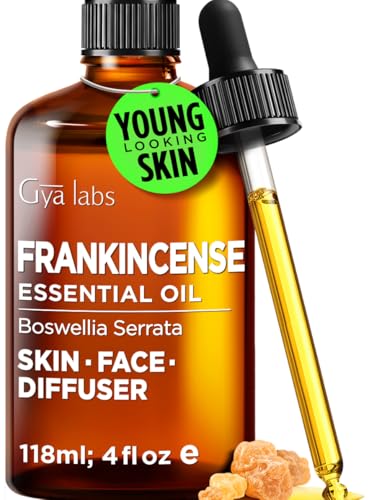
Gya Labs Frankincense Essential Oil, 4 fl oz stands out for its specific moisturizer-mixing directions: add 2–3 drops to moisturizer or a carrier oil, and dilute before topical use. The 4 fl oz bottle is also presented for diffuser use, so it may suit someone who wants one aromatic oil for skin routines and room fragrance. Its earthy, resinous scent is described as bold, which may matter if you prefer a lighter aroma. Essential oils are concentrated; do not apply this undiluted, and patch-test a diluted mixture before broader use.
Bottom line: Choose this if you want an essential oil with explicit moisturizer-mixing directions.
Kukka Frankincense Essential Oil, 4 fl oz

Kukka Frankincense Essential Oil, 4 fl oz gives separate directions for face and body: mix 2–3 drops with carrier oil for a face routine, or 4–6 drops with carrier oil for body massage. That makes it the clearest fit for someone planning both uses. It is a 4 fl oz steam-distilled essential oil with a dropper, rather than a pre-mixed balm. Because the directions call for dilution, anyone seeking a ready-to-apply skin product should choose a formulated balm instead; patch-test the diluted blend first and keep it away from eyes.
Bottom line: Pick this if you want separate face and body-massage dilution directions.
Vitality Extracts Frankincense Balm, 2 oz

Vitality Extracts Frankincense Balm, 2 oz differs from the essential oils because it is a balm made with olive oil, almond oil, white and yellow beeswax, and frankincense essential oil. Its 2-ounce format suits someone who wants a moisturizing balm rather than a concentrated oil to blend into another product. The ingredients also include vitamin E. It is a partial match for a search focused on frankincense oil itself: choose it for the balm format, not for a bottle of standalone essential oil or drop-by-drop dilution.
Bottom line: Choose this if you prefer a formulated balm over standalone essential oil.
How to dilute frankincense oil for skin
Frankincense essential oil should be diluted in a carrier before skin application; the essential oil directions here also call for mixing. A common conservative starting point for adult body products is a 1% dilution, roughly 6 drops of essential oil per 1 fluid ounce of carrier, though drop size varies. For the face, use less and avoid the eye area. Mix a small amount at a time, and do not add essential oil directly to water because oil and water do not blend evenly. A patch test can flag irritation: apply a small amount of the diluted mixture to a small area and wait 24 hours before wider use. Stop if redness, burning, itching, or swelling develops.
Choose oil or balm for your skin routine
Choose a standalone essential oil when you want to control the carrier and dilution; choose a balm when you want a ready-made, thicker product. The essential oils in this comparison are sold in 4 fl oz bottles, while the balm is 2 oz and combines frankincense essential oil with olive oil, almond oil, and beeswax. The balm avoids a separate drop-count blending step, but its formula includes almond oil, which may be unsuitable for some people with ingredient sensitivities. The table distinguishes format from application guidance, not product effectiveness.
| Format | What it means for use | Decision cue |
|---|---|---|
| Essential oil | Concentrated; dilute with carrier | Choose when you want to blend |
| Balm | Pre-formulated topical texture | Choose when you want a balm format |
Skin safety and patch testing
Undiluted essential oils can irritate skin, so avoid applying frankincense oil neat or near eyes, lips, and other sensitive areas. A 24-hour patch test with a diluted mixture is a practical screening step, but it cannot guarantee that a reaction will not occur later. Keep essential oils away from children and pets, and do not ingest them for a skin routine. If you have a known fragrance or nut sensitivity, check the full ingredient panel before using any topical product; the balm includes almond oil. Stop use if a reaction appears, and seek medical advice for a severe or persistent reaction.
What to check before choosing a frankincense product
Match the product format to the routine: a dropper bottle requires measuring and a carrier, while a balm is already blended. For face use, a 2–3-drop instruction still needs a carrier; the number of drops alone does not define a safe concentration because carrier volume matters. Avoid assuming that a product’s aromatic or cosmetic positioning establishes a skin benefit. These products should be treated as fragrance or cosmetic choices, not as treatments for blemishes, wrinkles, or other skin conditions. If the product does not give a precise carrier volume for your intended use, start with a small, conservative dilution and patch-test before regular application.
Frequently Asked Questions
Can frankincense essential oil go directly on skin?
No; dilute frankincense essential oil in a carrier oil or moisturizer before topical use. A commonly used conservative adult starting point is about 1%, or roughly 6 drops per 1 fluid ounce of carrier, with smaller amounts for sensitive areas.
How should I patch-test diluted frankincense oil?
Apply a small amount of the diluted mixture to a small area of skin and wait 24 hours before broader use. Stop if you notice itching, redness, burning, or swelling.
Can I use frankincense oil on my face?
Use only a diluted mixture and keep it away from eyes and lips. Face skin can be more sensitive than body skin, so start below a 1% concentration and patch-test first.
Can I mix essential oil with water for skin?
Water does not evenly disperse essential oil, so droplets can contact skin in a concentrated form. Use a suitable carrier oil or a formulated moisturizer instead.
What is the difference between frankincense oil and balm?
Frankincense essential oil is a concentrated aromatic oil that needs dilution, while a balm is a pre-formulated topical product with other ingredients. Check the balm’s ingredient panel for sensitivities, including almond oil in the balm compared here.