
Best Whistles for Coaches: 5 Models Compared

Fox 40 Classic CMG 3-Pack suits most coaches who want a pealess whistle and a set of three, each with a lanyard. Coaches who prefer a cork pea should choose a stainless-steel option such as Hipat Stainless Steel 2-Pack or HUTOU Stainless Steel 2-Pack instead.
A sports whistle signals starts, stops, and changes of direction; its sound design and how it hangs between uses matter as much as a loudness claim.
We earn a commission if you buy through links on this page. As an Amazon Associate I earn from qualifying purchases. Products are compared on manufacturer specifications, not hands-on testing.
- Best overall: Fox 40 Classic CMG 3-Pack – Three pealess whistles and three lanyards make it practical to keep spares on hand.
- Best for stainless steel: Hipat Stainless Steel 2-Pack – The two-whistle set uses stainless steel and natural cork peas.
- Best for loudness claim: Fox 40 Sonik Blast CMG – The maker claims a 120+ dB sound and a pealess design.
- Best for a plastic pair: Hipat Plastic 2-Pack – The set includes two plastic whistles and two lanyards.
| Product | Best for | Sound design | Pack size | Material | Shop |
|---|---|---|---|---|---|
| Fox 40 Classic CMG 3-Pack | Team spares | Pealess; 115 dB claim | 3 whistles, 3 lanyards | — | Check Price on Amazon |
| Hipat Stainless Steel 2-Pack | Cork pea sound | Cork pea; up to 120 dB claim | 2 whistles, 2 lanyards | Stainless steel | Check Price on Amazon |
| Fox 40 Sonik Blast CMG | Single loud whistle | Pealess; 120+ dB claim | 1 whistle, breakaway lanyard | ABS plastic | Check Price on Amazon |
| Hipat Plastic 2-Pack | Plastic pair | Pea not identified; up to 120 dB claim | 2 whistles, 2 lanyards | Plastic | Check Price on Amazon |
| HUTOU Stainless Steel 2-Pack | Color variety | Cork pea; 128+ dB claim | 2 whistles, 2 lanyards | Stainless steel | Check Price on Amazon |
Best whistles for coaches
Compare whistle mechanism, pack contents, and construction to find a setup that fits your practices.
Fox 40 Classic CMG 3-Pack

Fox 40 Classic CMG 3-Pack stands out as a three-whistle set, so a coach can keep spares available for assistants or equipment bags. The pealess design has no moving parts, and the maker says its chambers self-clear when submerged; the maker also claims 115 dB. The pack includes three lanyards. Choose this set when the extra whistles matter more than having one compact unit.
Bottom line: Choose it when you want three pealess whistles and matching lanyards.
Hipat Stainless Steel 2-Pack

Hipat Stainless Steel 2-Pack is the stainless-steel choice with a natural cork pea, unlike the pealess options in this group. The maker claims a sound of up to 120 dB and describes the steel as food-grade and resistant to rust or corrosion. Two lanyards come with the pair, and each has an adjustable bead for setting its length. A pea whistle has a moving component inside, so this is a different mechanism from a no-moving-parts design; choose it if you specifically want a cork-pea whistle rather than a pealess one.
Bottom line: Pick it if you prefer stainless steel, a cork pea, and adjustable lanyards.
Fox 40 Sonik Blast CMG

Fox 40 Sonik Blast CMG is the single-whistle option for a coach seeking a pealess design with a breakaway lanyard. The maker claims 120+ dB and says the ABS plastic construction is impervious to moisture; it also says the whistle cannot be overblown. With one whistle rather than a multipack, this choice suits a coach who wants one dedicated signal tool, not extras for a staff.
Bottom line: Choose it for one pealess whistle with a breakaway lanyard.
Hipat Plastic 2-Pack
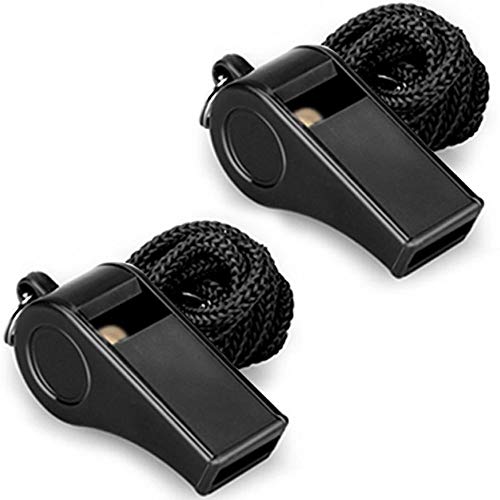
Hipat Plastic 2-Pack differs from the metal options by using thickened plastic and including two whistles with lanyards. That distinction matters for coaches who want a whistle with no moving part or specifically want a cork pea. The compact dimensions are about 1.81 inches long by 0.71 inch high and wide. Choose this pair when plastic construction is your preference and mechanism is not the deciding factor.
Bottom line: Pick it for a two-whistle plastic set when the mechanism is secondary.
HUTOU Stainless Steel 2-Pack

HUTOU Stainless Steel 2-Pack pairs stainless-steel construction and natural cork peas with a two-whistle pack. The maker claims a sound of 128+ dB and says each whistle has a lanyard. The colors are random, so the exact colors are not a choice to rely on; the set is better suited to a coach who is comfortable with a mixed-color pair. As with other pea whistles, the internal pea is a moving component, unlike a pealess whistle. Consider that mechanism difference before choosing based only on the decibel figure.
Bottom line: Choose it if you want a stainless-steel cork-pea pair and accept random colors.
How to choose a coach whistle
Start with the signal mechanism: pea whistles have a small moving pea inside, while pealess whistles use chambers and have no moving part. A moving pea can affect the sound as it rolls; a pealess design avoids that component. Next, decide whether one whistle or a multipack fits your staff: packs of two or three can provide spares, while a single whistle avoids carrying extras. Sound claims in decibels need cautious comparison because the measurement distance and conditions are not provided for these products. A louder-sounding choice is not automatically better at close range; keep any whistle away from ears and use brief signals rather than blowing continuously.
Pea and pealess whistle designs
Pea and pealess whistles create sound differently, so choose by mechanism preference rather than treating a decibel claim as the only deciding factor. A cork-pea model includes a moving part; a pealess model has no moving part to freeze or jam. Pealess designs can be useful when moisture or cold is a concern, though product-specific construction still matters. A whistle’s sound also depends on how it is blown and the surrounding noise, so a printed maximum is not a guarantee of audibility at every field or gym. For a close sideline, position yourself where players can see or hear the signal instead of relying on more volume alone.
Whistle pack size and lanyard fit
Choose a pack based on who needs a whistle and how it will be carried. A single whistle suits one coach; a two- or three-whistle set can cover assistants or leave spares in equipment bags. A lanyard keeps a whistle accessible, but length affects how it rests when the wearer bends or runs. For field use, set it short enough that it does not swing into equipment or snag on clothing. A breakaway style can release under a hard pull; check that feature when a whistle will be worn during active drills. Don’t assume every included lanyard has the same adjustment or release design.
How to compare whistle sound claims
Compare stated decibel figures only as maker claims, not as a guaranteed ranking in real coaching conditions. The decibel scale is logarithmic: a 10 dB increase represents ten times the sound intensity, not merely a small linear step. In practice, background noise, field layout, wind, and where players stand all affect whether a cue carries. Use this decision rule: if a whistle will be used within arm’s reach of players, prioritize placement and short signals over the highest printed number. Avoid blowing directly near anyone’s ears because loud sound at close range can cause hearing harm.
| Coaching need | Useful choice | Why it fits |
|---|---|---|
| Spare whistles for assistants | Two- or three-whistle pack | Provides multiple units for a coaching staff |
| No moving part | Pealess design | Uses chambers rather than an internal pea |
| Traditional cork-pea mechanism | Pea whistle | Uses a moving cork pea inside |
| Whistle worn during active drills | Breakaway lanyard | Can release under a hard pull |
Frequently Asked Questions
Are pealess whistles better for outdoor coaching?
Pealess whistles have no moving pea, which removes one component that can freeze or jam. Outdoor performance still depends on the whistle’s construction, weather, and background noise.
What does a whistle rating in decibels mean?
A decibel rating describes sound level under a measurement setup, and a 10 dB increase corresponds to ten times the sound intensity. Without a measurement distance and conditions, treat ratings as maker claims rather than a direct field comparison.
How many whistles should a coaching staff carry?
One whistle can serve a coach working alone, while a two- or three-whistle pack can supply assistants or provide spares. Keep spare whistles somewhere accessible so a missing or damaged unit does not interrupt practice.
Can a coach wear a whistle while running drills?
A lanyard keeps a whistle close at hand, but a loose cord can snag or swing during movement. Set the length to limit swinging, and prefer a breakaway style when a whistle will be worn during active drills.
Can loud whistles damage hearing at close range?
Yes, loud sound close to the ear can cause hearing harm. Avoid blowing directly beside players or officials, and use short signals rather than prolonged blasts.