
Baofeng Antenna Upgrade Range: 4 Whips Compared

For most Baofeng owners, Baofeng 18.8-Inch Foldable Antenna is the balanced antenna upgrade: its 18.8-inch foldable whip covers 144/430 MHz and has a 2.15 dBi gain. Choose a different option if you need a shorter whip, a longer antenna, or broader frequency coverage.
We earn a commission if you buy through links on this page. As an Amazon Associate I earn from qualifying purchases. Products are compared on manufacturer specifications, not hands-on testing.
- Best overall: Baofeng 18.8-Inch Foldable Antenna – An 18.8-inch foldable whip covers 144/430 MHz and specifies 2.15 dBi gain.
- Best for shorter length: LUITON 15.6-Inch Whip Antenna – Its 15.6-inch whip is the shortest option.
- Best for extended reach: Bingfu 42.5-Inch Foldable Antenna – At 42.5 inches, it is the longest option and specifies 3.5 dBi gain.
| Product | Best for | Length | Frequency range | Gain | Shop |
|---|---|---|---|---|---|
| Baofeng 18.8-Inch Foldable Antenna | Balanced upgrade | 18.8 in | 144/430 MHz | 2.15 dBi | Check Price on Amazon |
| LUITON 15.6-Inch Whip Antenna | Shorter whip | 15.6 in | 144/430 MHz | — | Check Price on Amazon |
| Baofeng 18.5-Inch Dual-Band Antenna | Two-pack option | 18.5 in | 144/430 MHz | 2.15 dBi | Check Price on Amazon |
| Bingfu 42.5-Inch Foldable Antenna | Maximum length | 42.5 in | 136–520 MHz | 3.5 dBi | Check Price on Amazon |
Baofeng Antenna Upgrades for Range
Compare each whip’s size, frequency coverage and stated gain, then check its connector against your radio.
Baofeng 18.8-Inch Foldable Antenna

At 18.8 inches, this foldable antenna is a middle ground between the shorter 15.6-inch whip and the much longer 42.5-inch option. Its specified 144/430 MHz coverage suits dual-band use, and the maker gives its gain as 2.15 dBi. The SMA-female connector and listed Baofeng radio compatibility make it a candidate for owners whose radio matches that connector. The limitation is that the frequency range is the two named bands, not broad 136–520 MHz coverage; choose another option if that wider range is essential.
Bottom line: Choose this for a foldable, mid-length whip covering 144/430 MHz.
LUITON 15.6-Inch Whip Antenna
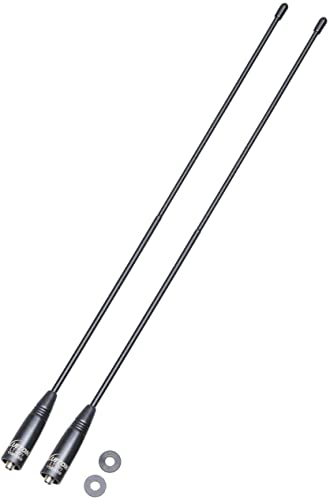
The 15.6-inch length makes this the most compact of the four listed whips, a useful distinction where a longer antenna would snag or be awkward to carry. The maker names VHF/UHF 144/430 MHz operation and describes a flexible whip with an SMA-female connection; compatibility spans a range of radios, so confirm your exact model and connector before ordering. Its shorter reach may be less convenient if extra height is your main priority.
Bottom line: Pick this when a shorter whip matters more than a gain figure.
Baofeng 18.5-Inch Dual-Band Antenna

This option comes as a two-pack, distinguishing it from the single antenna options, and each whip is 18.5 inches long. The maker specifies 2.15 dBi gain and 144/430 MHz operation, with a spring-loaded base and flexible whip intended to tolerate bending. It may suit an owner wanting a spare or a second antenna, provided the radio’s connector matches the SMA-female fit. The maker does not provide a broader frequency range, so users seeking coverage beyond the named bands should consider another antenna in this group.
Bottom line: Choose this if you want two flexible, dual-band whips.
Bingfu 42.5-Inch Foldable Antenna

The 42.5-inch foldable whip is substantially longer than the other choices and specifies 3.5 dBi gain across 136–520 MHz. Its 50-ohm impedance and 8-watt maximum input power are useful compatibility checks alongside the SMA-female connector. The maker describes it as omnidirectional, and it is listed for a range of Baofeng radios. Its length can be cumbersome on a handheld radio and may catch on branches or gear; choose a shorter whip if portability or snag resistance is more important than antenna height.
Bottom line: Choose this for the widest range and longest whip, if its size suits your use.
How to choose a Baofeng antenna upgrade
Choose by connector fit, frequency coverage and the antenna length you can comfortably carry; a longer whip alone does not guarantee more range. These options specify SMA-female connectors, but radio connector gender can differ by model, so verify the radio’s connector before ordering. For dual-band amateur use, match the antenna’s coverage to the radio’s intended VHF/UHF bands; only one option here gives a 136–520 MHz range. Gain figures are supplied for three antennas, but they are not a direct promise of added distance: terrain, antenna orientation, and the other station’s location affect the link. If your use requires a named frequency outside an antenna’s range, do not assume the antenna is suitable.
Antenna length and range tradeoffs
A longer antenna can provide more effective height, but handheld range is usually limited by obstructions and line of sight. VHF/UHF signals often work best when both stations have a clear path; hills, buildings, and dense terrain can block that path regardless of a whip’s advertised gain. Height above surrounding obstructions matters more than simply choosing the longest product. A 42.5-inch whip may be unwieldy on a handheld, while a shorter antenna is easier to carry and less likely to snag. For a portable radio used around brush or inside a vehicle, prefer a manageable length; for stationary use with room to position the radio higher, a longer whip may be more practical.
What antenna gain and tuning mean
Gain in dBi compares an antenna’s directional performance with an ideal isotropic reference; it is not a guaranteed range multiplier. Whip shape and length affect the radiation pattern, so gain can favor some directions over others even when an antenna is described as omnidirectional. Amateur handheld antennas also need to work on the frequencies you actually transmit; a broad frequency label does not prove equal performance across the whole span. Use the antenna only on frequencies and power levels permitted for your radio and license. A poor match can send more transmitter energy back toward the radio, so stop transmitting if you suspect a damaged connector or antenna rather than treating extra power as a fix.
Safe and reliable handheld radio use
Keep the antenna upright and away from your face while transmitting, and follow the radio maker’s RF-exposure guidance; an antenna upgrade does not remove exposure limits. Transmit only on frequencies you are authorized to use: in the United States, amateur radio bands generally require an FCC amateur license, while FRS and GMRS have separate rules and equipment requirements. Check that the antenna connector is fully seated before use, since a loose connection can impair operation. A clear elevated position often helps more than changing whips: moving a few feet away from a wall or vehicle body can improve the path. Never assume an antenna’s broad frequency range authorizes transmission on every frequency it covers.
Frequently Asked Questions
Will a longer Baofeng antenna always increase range?
No; antenna length alone does not determine range. VHF/UHF communication depends strongly on line of sight, terrain, obstructions, and antenna orientation.
How do I check whether an antenna fits my Baofeng radio?
Match the antenna connector to the radio’s connector before ordering; these four options specify SMA-female. Check the exact radio model because connector gender varies across radios.
What does 2.15 dBi gain mean on a handheld antenna?
The dBi figure compares an antenna’s directional performance with an ideal isotropic reference; it does not promise a specific distance increase. Terrain and where the antenna is pointed still affect communication.
Can I transmit anywhere within an antenna’s frequency range?
No; an antenna’s coverage does not grant permission to transmit. In the United States, amateur bands generally require an FCC amateur license, and other services such as FRS and GMRS follow separate rules.
Should I use a handheld antenna while driving?
A handheld whip can snag or be awkward inside a vehicle, and the vehicle body can obstruct radio signals. Park before adjusting equipment, and use only a radio setup permitted for the service and vehicle.