
Best Pond Muck Remover: 4 Treatments Compared

Airmax MuckAway, 8 Scoops suits most pond owners seeking a routine bacteria-and-enzyme treatment, with dosing every two weeks when water is above 50°F. Choose Cold Water Muck & Sludge Remover, 3 lb instead if you need a formula specifically made to work in colder water from 32°F to 55°F.
We earn a commission if you buy through links on this page. As an Amazon Associate I earn from qualifying purchases. Products are compared on manufacturer specifications, not hands-on testing.
- Best overall: Airmax MuckAway, 8 Scoops – The scoop format has a clear every-two-weeks schedule for water above 50°F.
- Best for cold water: Cold Water Muck & Sludge Remover, 3 lb – Its bacteria are designed to stay active from 32°F to 55°F.
- Best for large areas: LMJP Muck Reducer, 5 lb – The product is described as treating up to 30,000 square feet.
| Product | Best for | Format | Package size | Temperature range | Shop |
|---|---|---|---|---|---|
| Airmax MuckAway, 8 Scoops | Routine warm-water care | Scoops | 8 scoops | Above 50°F | Check Price on Amazon |
| Cold Water Muck & Sludge Remover, 3 lb | Cold-season treatment | Pellets | 3 lb | 32°F–55°F | Check Price on Amazon |
| LMJP Muck Reducer, 5 lb | Large pond areas | Tablets | 5 lb | — | Check Price on Amazon |
| Natural Muck Remover Tablets, 4.1 lb | Rocky bottom buildup | Tablets | 4.1 lb | — | Check Price on Amazon |
Pond Muck Removers
Compare these treatments by application format, package size and the water conditions each is meant to handle.
Airmax MuckAway, 8 Scoops

Airmax MuckAway, 8 Scoops is the only option here with a recurring scoop schedule: use one scoop every two weeks when water is above 50°F. Its tablets sink below the surface and release beneficial bacteria, while the product also includes enzymes. The eight-scoop package may suit pond owners who want a set quantity for repeated applications rather than a pound-based container. The temperature threshold matters: this schedule is for warmer conditions, so choose another product if you need treatment in colder water. The maker says it can reduce up to 2 inches of muck per month.
Bottom line: Choose this for scheduled applications when the water is above 50°F.
Cold Water Muck & Sludge Remover, 3 lb

Cold Water Muck & Sludge Remover, 3 lb is distinct for its cold water operating range of 32°F to 55°F, covering fall cooldown and spring warmup conditions that the other options do not specify. The 3-pound pellet formula targets settled leaves, fish waste and other organic debris. The maker says the bacteria pause if the pond freezes and resume after thawing, so this is not a treatment for frozen water. Its specified area coverage is up to 0.75 acres; consider that limit when matching the package to pond size.
Bottom line: Pick this when pond water is between 32°F and 55°F.
LMJP Muck Reducer, 5 lb
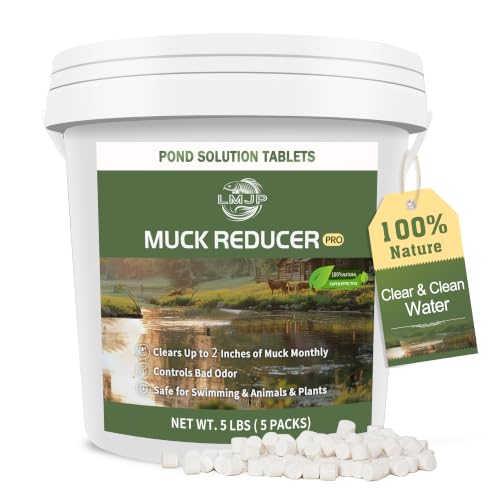
LMJP Muck Reducer, 5 lb gives a defined maximum coverage of up to 30,000 square feet, making area the clearest selection point for this 5-pound product. Its tablets dissolve after sinking and release natural enzymes, with bacteria also identified in the product name. The maker says it can reduce up to 2 inches of muck per month and is intended for odor control as well. Avoid treating the coverage figure as a pond-depth measure.
Bottom line: Choose this when its area coverage matches your pond.
Natural Muck Remover Tablets, 4.1 lb

Natural Muck Remover Tablets, 4.1 lb is positioned for organic buildup trapped among rocks, in crevices and in oxygen-deprived zones, a more specific target than a general bottom-muck treatment. The 4.1-pound package uses tablets that dissolve in water, and the maker also presents it as a clarifier for improving water clarity. Its described action targets organic matter such as leaves and fish waste. This product’s fields give no temperature range or coverage area, so it is harder to size for a particular pond or cold-season application; choose it for the rocky or crevice-heavy bottom condition it calls out.
Bottom line: Select this for buildup lodged among rocks and crevices.
How to choose a pond muck remover
Match the treatment to water temperature and the kind of debris before comparing package size. Warm-season bacterial treatments generally work best once water is above about 50°F; cold-adapted formulas can remain active near 32°F, but frozen water halts biological activity. Pond muck is decomposing organic material such as leaves, fish waste and plant debris, so products that use bacteria or enzymes act on that material rather than physically removing it. Use a rake or pond vacuum when you need immediate physical removal instead of waiting for biological breakdown. For a pond below 50°F, prioritize an operating range; for an established routine above 50°F, a clearly defined repeat schedule is easier to follow.
Compare the label’s treated area with the pond’s surface area, not its volume. A rectangular pond’s approximate area is length times width; for an irregular shoreline, estimate several sections and add them together.
When cold water treatment makes sense
Cold water treatment is useful during fall cooldown and spring warming, when water may be too cool for many standard beneficial bacteria products. One product here specifies activity from 32°F to 55°F, while another gives a schedule only above 50°F; those thresholds should not be treated as interchangeable. Bacteria are biological organisms, and frozen pond water pauses their activity until thawing. A treatment intended for cold water can therefore help address seasonal organic buildup, but it does not remove leaves already sitting on the bottom. Netting leaves before they sink reduces the organic load a pond treatment must break down.
Measure water temperature rather than relying on the day’s air temperature. Shallow edges and deeper water can differ, especially during seasonal transitions, so a reading from representative pond water is more useful than a weather forecast.
Tablets, pellets and treatment coverage
Tablets and pellets are designed to sink and dissolve, placing the treatment near settled organic debris; scoop-based formats instead make the application amount easy to portion. The specifications provide package weights of 3, 4.1 and 5 pounds for three options, plus one eight-scoop container, but only some provide a specific area or application schedule. The table separates what each format tells you about use from what remains product-specific.
| Need | Selection cue |
|---|---|
| Repeated warm-water dosing | Use a product with a scoop schedule above 50°F |
| Fall or spring cool water | Choose a treatment with a low-temperature range |
| Area-based sizing | Match the square-foot or acre coverage to pond surface area |
| Debris among rocks | Consider a product that specifically targets crevices |
Do not infer comparable coverage from package weight alone: concentration and recommended dose can differ between formulations. The maker’s rate and coverage are the useful comparison points where provided.
Using pond muck treatments safely
Biological pond treatments are not a substitute for managing oxygen in a stocked pond. Decomposition consumes dissolved oxygen, and warm water holds less oxygen than cold water; avoid adding excess organic matter and maintain aeration when fish are present. The products here describe themselves as suitable around fish or other aquatic life, but that does not make overapplication useful or remove the need to follow the package rate. In hot weather or a pond with many fish, watch for gasping at the surface, which can signal low oxygen and calls for immediate aeration rather than more muck treatment.
Remove large accumulations of leaves before they decay, and apply only the amount intended for the pond’s surface area. Keep the treatment container dry and secured away from children and pets, and use protective handling measures on the product packaging.
Frequently Asked Questions
How long does pond muck remover take to work?
Biological treatments work over time as bacteria and enzymes break down organic matter, not as an instant removal method. Temperature and the amount of settled debris affect the pace; one product maker claims up to 2 inches of muck reduction per month under its recommended use.
Can I use pond muck remover in winter?
Some products are formulated for cold water, with one option specifying activity from 32°F to 55°F. If the pond freezes, that product’s maker says the bacteria pause and resume after thawing.
Should I remove leaves before treating pond muck?
Yes, removing fallen leaves before they sink reduces the organic load at the pond bottom. Skimming or netting leaves promptly is more effective than waiting for them to decompose into sludge.
How do I calculate pond treatment coverage?
Estimate surface area in square feet by multiplying length by width for a rectangular pond, then compare that figure with the product’s coverage. For irregular ponds, divide the surface into rough sections, estimate each area, and add them.
Can muck treatments replace pond aeration?
No, muck treatments do not replace aeration, especially in a warm pond with fish. Decomposition uses dissolved oxygen, and warm water holds less oxygen than cold water; provide aeration if fish gasp at the surface.