
Best Horse Fly Spray: 4 Options Compared by Use

Absorbine UltraShield EX, 32 oz suits most horse owners who want a ready-to-use spray with weatherproof protection claimed for up to 17 days. Choose Farnam Endure, 128 oz Refill instead if you want a 128-ounce refill, or Farnam Repel-X, 32 oz Ready-to-Use if you prefer a ready-to-use option with barn and pasture use described.
We earn a commission if you buy through links on this page. As an Amazon Associate I earn from qualifying purchases. Products are compared on manufacturer specifications, not hands-on testing.
- Best overall: Absorbine UltraShield EX, 32 oz – Ready to use, with a weatherproof protection claim of up to 17 days.
- Best for refill size: Farnam Endure, 128 oz Refill – A 128-ounce refill for buyers who want a larger format.
- Best for multi-setting use: Farnam Repel-X, 32 oz Ready-to-Use – Ready to use and described for stable, turnout and pasture environments.
| Product | Best for | Format | Claimed protection | Size | Shop |
|---|---|---|---|---|---|
| Absorbine UltraShield EX, 32 oz | Weather resistance | Ready-to-use spray | Up to 17 days | 32 fl oz | Check Price on Amazon |
| Farnam Endure, 32 oz Spray | Turnout protection | Spray | Up to 14 days | 32 oz | Check Price on Amazon |
| Farnam Endure, 128 oz Refill | Large refill format | Refill | Up to 14 days | 128 oz | Check Price on Amazon |
| Farnam Repel-X, 32 oz Ready-to-Use | Barn and pasture | Ready-to-use spray | — | 32 fl oz | Check Price on Amazon |
Horse Fly Sprays Compared
Compare the formats, stated use cases and protection claims to match a spray to your barn routine.
Absorbine UltraShield EX, 32 oz

Absorbine UltraShield EX, 32 oz stands apart with a weatherproof protection claim of up to 17 days, longer than the duration claims on the other included sprays. The ready-to-use, water-based formula is intended for horses, ponies, dogs and premises, and the maker says it kills and repels more than 70 insect species. Its sunscreen and coat-conditioner features may appeal to owners combining insect control with coat care. The limitation is that the protection duration is a maker claim, not a guarantee for every horse or setting; choose another format if refill volume is your priority.
Bottom line: Pick this if ready-to-use application and the longest protection window matter most.
Farnam Endure, 32 oz Spray

Farnam Endure, 32 oz Spray offers a spray format with a sweat-resistant coverage claim, making it distinct for owners who ride or turn horses out in warm conditions. Farnam says Repelock Technology binds to the hair shaft and supports protection through rain, heat, humidity and sweat; the maker claims up to 14 days. The spray targets multiple fly types as well as gnats, mosquitoes, ticks and lice. Choose it when the 32-ounce spray is the practical format, but consider the refill if you need substantially more volume for repeated seasonal applications.
Bottom line: Choose this for a 32-ounce spray with a sweat-resistance claim.
Farnam Endure, 128 oz Refill
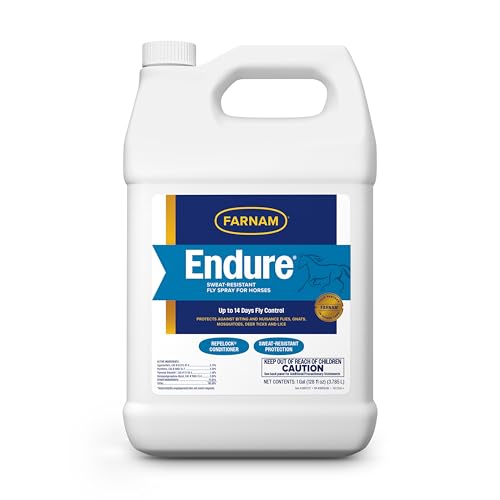
Farnam Endure, 128 oz Refill is the only 128-ounce option here, so it suits barns that want a larger refill rather than another 32-ounce spray bottle. Its protection claim matches the smaller Endure spray: Farnam says Repelock Technology binds to hair and supports coverage through sweat and weather, with up to 14 days of protection. The maker says it targets flies, gnats, mosquitoes, ticks and lice. This is a refill rather than a ready-to-use sprayer, so confirm that your application setup is compatible before choosing it.
Bottom line: Pick this when refill volume matters more than a ready-to-use spray bottle.
Farnam Repel-X, 32 oz Ready-to-Use

Farnam Repel-X, 32 oz Ready-to-Use is differentiated by its range of settings: stable, turnout and pasture environments, alongside use on horses and dogs. That makes it a straightforward choice for buyers who want one ready-to-apply product across barn routines rather than a concentrate. The available product wording also mentions a concentrate, so verify the package format before ordering if you specifically need a ready-to-use bottle.
Bottom line: Choose this for ready-to-use application across barn, turnout and pasture routines.
How to choose a horse fly spray
Choose a horse fly spray by application format, stated protection window and where you plan to use it. Ready-to-use sprays avoid dilution, while a refill or concentrate can suit a barn that already has an application routine. A longer protection claim can mean fewer planned reapplications, but weather, sweat and turnout conditions affect how a repellent performs in practice. With frequent riding or heavy sweating, prioritize a product whose maker specifically discusses sweat resistance; for convenience, choose a ready-to-use format.
Check the label for the animal and setting before use. A product intended for horses and premises is not automatically appropriate for every animal or surface, and the instructions govern application amount, frequency and precautions.
Spray and refill formats
Ready-to-use sprays require no mixing, while a refill supplies more volume for ongoing use. In this selection, the ready-to-use options are 32 ounces or 32 fluid ounces, and the refill is 128 ounces. That fourfold volume difference makes the refill the clear fit for buyers managing repeated applications, while a 32-ounce spray is easier to handle as a standalone format.
Do not assume every refill is a concentrate or can be applied directly: product formats differ. Confirm the application equipment and preparation directions on the container before use, especially when moving from a sprayer to a refill.
| Need | Format to consider | Reason |
|---|---|---|
| No dilution | Ready-to-use spray | Designed for direct application |
| More volume on hand | 128-ounce refill | Four times the volume of a 32-ounce size |
What protection-duration claims mean
Protection windows are product claims, not fixed guarantees for every horse. The products here make claims of up to 14 or 17 days, but activity, rain, sweat and label directions can change the practical reapplication schedule. A useful rule is to reassess coverage after the horse gets wet or sweats heavily rather than relying on a calendar alone.
Keep fly control broader than topical spray when insect pressure is high. Manure removal, clean feed storage and well-managed standing water reduce breeding and attractants around barns; spray alone does not remove those sources. Follow the specific label for application frequency and avoid spraying near eyes, nostrils or other sensitive areas unless the directions expressly permit it.
Safe application around horses and dogs
Apply insecticide only to animals and locations named on the product label. A spray that permits use on horses and dogs still needs species-specific directions, since application areas and precautions can differ. Keep animals away from treated areas until the label’s re-entry directions allow access, and avoid contact with eyes, mouth and broken skin.
Use sprays with good ventilation and keep them away from feed, water buckets and flames. If a horse shows irritation, stop application and rinse the area with water; seek veterinary guidance for persistent or serious reactions. Never transfer a product into an unlabeled container, since the original label contains the safety and first-aid directions.
Frequently Asked Questions
How often should I reapply horse fly spray?
Use the product label’s interval, because the products in this selection claim up to 14 or 17 days rather than a universal schedule. Reassess coverage after heavy rain or sweating, which can affect topical protection.
Can I use horse fly spray on dogs?
Only use a spray on dogs when its label expressly allows dog use. A product’s horse directions do not automatically establish a safe dog dose or application area.
Does rain wash horse fly spray off?
Rain can reduce coverage, although some formulas claim weather resistance or sweat-resistant coverage. Check the specific label and reassess after the horse gets soaked rather than assuming every spray lasts through rain.
What helps control flies besides spraying horses?
Removing manure regularly and eliminating standing water help reduce breeding sources near barns. Store feed in sealed containers to avoid attracting pests.
Should I spray a horse’s face directly?
Avoid spraying near the eyes, nostrils and mouth unless the label explicitly gives directions for those areas. Apply cautiously with a cloth if the label permits an alternate face-application method.