
AISITIN Solar Fountain Pump: 5 Models Compared

The AISITIN 3.5W Solar Fountain Pump with a separate panel suits buyers who need to place the pump away from direct sun, thanks to its 9.8-foot connecting cord. Choose a floating model instead if you want a simpler bird-bath setup without a separate panel; choose the battery model if operation beyond direct sunlight matters.
We earn a commission if you buy through links on this page. As an Amazon Associate I earn from qualifying purchases. Products are compared on manufacturer specifications, not hands-on testing.
- Best overall: AISITIN 3.5W Separated-Panel Pump – Its 3.5W panel connects to the pump by a 9.8-foot cord, allowing more flexible placement.
- Best for cloudy periods: AISITIN 3.5W Pump with 1500mAh Battery – Its built-in 1500mAh battery is claimed to support operation for up to 34 hours.
- Best for hose-fed features: AISITIN 2.5W Pump with 4-ft Hose – It includes a 4-foot flexible hose for a DIY water feature.
| Product | Best for | Panel power | Nozzles | Power setup | Shop |
|---|---|---|---|---|---|
| AISITIN 3.5W Separated-Panel Pump | Flexible placement | 3.5W | 8 | 9.8-ft cord; no battery | Check Price on Amazon |
| AISITIN 1.5W DIY Pump Kit | Compact DIY builds | 1.5W | 6 | Solar panel; no battery stated | Check Price on Amazon |
| AISITIN Floating Pump with 6 Nozzles | Simple floating setup | — | 6 | Solar powered; no battery stated | Check Price on Amazon |
| AISITIN 2.5W Pump with 4-ft Hose | Hose-fed features | 2.5W | 6 | Solar panel; 4-ft hose | Check Price on Amazon |
| AISITIN 3.5W Pump with 1500mAh Battery | Stored solar power | 3.5W | 10 | 1500mAh built-in battery | Check Price on Amazon |
AISITIN Solar Fountain Pumps
Compare the panel power, spray options and power arrangement to match a pump to your basin and sunlight.
AISITIN 3.5W Separated-Panel Pump

The separated solar panel and 9.8-foot cord distinguish this kit from the floating designs. Its 3.5W panel powers the pump without a battery or external supply, and the kit includes eight nozzles and three anti-drift brackets. It suits a shaded water feature or fish tank when the panel can sit in direct sun. The pump still needs adequate water depth and sunlight to operate; a cord does not make the pump itself suitable for dry placement.
Bottom line: Choose this kit when the pump and sunlit panel need separate locations.
AISITIN 1.5W DIY Pump Kit
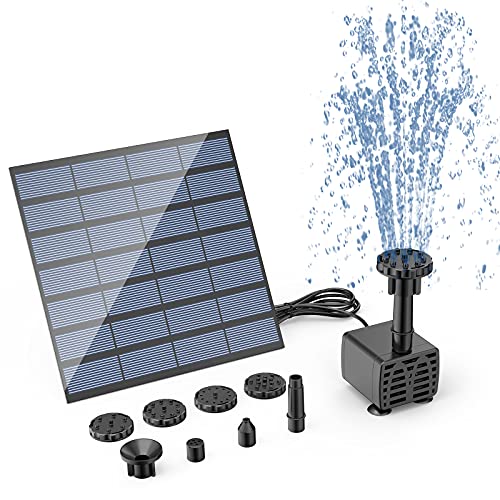
The 1.5W panel makes this the lowest-power option among these kits, and its DIY configuration is intended for bird baths, fish-tank circulation and custom water features. Six nozzles provide spray choices, while the maker says spray height depends on sunlight intensity. This is a fit for a small feature with strong sun rather than a setup needing a predictable tall jet. Since the pump relies on solar power, cloud cover and shade can reduce or stop the spray.
Bottom line: Choose it for a small, sun-exposed DIY water feature.
AISITIN Floating Pump with 6 Nozzles

The free-standing floating format sets this model apart from the separated-panel kits: it is designed to sit at the water surface rather than connect to a remote panel. Its six adjustable nozzles let buyers change spray shape and height. The maker says it starts in direct sunlight, so it is best for an uncovered bird bath or pond that receives sun. Unlike a corded setup, the floating design offers less flexibility for positioning the panel away from shade, and spray can fall off as sunlight weakens.
Bottom line: Choose it for a straightforward floating fountain in direct sun.
AISITIN 2.5W Pump with 4-ft Hose

The included 4-foot flexible hose is the distinguishing feature for buyers building a DIY water feature rather than using only a nozzle spray. The 2.5W solar panel and six nozzles give options for a bird bath, pond or patio feature without a wall outlet or external battery. It suits setups where the hose can reach the intended outlet. The maker’s service-life figure is not a guarantee of real-world run time; solar output and clean, unobstructed pump flow remain practical constraints.
Bottom line: Choose it when a short hose is useful for your feature layout.
AISITIN 3.5W Pump with 1500mAh Battery

The built-in 1500mAh battery separates this model from the other pumps, which do not specify battery storage. The maker claims up to 34 hours of operation in cloudy conditions or at night; actual operation depends on charge and conditions. The kit has a 3.5W panel, four fixers and ten nozzles, making it suitable for buyers who want spray options plus stored solar energy. A battery does not remove the need for regular sun exposure to recharge, and the pump remains dependent on water level.
Bottom line: Choose it if stored solar energy is more important than a remote panel.
How to choose an AISITIN solar fountain pump
Choose by installation layout first, then by panel power and spray options. A separated-panel pump can place its panel in sun while the pump stays in a shaded water feature; a floating model is simpler when the whole basin receives sun. Among these five, panel ratings run from 1.5W to 3.5W, but wattage alone does not tell you the spray height because sunlight, nozzle shape and water flow also matter. A measurable rule: if the panel location is more than 4 feet from the pump, select a model whose cord reaches that distance or plan a closer sunlit location. For uninterrupted operation after sunset, only the model with an explicitly described built-in battery offers that design.
Fit the fountain to the basin
Match the spray to basin width and depth before choosing a nozzle. In a shallow bird bath, a high or wide spray can send water over the rim, lowering the water level and leaving the pump exposed. Start with a narrower spray and adjust until droplets return to the basin; keep the pump intake submerged. Bird baths commonly use a shallow 1- to 2-inch water depth, while deeper ponds give more room for splash. Floating pumps need enough open water to sit level, and anti-drift supports or fixers can help keep a floating unit centered. Refill evaporated or splashed water before the intake is uncovered.
Solar power, batteries and spray expectations
Solar fountain output changes with the light reaching the panel: direct, unobstructed sun generally produces more output than cloud, shade or low-angle light. A panel rating in watts describes its rated electrical input, not a guaranteed jet height or all-day runtime. A battery stores energy for later use, but it must first receive adequate charge; a battery-free pump can stop when its panel is shaded. Nozzle openings also affect how flow appears: narrower outlets usually create a more concentrated jet, while broader patterns spread water over a larger area. Choose the setup around the hours of sun available at your yard, not only the nozzle count.
Keep a solar fountain flowing
Clean the intake and nozzle whenever spray weakens, since leaves, algae and mineral deposits can restrict a small pump quickly. Rinse removable parts with clean water and use a soft brush rather than forcing debris deeper into the intake. Hard water leaves mineral scale; periodic soaking of removable nozzle parts in diluted white vinegar can loosen deposits, followed by a thorough rinse. Do not run the pump dry: keep its inlet underwater and switch it off before cleaning or repositioning it. In freezing weather, remove and store the pump indoors after draining it, since frozen water can damage small pump components.
Frequently Asked Questions
Will a solar fountain pump work in cloudy weather?
A solar-only pump may slow or stop when clouds reduce the light reaching its panel. A built-in battery can store energy for later operation, but it needs sunlight to recharge.
How much water should a bird bath hold?
A shallow 1- to 2-inch water depth is a common target for a bird bath. Keep the pump intake submerged and adjust the nozzle if spray splashes water over the rim.
How often should I clean a solar fountain pump?
Inspect the intake and nozzle weekly during frequent use, and clean them whenever flow drops. Leaves, algae and mineral scale can clog small openings faster in warm or hard-water conditions.
Can I run a solar fountain pump at night?
A battery-free model generally needs sunlight on its panel to run. A battery model may operate after dark if it has stored enough charge, but runtime depends on charging and operating conditions.
Why does my solar fountain spray stop suddenly?
Check that the intake is underwater and free of debris, then check whether the panel has direct light. Low water, a clogged nozzle, shade or cloud cover can each reduce or interrupt flow.