
Best Cabinet Door Magnets: 5 Catches Compared

The Mousike 90-pound magnetic catch is the best choice for most people seeking cabinet door magnets because its holding force suits taller, heavier doors. Choose a slim adhesive catch instead when drilling is not an option or a low-profile fit matters.
Magnetic catches use a magnet and a matching strike plate to keep a closed door from swinging open; they do not replace a hinge or a childproof lock.
We earn a commission if you buy through links on this page. As an Amazon Associate I earn from qualifying purchases. Products are compared on manufacturer specifications, not hands-on testing.
- Best overall: Mousike 90 lb Heavy-Duty Catch – Its 90-pound magnetic force is the highest among these options and is suited to heavy doors.
- Best for no-drill installation: Jiayi 9 lb Adhesive Catch, 6 Pack – The product name specifies an adhesive, no-drill catch with a 9-pound hold.
- Best for a slim profile: Jiayi 10 lb Ultra-Thin Catch, 4 Pack – At 3.65 mm thick, this adhesive catch is the thinnest option with a holding force.
| Product | Best for | Holding force | Mounting | Pack size | Shop |
|---|---|---|---|---|---|
| Mousike 90 lb Heavy-Duty Catch | Heavy doors | 90 lb | Screws | 2 pack | Check Price on Amazon |
| Jiayi 9 lb Adhesive Catch, 6 Pack | No-drill installs | 9 lb | Adhesive | 6 pack | Check Price on Amazon |
| Jiayi 10 lb Ultra-Thin Catch, 4 Pack | Tight clearances | 10 lb | Adhesive | 4 pack | Check Price on Amazon |
| Mousike Strong Catch, 4 Pack | Screw-mounted sets | — | Screws | 4 pack | Check Price on Amazon |
| QEDT Brown Plastic Catch, 12 Pack | Multi-door projects | — | — | 12 pack | Check Price on Amazon |
Best cabinet door magnets
Compare holding force, mounting style, and package count against your door weight and available clearance.
Mousike 90 lb Heavy-Duty Catch

The Mousike 90-pound catch stands apart with the strongest hold in this group, making it the clearest match for a tall or heavy door. Each catch is stainless steel and includes mounting screws, and the maker says it is especially suitable for doors over 1.5 meters tall. The package contains two catches for doors, drawers, or wardrobes. This model is best when a strong hold matters more than a low-profile installation; its screw mounting requires holes, and the force may be excessive for a small, lightweight cabinet door.
Bottom line: Choose this for a tall, heavy door where a screw-mounted catch is acceptable.
Jiayi 9 lb Adhesive Catch, 6 Pack
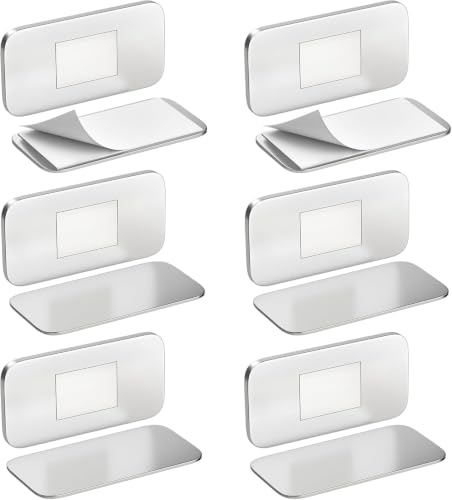
The Jiayi catch is the no-drill option here, with adhesive mounting and a 9-pound hold. The six-piece package suits several cabinet doors, and the maker describes its closure as quiet and its profile as ultra-thin. Its silver stainless-steel construction is aimed at kitchens, bathrooms, closets, and RV doors. Choose it when avoiding screw holes matters more than a high holding-force rating. The maker’s claim of a 9-pound hold is lower than the 10- and 90-pound ratings in this group, so it is a less suitable choice for a heavy panel.
Bottom line: Pick this for several light doors when you want adhesive rather than screws.
Jiayi 10 lb Ultra-Thin Catch, 4 Pack
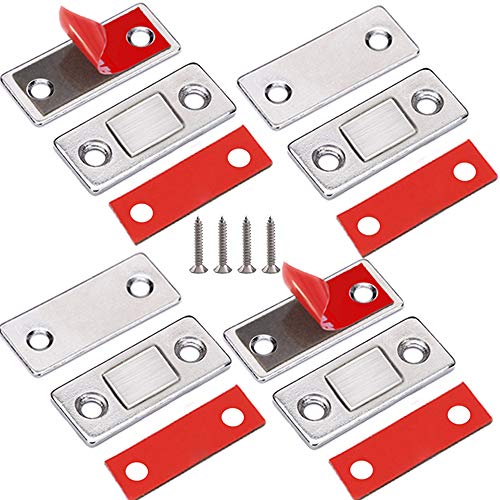
The Jiayi 10-pound catch pairs the highest hold among the slim options with a 3.65 mm profile. Its four-piece package uses adhesive, so it avoids screw holes and suits cabinet doors, drawers, lids, and sliding wardrobe doors where clearance is limited. The metal construction is described as corrosion resistant. This is a practical choice when a conventional catch would protrude too far. Adhesive mounting depends on a clean, compatible surface, and the maker’s 10-pound rating is below the 90-pound screw-mounted option for heavier doors.
Bottom line: Choose this for a tight gap where a thin adhesive catch is important.
Mousike Strong Catch, 4 Pack

The Mousike four-pack provides more screw-mounted catches per package than the two-piece heavy-duty set. Each black catch is made of stainless steel, includes dedicated screws, and is intended for cabinets, wardrobes, closets, and drawers. It suits buyers who need several screw-mounted units and can match the catch to their door by fit; anyone choosing specifically by load should use a product with a rating.
Bottom line: Select this when you need four screw-mounted catches and do not require a load rating.
QEDT Brown Plastic Catch, 12 Pack

The QEDT package has 12 catches, the largest count in this comparison, and a brown plastic body for coordinating with darker cabinet interiors. The catches are intended for cupboard doors, drawers, and shutters; the maker says they can also help keep shutters in place and prevent rattling. At 1.77 by 0.59 by 0.55 inches, the catch has a defined footprint to compare with available mounting space.
Bottom line: Use this for a multi-door project when the brown finish and 12-piece count fit.
How to choose cabinet door magnets
Match the catch’s holding force to the door’s weight and how often it is opened; the force ratings here run from 9 to 90 pounds, but those numbers are maker claims rather than a universal sizing standard. A light cabinet door generally needs less retention than a tall wardrobe panel. As a practical rule, choose a rated catch with a hold above the door’s weight and test the fit on one door before installing a set; alignment and leverage affect how secure the closure feels. Select screw mounting for a fixed, solid attachment point, or adhesive when avoiding holes is the priority. Adhesive still needs a clean, dry, compatible surface.
Clearance and catch placement
Check the space between the door and cabinet frame before choosing a catch: the Jiayi slim option measures 3.65 mm thick, while a bulkier body may interfere with a tight reveal. A magnetic catch needs its magnet and strike plate to meet squarely when the door closes; even a small offset can reduce contact. Measure the available flat mounting area and account for the door’s swing, hinges, and any frame lip. Place the catch near the opening edge rather than beside the hinge, where leverage is lower. Before fitting multiple catches, align and confirm one pair with the door closed so you do not drill repeated holes in the wrong position.
Adhesive versus screw-mounted catches
Adhesive catches avoid drilling and suit renters or finished surfaces, while screw-mounted catches provide a mechanical attachment to the cabinet or door. Adhesive performance depends on surface preparation, contact area, temperature, and load; do not rely on tape over dust, grease, loose paint, or textured finishes. Screws need a solid substrate and enough depth to avoid breaking through the door face. The options here include adhesive models rated at 9 and 10 pounds, plus screw-mounted models including one rated at 90 pounds. Use a rated screw-mounted catch for a heavy panel, and avoid treating a magnetic catch as a safety latch for children or a substitute for a lock.
Common cabinet magnet installation mistakes
Misalignment is a common reason a magnetic catch fails to hold: the strike plate should sit flat against the magnet when the door is closed. Measure twice, mark both halves with the door shut, then confirm the door opens freely before tightening screws. Another mistake is selecting by package count alone; a dozen unrated catches are not interchangeable with a single rated heavy-duty catch. Keep magnets away from small children because small hardware can present a choking hazard, and use suitable supervision during installation. For tall or heavy doors, make sure hinges carry the panel’s weight; the catch only retains the closed position and does not support the door.
Frequently Asked Questions
Can a cabinet magnet hold a heavy door closed?
A rated catch gives a better basis for a heavy door: the strongest option here is maker-rated at 90 pounds and is described for doors over 1.5 meters tall. The catch retains the closed door but does not support its weight, so sound hinges remain essential.
How thick is an ultra-thin cabinet magnetic catch?
The Jiayi ultra-thin catch measures 3.65 mm thick. Check the cabinet reveal and door swing for clearance, since the magnet and strike plate both need room to meet.
Are adhesive cabinet magnets safe for painted cabinets?
Adhesive may pull paint or finish away when removed, especially if the coating is weak or the surface is textured. Test an inconspicuous area first and use screw mounting when the finish cannot risk damage.
Where should I place a magnetic cabinet catch?
Place the catch near the door’s opening edge so the magnet has more leverage against the door swinging open. Align the strike plate directly with the magnet while the door is shut.
Do magnetic catches make cabinets childproof?
No, a magnetic catch is a closure aid, not a certified childproof lock. Use a purpose-made child safety latch for hazardous contents, and keep small catch hardware out of children’s reach during installation.