
12 Volt Circuit Breakers: 4 Models Compared by Fit

For a 12 volt circuit breaker, choose RED WOLF 60A Manual-Reset Breaker if a 60A manual-reset breaker suits the circuit; match the amp rating to the wire and load first. Choose another option if you need a 150A breaker, an automatic-reset style, or a multi-breaker pack.
These breakers open a DC circuit when current exceeds their trip limit; reset style and the protected circuit’s requirements determine the right fit.
We earn a commission if you buy through links on this page. As an Amazon Associate I earn from qualifying purchases. Products are compared on manufacturer specifications, not hands-on testing.
- Best overall: RED WOLF 60A Manual-Reset Breaker – A 60A manual-reset breaker with a 12V–48V range fits a common accessory-circuit use case.
- Best for higher current: Bolipoeq 150A Manual-Reset Breaker, 2-Pack – Its 150A rating and stated IP67 enclosure distinguish this two-pack.
- Best for manual reset: Voltrish 60A Thermal Manual-Reset Breaker – This 60A model uses a thermal mechanism and lever reset.
- Best for multiple circuits: BFXM 30A Auto-Reset Breakers, 4-Pack – The pack includes four 30A automatic-reset breakers with protective covers.
| Product | Best for | Voltage range | Reset style | Shop |
|---|---|---|---|---|
| RED WOLF 60A Manual-Reset Breaker | 60A accessory circuit | 12V–48V | Manual reset | Check Price on Amazon |
| Bolipoeq 150A Manual-Reset Breaker, 2-Pack | Higher-current circuits | 12V–48V | Manual reset | Check Price on Amazon |
| Voltrish 60A Thermal Manual-Reset Breaker | Thermal lever reset | 12V–48V | Manual reset | Check Price on Amazon |
| BFXM 30A Auto-Reset Breakers, 4-Pack | Multiple 30A circuits | — | Automatic reset | Check Price on Amazon |
12 Volt Circuit Breakers Compared
Compare the current rating and reset method with the needs of the DC circuit before choosing a breaker.
RED WOLF 60A Manual-Reset Breaker

RED WOLF 60A Manual-Reset Breaker combines a 60A rating with a manual-reset button and a 12V–48V operating range. The maker describes its housing as waterproof and says the breaker can also serve as a battery disconnect, which may suit a boat, RV, trailer, or accessory circuit where an accessible shutoff is useful. Its dimensions are 3.9 inches long, 2.7 inches wide, and 0.75 inch high. A 60A rating is only appropriate when the circuit wiring and connected equipment are protected at that level; buyers needing a different current rating should choose another breaker.
Bottom line: Choose this for a 60A circuit that calls for manual-reset and a disconnect-style button.
Bolipoeq 150A Manual-Reset Breaker, 2-Pack

Bolipoeq 150A Manual-Reset Breaker, 2-Pack is the highest-rated option here, at 150A, and comes as a two-pack. The maker gives an operating range of 12V–48V, an IP67 rating, and says it meets SAE J1625, SAE J1171, and UL 1500; those claims make verification of the specific installation requirements important, especially in marine or ignition-protected locations. A long-handle reset lever and disconnect button set it apart from the other manual-reset models. Its 150A capacity is not a general upgrade: use it only when the wire, load, and circuit design call for that rating.
Bottom line: Choose this two-pack only when the protected circuit is designed for a 150A breaker.
Voltrish 60A Thermal Manual-Reset Breaker

Voltrish 60A Thermal Manual-Reset Breaker uses a thermal breaker mechanism and a lever reset at 60A, rather than the push-button reset described for RED WOLF 60A Manual-Reset Breaker. The maker gives a 12V–48V range and describes copper conductors and studs, a thermoset plastic housing, and zinc-plated steel hardware for splash protection and corrosion resistance. Included installation hardware is specified as two 6¼-inch AWG copper lugs, four copper flat washers, and two mounting screws; the studs are ¼-28. This hardware detail may help buyers planning a compatible installation, but the product’s 60A rating still must match the wire and load.
Bottom line: Choose this if a 60A thermal breaker with a lever reset and supplied hardware suits the installation.
BFXM 30A Auto-Reset Breakers, 4-Pack
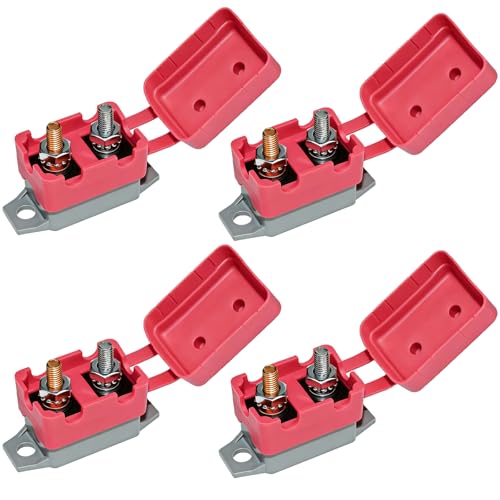
BFXM 30A Auto-Reset Breakers, 4-Pack differs from the manual-reset choices because its 30A breakers automatically reset, and the package includes four units. Each breaker uses #10-32 threaded stud terminals, with terminal stacking up to ½ inch; the maker specifies a thermoplastic housing and red protective covers. This configuration can suit buyers equipping several separate 30A circuits, rather than a single high-current circuit. The features do not give a voltage range, so confirm that the breaker’s markings and rating suit the intended DC system before installation.
Bottom line: Choose this pack for multiple circuits that need 30A automatic-reset protection.
How to choose a 12 volt circuit breaker
Choose a breaker by the protected wire’s ampacity and the circuit’s expected load, not by selecting the largest rating available. A breaker that is oversized for its wire may fail to protect the wiring; a rating that is too low can trip during normal operation. Confirm that the breaker’s DC voltage rating is at least the system voltage, and check its interrupt rating against the possible fault current where the battery connects. For motor circuits, account for brief startup surge and use a breaker appropriate to the motor circuit rather than treating running current as the only factor. If the wire size or load is unknown, identify both before selecting a breaker.
Manual-reset versus automatic reset
Manual-reset breakers require a person to restore the circuit after a trip, while automatic-reset breakers can reconnect after cooling. Manual-reset can be preferable where an unexpected restart could be hazardous or where a fault should be investigated before power returns. Automatic reset may suit circuits where continuity is useful, but repeated tripping can cause repeated cycling of connected equipment. The 30A pack here is automatic-reset; the three other choices describe manual-reset. Match the reset behavior to the equipment and location, and do not treat reset capability as a substitute for finding the cause of a trip. A breaker that trips again after reset signals a continuing overload or fault that needs attention.
Match breaker size to the circuit
Use this comparison as a starting point, then verify that the amperage protects the installed wire and suits the connected equipment. The options span 30A, 60A, and 150A, so they are not interchangeable simply because all are intended for DC systems. A 12V system commonly operates above 12V while charging; vehicle and marine charging voltages are typically around 13.8–14.7V. That makes the breaker’s DC voltage rating and intended application important, not just the system’s nominal label. Confirm the wire’s ampacity, equipment requirements, breaker voltage rating, and connection hardware before installation.
| Need | Compare | Selection check |
|---|---|---|
| Multiple smaller circuits | 30A automatic reset | Confirm each circuit and its wire are suited to 30A |
| Single 60A accessory circuit | 60A manual-reset | Verify wire ampacity and device requirements |
| Higher-current circuit | 150A manual-reset | Confirm the complete circuit is designed for 150A |
Installation and safe use
Install a breaker in the circuit it is intended to protect, with connections sized for the system’s current and installation environment. DC batteries can supply very high fault current, so disconnect power before wiring, prevent tools from bridging terminals, and use terminal covers where provided. In marine and vehicle installations, vibration, moisture, corrosion, and ignition-protection requirements can affect component choice; a waterproof claim alone does not establish suitability for every location. Use the breaker’s DC rating and any applicable equipment or vessel requirements as selection checks. If the breaker trips, remove or isolate the load and investigate the overload or short before restoring power; repeated resetting does not resolve a fault.
Frequently Asked Questions
How do I choose the breaker amperage for a 12V circuit?
Choose a rating that protects the circuit wire while accommodating the equipment’s normal current and startup surge. The rating must also comply with the equipment requirements; do not select a 150A breaker simply because it is the largest option.
Why does a circuit breaker trip when a motor starts?
A motor can draw a short startup surge above its running current, which may trip a breaker that is not suited to that circuit. Check the motor’s startup requirements and the breaker’s trip behavior rather than increasing the rating without verifying wire ampacity.
What does an automatic-reset breaker do after tripping?
An automatic-reset breaker can reconnect after it cools, unlike a manual-reset breaker that requires a person to reset it. If the underlying fault remains, it may trip and reconnect repeatedly, so isolate the load and diagnose the cause.
Can I replace a blown fuse with a circuit breaker?
A breaker can replace a fuse only when its current rating, DC voltage rating, interrupt capability, and circuit suitability match the protected wiring and equipment. A resettable breaker does not remove the need to correct an overload or short circuit.