
Vole Deterrent Castor Oil: 3 Formulas Compared

For a castor oil vole deterrent in a large container, Natural Elements Castor Oil Repellent, 1 Gallon is the most straightforward match: it comes in a 1-gallon size and is labeled for both moles and voles. Choose PetraMax Castor Oil Mole Repellent, 33.8 fl oz if you need a smaller 33.8-fluid-ounce bottle; choose Natural Elements Castor Oil Repellent, 4 Gallons if you want a four-gallon pack with a coverage rate.
Castor oil repellents are intended to discourage activity, not trap or remove voles. The best fit depends on the size of the area and the product’s coverage directions.
We earn a commission if you buy through links on this page. As an Amazon Associate I earn from qualifying purchases. Products are compared on manufacturer specifications, not hands-on testing.
- Best overall: Natural Elements Castor Oil Repellent, 1 Gallon – The 1-gallon formula is labeled for both moles and voles.
- Best for a smaller container: PetraMax Castor Oil Mole Repellent, 33.8 fl oz – The 33.8-fluid-ounce bottle is the smallest castor oil option here.
- Best for stated coverage: Natural Elements Castor Oil Repellent, 4 Gallons – The maker says one gallon treats up to 20,000 square feet.
| Product | Best for | Container size | Shop |
|---|---|---|---|
| Natural Elements Castor Oil Repellent, 1 Gallon | Large-area treatment | 128 fl oz | Check Price on Amazon |
| PetraMax Castor Oil Mole Repellent, 33.8 fl oz | Smaller container | 33.8 fl oz | Check Price on Amazon |
| Natural Elements Castor Oil Repellent, 4 Gallons | Known coverage rate | 4 gal | Check Price on Amazon |
Castor Oil Vole Deterrents
Compare the container sizes and formula claims to find an option that fits your treatment area.
Natural Elements Castor Oil Repellent, 1 Gallon
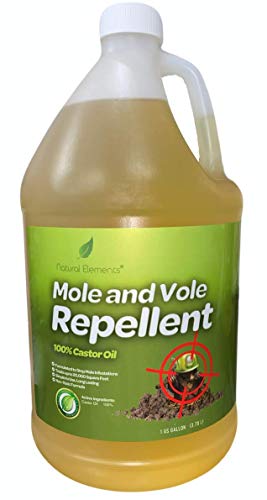
For a single large container labeled for both moles and voles, this formula comes in a 1-gallon size. The maker says it uses 100% castor oil and works gradually by affecting the animals’ senses of smell and taste. That makes it a fit for buyers who want a castor oil treatment rather than a small bottle. A repellent is not a substitute for trapping when immediate removal is the goal.
Bottom line: Choose this if you want a 1-gallon castor oil formula labeled for both moles and voles.
PetraMax Castor Oil Mole Repellent, 33.8 fl oz

The 33.8-fluid-ounce bottle is the smallest castor oil container among these matching options, making it a practical size to consider for a limited treatment area. The maker describes the formula as 100% castor oil and says it is pet-safe.
Bottom line: Pick this for a smaller bottle, after confirming the label’s vole directions and coverage.
Natural Elements Castor Oil Repellent, 4 Gallons

This four-gallon pack stands apart by giving a specific area claim: the maker says one gallon treats up to 20,000 square feet. The formula is identified as 100% castor oil, and the product is labeled for moles and voles. The rate can help estimate whether the pack suits a broad treatment area, but actual application should follow the product label. A larger supply is less useful if the lawn is small or the label’s treatment schedule does not fit your needs. The maker also calls the formula non-toxic; that claim does not replace safe handling directions.
Bottom line: Choose this if the per-gallon coverage matches your measured treatment area.
How to Choose a Castor Oil Vole Deterrent
Choose by treatment area first, then compare container size and the label’s application rate. One product here claims coverage of up to 20,000 square feet per gallon; the other matching products do not provide an area figure in the specifications. Measure the lawn or garden you intend to treat rather than estimating from the whole lot. For example, a 10,000-square-foot treatment area is half of the 20,000-square-foot rate, but that arithmetic is not a substitute for the product’s own directions. Castor oil repellents are meant to discourage activity, so they are a poor fit when the priority is immediate capture or removal. Check that the label specifically supports vole use before applying.
What Castor Oil Repellents Can and Cannot Do
Castor oil repellents are intended to make treated soil less attractive to burrowing animals; they are not traps and do not physically remove voles. Voles often feed on roots, bulbs, and bark, and their shallow surface runways can appear as narrow trails through grass. A treatment is more useful when aimed at the active area than spread without regard to signs of activity. Keep in mind that a repellent’s formula claim does not establish its application rate or how long it lasts. Those details affect how much product a site needs and whether repeat treatment is necessary. Pair any repellent approach with reducing dense ground cover near vulnerable plants, which gives voles fewer sheltered routes.
How to Plan Coverage and Apply Treatment
Use the product label’s rate and watering directions, because liquid and granular repellents can require different application steps. Start by measuring the treatment area in square feet and comparing it with the labeled coverage; the 20,000-square-foot-per-gallon claim on Natural Elements Castor Oil Repellent, 4 Gallons provides one calculation point, not a universal castor oil rate. Apply only to the area the label permits, and do not assume that a larger container means a stronger mixture. Rainfall and irrigation can affect soil treatments, so follow the label about watering and reapplication rather than improvising. Keep children and pets away during application and for the period specified by the label; a “natural” or plant-based claim is not a substitute for handling precautions.
Common Vole Deterrent Mistakes
The most common mistake is treating every hole or mound as evidence of voles; moles, voles, and other burrowing animals leave different signs and may need different management. Voles often leave surface runways and gnawing damage, while mole activity is associated with raised soil ridges. Another mistake is treating a product name as proof of coverage: only a rate can be used to estimate product quantity. Do not count on repellents alone when vegetation provides heavy cover or food; reduce dense weeds and protect vulnerable trunks or bulbs with suitable physical barriers. If damage continues, recheck the animal identification and the label’s allowed use rather than increasing concentration beyond its directions.
Frequently Asked Questions
How long does castor oil vole repellent last?
Persistence depends on the product and conditions, so use the label’s reapplication interval rather than assuming one treatment lasts a fixed number of days. Rain and irrigation can affect soil-applied products.
How much castor oil repellent covers a lawn?
Coverage depends on the specific label rate and measured area. One product here claims up to 20,000 square feet per gallon; do not transfer that rate to another formula.
Does castor oil repellent kill voles?
Castor oil repellents are intended to discourage activity, not trap or remove voles. If immediate removal is needed, consider a control method designed for capture and follow local rules.
Can castor oil vole repellent be used around pets?
Use only products whose label permits the intended setting, and follow all handling and re-entry directions. A maker’s pet-safe claim does not mean a product can be ingested or applied without precautions.
How can I tell vole damage from mole damage?
Voles commonly leave narrow surface runways and gnaw marks on plants, while moles are associated with raised soil ridges from tunneling. Identify the animal before choosing a deterrent, since the target matters.