
Best Boom Arm for Blue Yeti: 5 Arms Compared

The SUNMON boom arm with an extension tube suits most Blue Yeti setups because it adds 6.3 inches of height and supports up to 3 pounds. Choose another arm if cable routing, extra reach, or a different height target matters more; a boom arm clamps to a desk and positions a microphone above the work surface.
We earn a commission if you buy through links on this page. As an Amazon Associate I earn from qualifying purchases. Products are compared on manufacturer specifications, not hands-on testing.
- Best overall: SUNMON Extension Tube Arm – Its extension tube adds 6.3 inches of height, and its 3-pound capacity suits the microphone setup described.
- Best for cable routing: InnoGear Cable-Channel Arm – Built-in cable channels and 32.3 inches of horizontal reach suit a setup that needs managed cables and extended reach.
- Best for extra height: SUNMON 22.7-Inch Extension Arm – The extension tube raises the stand to a maximum vertical height of 22.7 inches.
| Product | Best for | Reach or height | Weight capacity | Cable management | Shop |
|---|---|---|---|---|---|
| SUNMON Extension Tube Arm | Added height | Adds 6.3 in height | 3 lb | — | Check Price on Amazon |
| InnoGear Cable-Channel Arm | Cable routing | 32.3 in horizontal reach | 3.5 lb | Built-in channels | Check Price on Amazon |
| SUNMON 22.7-Inch Extension Arm | Maximum height | Up to 22.7 in vertical | 3.5 lb | — | Check Price on Amazon |
| Upgraded Heavy-Duty Tube Arm | Hidden cable routing | — | 3.1 lb | Hidden cable management | Check Price on Amazon |
| InnoGear Folding Arm | Compact storage | — | — | — | Check Price on Amazon |
Blue Yeti Boom Arms
Compare the arms by the reach or height figures and setup features that are provided.
SUNMON Extension Tube Arm

The SUNMON arm stands out for its 6.3-inch extension tube, which adds height above the boom arm itself. Its metal construction and desk clamp are rated to hold up to 3 pounds, and the arm is described as compatible with Blue Yeti and several other microphones. That makes it a reasonable choice when the mic needs to sit higher than a basic desk arm allows.
Bottom line: Pick this arm if you need an extra 6.3 inches of height and a 3-pound capacity.
InnoGear Cable-Channel Arm

The InnoGear cable-channel arm is the option here with a 32.3-inch horizontal reach and built-in cable channels. The covers can be removed to place cables inside, and the arm moves through 135 degrees back and forth and 180 degrees up and down, with a 360-degree rotating base. Its 3.5-pound capacity gives it more headroom than the arms rated at 3 or 3.1 pounds. The larger reach is useful for moving a microphone across a desk, but it can require more clear space than a compact setup has available.
Bottom line: Choose it when cable organization and long horizontal reach are priorities.
SUNMON 22.7-Inch Extension Arm

The SUNMON arm gives a specific assembled vertical-height target: up to 22.7 inches with its extension tube. Its all-tube metal design supports microphones up to 3.5 pounds, and a 3/8-inch to 5/8-inch adapter is included for broad microphone compatibility. The maker says the design can be installed in more places than exposed-spring arms and adjusts without making a sound. This is a good fit when vertical reach is the deciding factor; the figures do not give a horizontal reach, so a wide desk span may call for another option.
Bottom line: Pick this arm when the 22.7-inch maximum vertical height fits your setup.
Upgraded Heavy-Duty Tube Arm

It includes a 3/8-inch to 5/8-inch adapter and is rated for 1.4 kilograms, or about 3.1 pounds. Three pivoting joints allow the microphone position to be adjusted. The weight rating falls below the 3.5-pound arms, which matters if the microphone and any attached accessories together approach that limit; confirm the clamp can attach securely to your desk before choosing.
Bottom line: Choose it for a tube-style arm with concealed cable routing and a 3.1-pound limit.
InnoGear Folding Arm
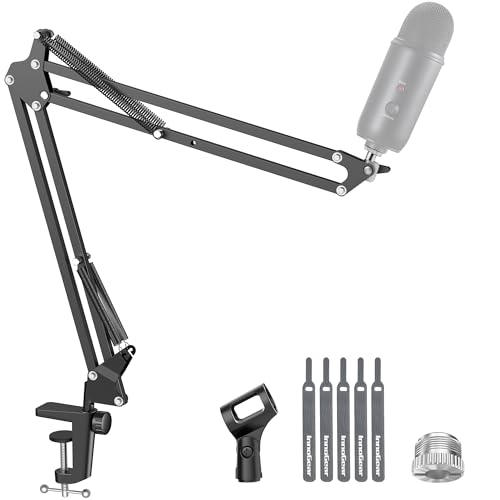
The InnoGear folding arm emphasizes repositioning and storage: its base rotates 360 degrees, the arm extends 135 degrees back and forth, and the shaft moves 180 degrees up and down. A 270-degree metal adapter offers additional microphone positioning, and the arm folds away when idle. Those movements make it a useful choice for a desk that needs to clear between recording sessions. The dimensions include a 15-inch length, but they do not establish a horizontal reach, so buyers needing a particular desk span should verify that measurement before ordering.
Bottom line: Pick this arm when folding it away and repositioning matter most.
How to choose a Blue Yeti boom arm
Start with the microphone’s combined load and the direction it needs to move. A boom arm rated for 3 pounds should support the microphone plus any attached mount or accessory only when their combined weight stays within that limit; leave some margin rather than working at the maximum. For this group, the limits range from 3 to 3.5 pounds. Then compare the dimension that matters on your desk: horizontal reach for pulling the mic toward you, or vertical height for clearing a monitor. If you need a specific span, use only an explicitly stated reach figure rather than inferring reach from an overall arm length.
Check desk and microphone fit
Confirm the clamp’s opening fits your desktop thickness and that the desk edge has room for the clamp before ordering; clamp dimensions are not consistent across arms. Microphone arms commonly use threaded mounts, and adapters bridge different thread sizes; the SUNMON and upgraded tube arm include 3/8-inch to 5/8-inch adapters. A Blue Yeti setup also needs enough clearance for the microphone body to sit above the desk without hitting a monitor or wall. Measure from the clamp point to the desired mic position, then compare that distance with the product’s reach rather than its package dimensions.
Reach, height, and cable routing
Choose a longer horizontal reach when the microphone must swing across a broad desk, and prioritize extension height when it needs to clear screens or other equipment. The InnoGear cable-channel model gives a 32.3-inch horizontal reach, while the SUNMON extension models provide explicit added or maximum vertical height. Cable routing is a separate decision: channels conceal the cable along the arm, while an arm without a routing feature may leave the cable visible. A longer arm can occupy more space while folded or extended, so check nearby shelves, walls, and monitor stands before selecting the longest reach.
| Need | Choose a feature |
|---|---|
| Long horizontal span | 32.3-inch horizontal reach |
| Added vertical clearance | 6.3-inch extension tube |
| Maximum vertical target | Up to 22.7 inches |
| Concealed cable path | Built-in or hidden cable management |
Set up and use a desk boom arm safely
Mount the clamp on a stable desk edge and keep the microphone’s total load within the arm’s capacity. A boom arm under tension can swing when joints are loosened, so hold the microphone while adjusting it and tighten the pivots before letting go. Keep the arm clear of walkways and avoid positioning it where a cable can snag or pull the clamp. Recheck the clamp and joints after repositioning; loosened hardware can let the microphone drop or the arm shift. Leave clearance above and behind the desk so the arm can fold without striking a monitor, wall, or shelf.
Frequently Asked Questions
How much weight should a Blue Yeti boom arm support?
Choose an arm whose rated capacity exceeds the combined weight of the microphone and attached accessories. The arms here are rated from 3 to 3.5 pounds, so do not assume every arm has the same margin.
Do Blue Yeti boom arms need a thread adapter?
Some arms include adapters to bridge common microphone thread sizes. Two options here include a 3/8-inch to 5/8-inch adapter; check the mount connection before ordering an arm without an adapter.
How do I measure boom arm reach for my desk?
Measure from the clamp point to the intended microphone position along the arm’s horizontal path. Allow a few inches of positioning room so the mic is not forced to sit at the arm’s maximum extension.
Where should I clamp a microphone boom arm?
Use a stable desk edge with enough flat area for the clamp and clearance for the arm to swing. Measure the desktop thickness first, since clamp opening sizes vary and a loose clamp can let the arm shift.
How can I keep a microphone arm from sagging?
Keep the microphone and accessories under the arm’s rated load and tighten the pivot joints after positioning. If the arm still drops, reduce the load or reposition the microphone closer to the support point.