
White Permanent Marker Pen for Fabric: 3 Options

For a white permanent marker pen for fabric, Gain-Art White Dual-Tip Fabric Marker is the clearest fit for dark clothes because it pairs a 1 mm fine tip with a 3 mm brush tip and claims wash resistance after drying. Choose ARTISTRO 2 White Dual-Tip Fabric Markers for a flexible brush tip and fine details, or Artline White Permanent Fabric Markers for a straightforward two-marker set intended for clothing and laundry.
We earn a commission if you buy through links on this page. As an Amazon Associate I earn from qualifying purchases. Products are compared on manufacturer specifications, not hands-on testing.
- Best overall: Gain-Art White Dual-Tip Fabric Marker – Its white formula is aimed at dark textiles, with a 1 mm fine tip and 3 mm brush tip.
- Best for varied strokes: ARTISTRO 2 White Dual-Tip Fabric Markers – The dual tips combine 1 mm detail work with a flexible brush for broader strokes.
- Best for uniforms: Artline White Permanent Fabric Markers – Its uses include uniforms, blazers, bedding, and camping gear.
| Product | Best for | Tip configuration | Fabric claim | Shop |
|---|---|---|---|---|
| Gain-Art White Dual-Tip Fabric Marker | Dark clothing | 1 mm fine, 3 mm brush | Wash-resistant after drying | Check Price on Amazon |
| ARTISTRO 2 White Dual-Tip Fabric Markers | Brush-stroke designs | 1 mm fine, flexible brush | Claims wash resistance | Check Price on Amazon |
| Artline White Permanent Fabric Markers | Clothing essentials | Thin and thick lines | Machine washable | Check Price on Amazon |
White Permanent Fabric Markers Compared
Compare the intended fabric use and tip setup to match a marker to your design and garment.
Gain-Art White Dual-Tip Fabric Marker

For dark garments and stain coverage, this white set combines a 1 mm fine tip with a 3 mm brush tip. Gain-Art says its opaque white paint is intended to show on dark textiles and resist fading, cracking, and washing once dry. The material range includes denim, canvas, cotton, leather, and upholstery, so it suits clothing repairs as well as craft designs. The set contains two markers. Its focus is broad fabric compatibility rather than a single fabric type; test a small hidden area first, especially on textured or coated materials, where coverage can look different.
Bottom line: Choose this set when white coverage on dark fabric and two tip widths matter most.
ARTISTRO 2 White Dual-Tip Fabric Markers

For expressive lines and shaded areas, this two-marker set pairs a 1 mm fine tip with a flexible brush tip. ARTISTRO says the fabric paint dries quickly, resists bleeding, and is designed to retain color through repeated washing. The uses include clothes, sneakers, bags, shoes, textiles, and canvas, giving it a broad craft-and-wearable focus. The brush tip is the distinguishing feature for varied stroke widths; the maker does not give its exact width. On porous fabric, plan the design with a scrap layer or cardboard inside the garment to keep paint from transferring through.
Bottom line: Pick this set for designs that mix fine outlines with flexible brush strokes.
Artline White Permanent Fabric Markers
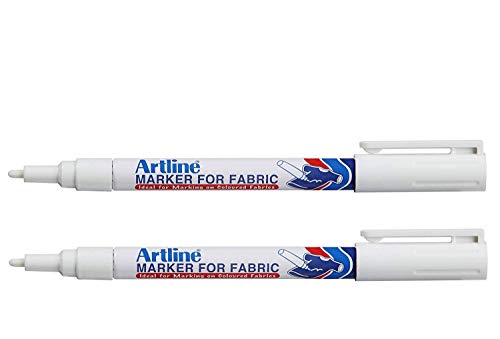
For everyday clothing and gear, Artline describes these two white markers as fabric-specific and suitable for laundry. The ink is described as fade-resistant and machine washable, and the uses include uniforms, blazers, camping gear, and bedding. Fabric texture and color can affect how white ink appears; try the marker on an inconspicuous spot before marking a visible area.
Bottom line: Choose these for labeling or decorating clothing and household fabric without needing a specified tip width.
How to Choose a White Fabric Marker
Choose by tip, intended material, and the maker’s wash claims rather than by the word permanent alone. A fine tip is useful for lettering and outlines; a brush tip covers broader strokes, but its width and flexibility affect how much control you have. White ink on dark fabric often needs strong opacity, so select a marker whose use includes dark textiles if visibility is the priority. Before drawing, wash new fabric to remove finishes, let it dry completely, and place cardboard between garment layers. That prevents transfer to the back. Test a small hidden patch first, since weave, texture, and fabric color change the appearance of white marks.
Preparing Fabric and Setting the Ink
Prepare the fabric clean, dry, and flat so ink does not spread unpredictably across wrinkles or residues. Put a piece of cardboard or scrap material beneath the working layer, especially on thin shirts and bags. Allow the mark to dry fully before folding or stacking the fabric; quick-dry claims do not mean the ink is ready for immediate laundering. Wash resistance and any required curing method differ by marker, so use only the care steps stated for the exact product. Do not iron directly over a mark unless its instructions specifically allow heat setting. If the item will be washed often, test a sample through a wash cycle before decorating the visible area.
White Fabric Marker Uses by Need
Use a dual-tip marker when a project combines small lettering with larger filled areas, and favor a fabric-specific marker when laundering is part of normal garment care. A general-purpose paint marker may write on canvas or leather but is not automatically interchangeable with a textile marker on washable clothing. The material and care need should decide the choice; surface compatibility alone does not guarantee a lasting garment mark. The table matches common needs to the relevant feature to prioritize.
| Need | Feature to prioritize |
|---|---|
| Lettering or small outlines | Fine tip, around 1 mm |
| Broad strokes and fill areas | Brush tip |
| Dark garments | Opaque white ink intended for dark textiles |
| Frequently washed clothing | Fabric-specific, wash-resistant claim |
Common Fabric Marker Mistakes
Skipping a fabric test is a common mistake because ink can look different on a smooth cotton weave than on denim, canvas, or a coated surface. Use under 1 mm lettering only when the marker tip supports that level of control; otherwise, choose larger lettering to avoid uneven lines. Another mistake is drawing through multiple layers without a barrier, which can leave a mirrored mark on the reverse side. Avoid washing before the ink has dried and any required setting period has passed. Do not assume a paint marker made for hard surfaces will remain flexible or wash-resistant on clothing; verify that garment use is specifically intended before using it on a frequently laundered item.
Frequently Asked Questions
Do white fabric markers work on black clothes?
Some are formulated for dark textiles, but opacity depends on the ink and the fabric surface. Choose a marker explicitly aimed at dark clothing and test a hidden patch before making a visible design.
How long should fabric marker ink dry before washing?
Let the ink dry completely before washing, and follow the product’s specific curing direction if it gives one. A quick-dry claim refers to surface drying and does not establish a universal wash-ready time.
Can fabric markers be used on denim and canvas?
Many fabric markers are intended for denim or canvas, but coverage varies with weave and texture. Test a small area first, and use cardboard beneath the layer to prevent bleed-through.
Should I wash fabric before using a permanent marker?
Wash new fabric first when practical to remove sizing or finishing residue, then dry and smooth it before marking. A clean, flat surface makes the ink easier to apply evenly.
Can I iron over a white fabric marker design?
Only iron over the design if the marker’s care directions allow heat setting. Keep a barrier between the iron and the ink unless direct contact is expressly permitted.