
Stanley 1200 Jump Starter: 3 Models Compared

For a built-in tire inflator, choose Stanley J5C09D 1200A: its 120 PSI compressor shuts off at a selected pressure. Choose Stanley LJ12FC 1200A Lithium if a 1-pound lithium unit matters more; its compact design omits the inflator feature highlighted in Stanley J5C09D 1200A.
The non-Stanley 9000A Jump Starter with Compressor is a related alternative with a higher peak-amp figure and a 160 PSI compressor, but it is a different brand and type of power unit.
We earn a commission if you buy through links on this page. As an Amazon Associate I earn from qualifying purchases. Products are compared on manufacturer specifications, not hands-on testing.
- Best overall: Stanley J5C09D 1200A – Its 120 PSI inflator adds tire inflation to a 1200-peak-amp jump starter.
- Best for portability: Stanley LJ12FC 1200A Lithium – The lithium jump starter weighs 1 pound and includes USB-A and USB-C charging.
- Best for higher peak amps: 9000A Jump Starter with Compressor – The alternative combines a 9000A peak rating with a 160 PSI compressor.
| Product | Best for | Peak amps | Inflator | Weight | Shop |
|---|---|---|---|---|---|
| Stanley J5C09D 1200A | Built-in inflation | 1200 A | 120 PSI | 14.6 lb | Check Price on Amazon |
| Stanley LJ12FC 1200A Lithium | Lightweight carrying | 1200 A | — | 1 lb | Check Price on Amazon |
| 9000A Jump Starter with Compressor | Higher peak rating | 9000 A | 160 PSI | 2.2 lb | Check Price on Amazon |
Stanley 1200 jump starters and alternatives
Compare the built-in air tools, portability, and charging features before choosing a roadside power unit.
Stanley J5C09D 1200A

Unlike the compact lithium model, the J5C09D combines 1200 peak amps with a digital air inflator. The compressor reaches 120 PSI, lets you set a target pressure, and shuts off automatically when it reaches that target. The unit also has three 3.1A/15W USB-A ports, an LED area light, and reverse-polarity warning protection. Stanley says it works with 12V wet, gel, and AGM lead-acid batteries and most 4-, 6-, and 8-cylinder cars and trucks. Its 14.6-pound weight matters if you want a unit that is easy to carry for longer distances.
Bottom line: Choose this if you want a jump starter with a built-in tire inflator.
Stanley LJ12FC 1200A Lithium
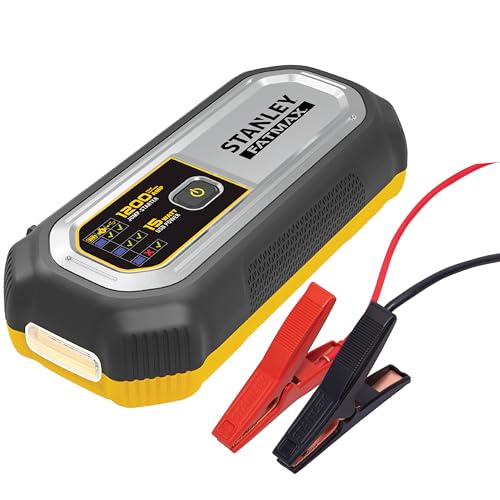
The LJ12FC is the lighter Stanley option at 1 pound, compared with the J5C09D’s 14.6 pounds. It is a lithium jump starter with 1200 peak amps and USB-A and USB-C charging rated at 15 watts. An included AC adapter handles recharging, while a screen shows charging status and a smart start controller provides reverse-polarity protection. Stanley says it works with 12V AGM, gel, and wet-cell batteries and most cars or trucks up to 8 cylinders. The tradeoff is that its feature set does not include an air compressor, so it is not the match for buyers who want tire inflation in the same unit.
Bottom line: Choose this if low carry weight and USB-C charging matter most.
9000A Jump Starter with Compressor

This non-Stanley unit is a different type of alternative: its feature set pairs a 9000A peak jump starter with a 160 PSI air compressor and a digital tire-pressure gauge. The name also identifies a 65W USB-C charging feature, and the weight converts to about 2.2 pounds. Its engine range is all gas and up to 14L diesel, unlike the Stanley units’ stated 4- to 8-cylinder fit. The tradeoff is that it is not a Stanley 1200-amp model, so it suits someone comparing broader roadside functions rather than seeking the Stanley name or rating.
Bottom line: Choose this only if you want the higher peak-amp rating and compressor combination.
How to choose a Stanley 1200 jump starter
Choose by the feature you will use beyond jump-starting: the J5C09D adds air inflation, while the LJ12FC prioritizes low weight and USB-C charging. Peak amps are a starting-current rating, not the same thing as a battery’s cold-cranking amps (CCA); the 1200A figure alone does not provide a CCA comparison. Check that the vehicle uses a compatible 12V lead-acid battery, since both Stanley models identify wet, gel, and AGM compatibility. If you expect to carry the unit far from the vehicle, the 1-pound lithium option is easier to transport than a 14.6-pound unit. For tire top-offs, the J5C09D’s automatic shutoff is useful; set the target to the vehicle maker’s recommended cold-tire pressure rather than the tire’s maximum sidewall pressure.
What the peak-amp rating tells you
Peak amps indicate a brief maximum current, so they are not a direct measure of how long a jump starter can supply power. Cold-cranking amps measure current under a defined cold-temperature test, and the two ratings should not be compared as if they were interchangeable. For a purchase decision, first match the unit’s vehicle and battery compatibility, then consider whether its other functions justify its size. Both Stanley options state 1200 peak amps and compatibility with 12V wet, gel, and AGM batteries. A jump starter still needs a charged internal battery and properly connected clamps; reverse-polarity warnings help flag an incorrect connection but do not replace careful polarity checks. Keep metal tools away from the battery terminals to avoid a short circuit.
Jump starter features compared
For integrated inflation, the J5C09D is the Stanley choice; for a lighter carry, the LJ12FC is the Stanley choice. The comparison below also includes a non-Stanley alternative because its compressor and much higher peak-amp figure make it a different fit.
| Need | Choice | Decision point |
|---|---|---|
| Inflate tires onboard | Stanley J5C09D | 120 PSI compressor with automatic shutoff |
| Minimize carry weight | Stanley LJ12FC | 1 pound; no inflator feature identified |
| Higher peak rating and compressor | 9000A alternative | 160 PSI compressor; not a Stanley 1200 model |
Air compressors can heat up during use, and repeated inflation can take longer than a single tire top-off. Use the compressor’s gauge to monitor pressure and stop at the vehicle maker’s recommended cold pressure. A tire’s sidewall maximum is a limit, not the usual inflation target.
Safe clamp connection and storage
Connect jumper clamps only to the vehicle’s designated positive and negative points, and keep the clamps from touching each other. Reverse-polarity protection is a warning feature, not permission to ignore the connection sequence; use the vehicle and jump starter instructions for the correct order. Do not jump-start a battery that is cracked, leaking, or visibly damaged, because damaged batteries can release acid or gas. Store a jump starter in a dry place and recharge it periodically so it is ready when needed; lithium and lead-acid power units can have different storage and charging requirements. Keep the unit secured in the vehicle rather than loose where it can become a projectile during sudden braking.
Frequently Asked Questions
Are 1200 peak amps enough for a car?
Both Stanley models identify 1200 peak amps and say they can start most cars and trucks up to 8 cylinders. Confirm that your vehicle’s battery is 12V wet, gel, or AGM lead-acid, the chemistries these models identify.
What is the difference between peak amps and CCA?
Peak amps are a brief maximum-current figure, while cold-cranking amps measure current under a defined cold-temperature test. Do not use a 1200 peak-amp rating as though it were a CCA rating.
Can a jump starter inflate a flat tire?
Only a model with an integrated compressor can inflate tires; the J5C09D has a 120 PSI digital inflator with automatic shutoff. It is intended for inflation, not repair of a puncture or damaged tire.
How often should a portable jump starter be recharged?
Recharge a jump starter after use and check its charge periodically during storage; the interval depends on its battery and self-discharge rate.
Can I use a jump starter on a 24V vehicle?
No; both Stanley models are identified for 12V batteries, not 24V systems. Using a 12V jump starter on a 24V vehicle risks damage, so verify the vehicle system voltage before connecting.