
Ultrasonic Cleaner for Eyeglasses: 4 Models Compared

For most eyeglass owners, onlikin 35W Ultrasonic Cleaner is the best starting point because its 45 kHz cleaner combines three power levels with five timed cycles. Choose OSLTWI 48 kHz Ultrasonic Cleaner instead if you want a smaller tank and simpler two-cycle operation.
Ultrasonic cleaners use high-frequency sound waves to create bubbles that dislodge soil from hard-to-reach surfaces. They are not suitable for every pair of glasses: check lens and frame maker guidance first, especially for coated lenses, glued parts, or loose components.
We earn a commission if you buy through links on this page. As an Amazon Associate I earn from qualifying purchases. Products are compared on manufacturer specifications, not hands-on testing.
- Best overall: onlikin 35W Ultrasonic Cleaner – Three power levels and five timed cycles give more adjustment than the two-mode alternatives.
- Best for compact storage: OSLTWI 48 kHz Ultrasonic Cleaner – Its 350 mL tank and 8.35-inch length are smaller than the larger tanks in this group.
- Best for five preset modes: Magnasonic 20 oz Ultrasonic Cleaner – Five cleaning cycles let you select from quick to deep-clean durations.
| Product | Best for | Frequency | Tank capacity | Cleaning modes | Shop |
|---|---|---|---|---|---|
| onlikin 35W Ultrasonic Cleaner | Adjustable cleaning | 45 kHz | 20 oz | 5 timers, 3 power levels | Check Price on Amazon |
| OSLTWI 48 kHz Ultrasonic Cleaner | Simple operation | 48 kHz | 350 mL | 2 cycles | Check Price on Amazon |
| Magnasonic 20 oz Ultrasonic Cleaner | Five preset cycles | 42 kHz | 20 oz | 5 modes | Check Price on Amazon |
| KUNPHY 48 kHz Ultrasonic Cleaner | Quiet compact use | 48 kHz | 400 mL | 2 modes | Check Price on Amazon |
Ultrasonic Cleaners for Eyeglasses
Compare frequency, tank capacity, and cycle controls, then verify that your lenses and frames are compatible with ultrasonic cleaning.
onlikin 35W Ultrasonic Cleaner
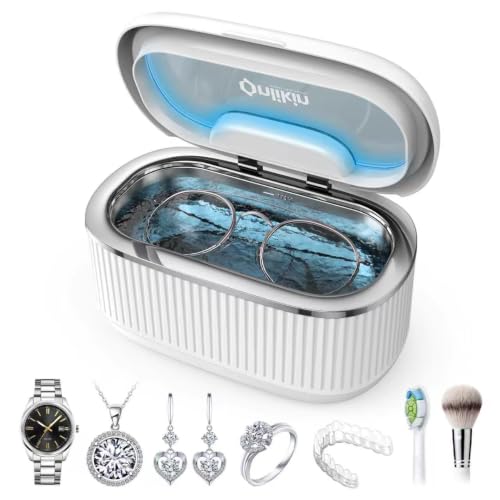
Three power levels set this cleaner apart for buyers who want more adjustment than a simple timed cycle. The 45 kHz unit has a 20-ounce 304 stainless-steel tank, digital touch controls, and five presets: 90, 180, 300, 420, and 480 seconds. The maker says its output is below 38 dB and describes the waves as suitable for lifting dirt from crevices. Its larger tank suits people cleaning more than one small item at a time, but the specifications do not give tank dimensions; confirm that your frames fit before ordering.
Bottom line: Pick it if adjustable power and multiple cycle lengths matter more than a compact footprint.
OSLTWI 48 kHz Ultrasonic Cleaner

A 350 mL tank and two straightforward cycles distinguish this model from the larger, more adjustable options. The 304 stainless-steel basin measures 8.35 by 4.21 by 2.83 inches, and the cleaner offers 5-minute gentle and 7-minute intensive settings. The maker says water alone can be used and that the unit pauses when a cycle ends. That simpler control scheme may suit someone who wants a short routine without choosing among many presets; buyers needing multiple power levels should consider another model.
Bottom line: Choose it for a smaller basin and uncomplicated two-cycle operation.
Magnasonic 20 oz Ultrasonic Cleaner

Five cleaning modes make this model the most cycle-focused option among the units with a 20-ounce tank. Its 42 kHz ultrasonic system uses a stainless-steel basin, and the maker says it is intended for eyeglasses as well as jewelry, watches, and retainers. The maker also notes that the cleaner does not remove tarnish, a useful limitation if you are considering it for jewelry as well as glasses. At 8.2 by 5.8 by 5.4 inches, it takes more room than the smallest unit here.
Bottom line: Pick it if five preset cleaning modes are your priority.
KUNPHY 48 kHz Ultrasonic Cleaner

The 400 mL tank is larger than the 350 mL basin in OSLTWI 48 kHz Ultrasonic Cleaner, while this cleaner keeps operation to two one-touch modes. The 48 kHz unit measures 7 by 3 by 3 inches and offers 5- and 10-minute cycles. The maker says operation stays below 45 dB and describes the unit as suitable for glasses and retainers. Its narrow 3-inch width can fit a tighter counter space, but it has no adjustable power levels, so buyers who want to tailor intensity should look at onlikin 35W Ultrasonic Cleaner.
Bottom line: Choose it for a slim body, 400 mL tank, and two simple cycle choices.
How to Choose an Ultrasonic Cleaner for Eyeglasses
Start with lens and frame compatibility, then compare tank size and cycle controls. Ultrasonic units commonly operate around 40 kHz; these models span 42 to 48 kHz, but frequency alone does not establish whether a particular lens coating or frame is safe to clean. Prefer a basin long and wide enough for glasses to sit without touching its walls, and choose adjustable power if you also clean delicate small items. A practical decision rule: if the manufacturer of your lenses or frames advises against ultrasonic cleaning, do not place them in the machine. A basket helps keep items off the tank floor and reduces contact with the vibrating basin; do not overcrowd it.
Which Eyeglasses Are Safe to Clean Ultrasonically
Use an ultrasonic cleaner only when the glasses’ manufacturer permits it, because lens coatings, glued components, and older or damaged frames can be vulnerable. Ultrasonic energy can loosen screws or bonding and can harm some coatings, so avoid using a cleaner on visibly peeling lenses, loose parts, or frames made from materials the maker excludes. Do not assume that a sturdy metal frame makes its lenses safe. If compatibility is unclear, use the eyewear maker’s recommended cleaning method instead. Never put contact lenses in an ultrasonic cleaner; these devices are intended for durable objects, not lenses worn directly on the eye. Remove glasses promptly after the cycle and dry them with a clean microfiber cloth.
How Tank Size and Cleaning Cycles Affect Fit
Choose tank dimensions by the size of the whole frame, not just by its volume rating. A 20-ounce basin offers more room than a 350 mL basin, but shape matters: a wide frame may need more length, while tall lenses need adequate depth. The four cleaners here range from 350 to 400 mL and offer two to five programmed modes. Short cycles are a sensible starting point for compatible eyewear; a longer cycle is not automatically safer or more effective. Keep frames separated from other objects so they do not rub together, and avoid placing items directly on the tank bottom if the cleaner includes a basket. Rinse and dry glasses after cleaning to remove loosened residue.
Ultrasonic Cleaning Mistakes to Avoid
Do not run incompatible glasses for extra time in an attempt to remove stubborn dirt. Long exposure cannot make a coating or adhesive compatible with ultrasonic energy, and repeated cleaning can increase the risk of damage. Avoid harsh household chemicals unless both the eyewear maker and cleaner maker approve them; a liquid that is safe for a tank may not be safe for a lens coating. Water is the simplest starting fluid when the device permits it. Do not use a machine with loose or damaged glasses, and keep electrical controls and plugs dry. A useful need-to-choice rule is to select a low-power setting for compatible delicate items and reserve longer or stronger modes for durable pieces whose makers permit ultrasonic cleaning.
Frequently Asked Questions
Can I clean prescription glasses in an ultrasonic cleaner?
Only if the eyewear maker says the lenses and frame are compatible. Coatings and glued components can be damaged, so avoid ultrasonic cleaning if a lens is peeling or a frame part is loose.
How long should eyeglasses stay in an ultrasonic cleaner?
Start with the shortest cycle permitted by the glasses’ manufacturer and cleaner instructions. The models here offer cycles as short as 90 seconds, but that setting does not make incompatible eyewear safe.
Should I add soap to an eyeglass ultrasonic cleaner?
Use only a cleaning liquid approved for both the ultrasonic unit and the eyewear. Plain water is a cautious starting choice when the device allows it; avoid household solvents or abrasive cleaners that may damage coatings.
Can an ultrasonic cleaner loosen glasses screws?
Yes, vibration can loosen small components, especially on glasses that already have loose screws or damaged joints. Check the frame before cleaning and do not use the machine if parts are unstable.
Can I put two pairs of glasses in one cleaning cycle?
Only if both pairs fit with space between them and neither touches the tank walls or the other pair. Crowded items can rub together, and each pair must independently be approved for ultrasonic cleaning.