
Ram Golf Pro Spin 3 Wedge Set: Fit and Specs

The Ram Golf Pro Spin 3 wedge set suits golfers seeking three standard loft gaps—52°, 56°, and 60°—with graphite regular-flex shafts. Choose another set if you need left-handed clubs or prefer steel shafts or full-face grooves.
We earn a commission if you buy through links on this page. As an Amazon Associate I earn from qualifying purchases. Products are compared on manufacturer specifications, not hands-on testing.
- Best overall: Ram Golf Pro Spin 3 Wedge Set – Its 52°, 56°, and 60° wedges use graphite regular-flex shafts and standard-size grips.
- Best for left-handers: Orlimar Spin Tech FF Left-Handed Set – The 52°/56°/60° set is explicitly left-handed and has full-face grooves.
- Best for steel shafts: Cobra Tour Trusty 3-Wedge Set – The set pairs 52°/56°/60° lofts with steel shafts.
| Product | Best for | Hand | Shaft | Shop |
|---|---|---|---|---|
| Ram Golf Pro Spin 3 Wedge Set | Graphite shafts | Right hand | Graphite, regular flex | Check Price on Amazon |
| Orlimar Spin Tech FF Left-Handed Set | Left-handed play | Left hand | — | Check Price on Amazon |
| Cobra Tour Trusty 3-Wedge Set | Steel-shaft preference | — | Steel | Check Price on Amazon |
| Yamato Full Face 52°/56°/60° Set | Forgiveness features | Right hand | — | Check Price on Amazon |
| Pinemeadow 52°/56°/60° Wedge Set | Expanded face area | Right hand | Steel, regular | Check Price on Amazon |
Ram Golf Pro Spin 3 Wedge Set Alternatives
Compare the three-wedge sets by loft progression, hand, shaft, and the face or sole design each emphasizes.
Ram Golf Pro Spin 3 Wedge Set
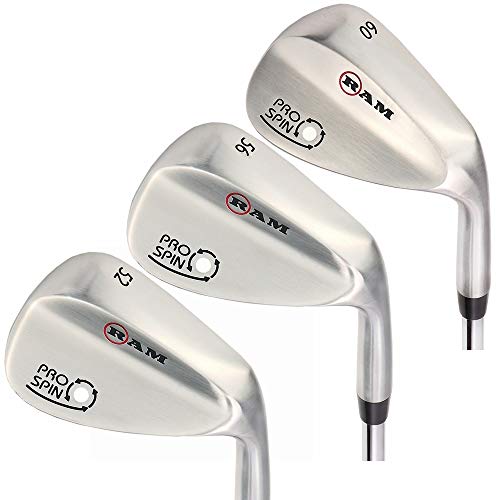
Graphite shafts distinguish this 52°/56°/60° set from the steel-shafted alternatives. The stainless steel heads come with regular-flex graphite shafts and standard-size grips; the 52° gap wedge has 8° bounce, the 56° sand wedge 10°, and the 60° lob wedge 8°. It fits right-handed golfers looking for three wedges spanning common gap, sand, and lob roles. The loft steps are 4° apart, but golfers matching wedges to an existing set should compare actual carry distances, since loft alone does not ensure even yardage gaps.
Bottom line: Choose this set if you want graphite regular-flex shafts and these three lofts.
Orlimar Spin Tech FF Left-Handed Set

The left-handed orientation and full-face groove pattern set this 52°/56°/60° group apart. Orlimar says grooves extend across the face for open-face shots, while laser-engraved micro-grooves are designed to add face texture. The C-shaped sole and toe weighting are also part of the design. This is a relevant alternative for a left-handed golfer wanting a broad grooved hitting area for flop shots and recovery shots. The fields do not identify shaft material, so golfers who require graphite or steel should confirm that before choosing.
Bottom line: Choose this if you play left-handed and want full-face grooves.
Cobra Tour Trusty 3-Wedge Set

Steel shafts and sole-grind details distinguish this set from the graphite-shafted Ram option. The set includes 52°, 56°, and 60° wedges; the maker says the 52° bridges short irons, while the 56° and 60° support varied lie and sand conditions. Cobra says the latter two have full-face grooves, and describes a trailing-edge notch intended to lower the leading edge toward the turf. It suits golfers seeking a steel-shafted trio with those sole features.
Bottom line: Choose this if steel shafts and the sole-grind features fit your needs.
Yamato Full Face 52°/56°/60° Set
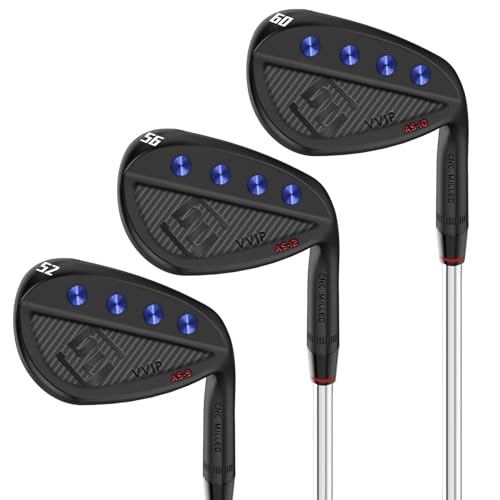
A right-handed configuration and a leading-edge design aimed at reducing digging distinguish this forged stainless-steel set. Yamato describes full-face grooves and a milled face, with a set of 52°, 56°, and 60° wedges. Its design focus is forgiveness on miss-hits and distance control, making it a possible fit for right-handed golfers who prioritize those features.
Bottom line: Choose this if you want right-handed wedges emphasizing full-face grooves.
Pinemeadow 52°/56°/60° Wedge Set
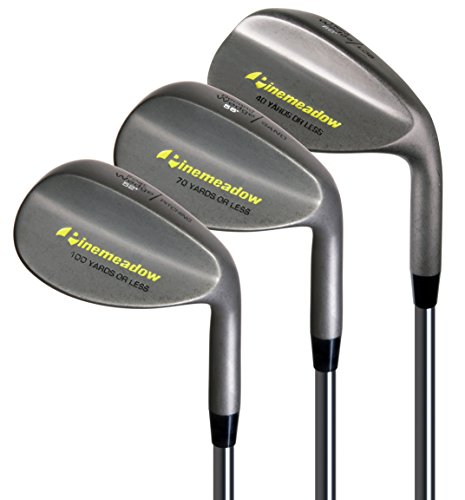
The expanded face area and dark-gray finish distinguish this right-handed steel set. That makes it a relevant alternative for golfers who want a larger-face design and steel construction in the same three-loft progression. Unlike the Ram set, the features do not break out bounce by wedge, so golfers choosing around sole interaction should not assume the bounce matches.
Bottom line: Choose this if you prefer regular steel shafts and a larger-face design.
How to choose a 52°/56°/60° wedge set
Start with carry gaps, not the number of clubs: a useful target is about 10 to 15 yards between full-swing wedges. Loft steps of 4° do not guarantee that separation, because shaft length, swing speed, and strike all affect carry. Compare the 52° wedge with your shortest iron and the next wedge above it; a gap that overlaps or leaves a large yardage hole is a reason to adjust the loft progression. For partial shots, also consider whether you want a repeatable set of swing lengths rather than relying on one wedge for every short shot.
Bounce and sole shape matter most when the club meets turf or sand. As a practical starting point, 8° to 10° of bounce covers many general-purpose conditions; firmer ground and shallow delivery often suit less bounce, while soft turf or a steep delivery can call for more. Match the wedge configuration to your common lies, not just the loft labels.
What wedge bounce and sole shape change
Bounce is the angle between the sole and the ground when the club is set, and it helps keep the leading edge from digging. Lower bounce can suit firm turf or a shallow swing; higher bounce can help in soft sand and for golfers with a steeper attack. These are starting points, not fixed rules, because sole width and grind also change how a wedge moves through the ground.
Full-face grooves are intended to keep grooves under the ball when the face is opened or contact moves toward the toe. They do not remove the need to match loft and sole to the shot: a lob wedge with a square face and one opened wide can expose different parts of its sole. Practice from your usual lies before depending on an open-face shot in a round.
Wedge set designs compared
Choose the design around the shots and club build you actually need. The table separates the major design choices represented among these wedge sets; it does not predict a golfer’s distance or spin.
| Design choice | Useful when | Check before choosing |
|---|---|---|
| Graphite shaft | You prefer a graphite build | Flex and feel relative to your other clubs |
| Steel shaft | You want a steel-shafted wedge | Shaft flex and weight |
| Full-face grooves | You often open the face or strike toward the toe | Sole shape and loft for the intended shot |
| Specified bounce | You want to match sole angle to turf and sand | Typical lies and delivery style |
A wedge set is not automatically a matched fit for every iron set. The lofts can be identical while shaft weight, length, lie angle, and grip differ, so check the transition into your existing clubs.
How to build safer short-game practice
Practice wedges in a clear area with enough room for the full swing and a safe ball-flight path. A golf ball can travel well beyond a practice net or target, so never aim toward people, roads, windows, or other occupied areas. Start with half swings before full swings, especially when learning a 60° wedge, where a steep or open-face delivery changes launch quickly.
Use repeatable carry targets such as 30, 50, and 70 yards, and record which swing length reaches each one. The exact distances depend on the golfer, so build a personal chart rather than assuming a loft produces a fixed yardage. Brush the turf or sand only after checking that the landing area and surrounding space are clear.
Frequently Asked Questions
How far apart should wedge lofts be?
A common setup uses 4° to 6° between wedges, but carry gaps matter more than loft gaps. Aim for roughly 10 to 15 yards between full-swing clubs, then adjust based on actual carry.
What bounce is best for soft sand?
Higher bounce, often around 10° or more, is a useful starting point in soft sand because the sole resists digging. Sole width and swing delivery also affect how the club moves through the sand.
When should a golfer open a lob wedge?
Open a lob wedge when you need extra launch or a shorter carry with more stopping room, provided the lie is clean enough for the face to slide under the ball. Opening the face also changes the effective loft and exposes more sole bounce.
How can I check wedge carry gaps?
Hit several full shots with each wedge and compare the typical carry, not the longest shot. A gap of about 10 to 15 yards is a common target; adjust the loft makeup or use partial swings if neighboring clubs overlap.
Do full-face grooves matter on open shots?
Full-face grooves keep groove coverage across more of the face when it is opened or contact shifts toward the toe. They do not replace a suitable loft and sole shape for the lie.