
Type F Plug Adapter Options Compared for Travel

For a Type F plug adapter with several charging connections, TESSAN Type E/F Adapter, 4 Outlets combines four outlets with three USB ports; choose a simpler plug-only adapter if you need multiple adapters or want to avoid built-in USB charging.
Type F, often paired with Type E sockets as Type E/F, is a wall-plug format used in much of continental Europe. An adapter changes plug shape, not voltage, so check each device label for 100–240V compatibility before connecting it to a 220–250V supply.
We earn a commission if you buy through links on this page. As an Amazon Associate I earn from qualifying purchases. Products are compared on manufacturer specifications, not hands-on testing.
- Best overall: TESSAN Type E/F Adapter, 4 Outlets – Four outlets and three USB ports, including USB-C, provide connections for up to seven devices.
- Best for spare adapters: Amazon Basics Type E/F Adapter, 3-Pack – The three-pack supplies basic Type E/F plug adapters without built-in USB ports.
- Best for USB-C ports: Type E/F Adapter, 3 Outlets – Four USB ports, including two USB-C, accompany three outlets.
| Product | Best for | Outlets | USB ports | Pack size | Shop |
|---|---|---|---|---|---|
| TESSAN Type E/F Adapter, 4 Outlets | Multiple devices | 4 | 3 (1 USB-C) | 2-pack | Check Price on Amazon |
| Type E/F Adapter, 2 Outlets | Compact charging | 2 | 3 (2 USB-C) | 1 | Check Price on Amazon |
| Type E/F Adapter, 3 Outlets | More USB-C | 3 | 4 (2 USB-C) | 2-pack | Check Price on Amazon |
| Amazon Basics Type E/F Adapter, 3-Pack | Multiple destinations | 1 | — | 3-pack | Check Price on Amazon |
Type F Plug Adapters
Compare outlet count, USB connections and pack size to match your devices and travel setup.
TESSAN Type E/F Adapter, 4 Outlets
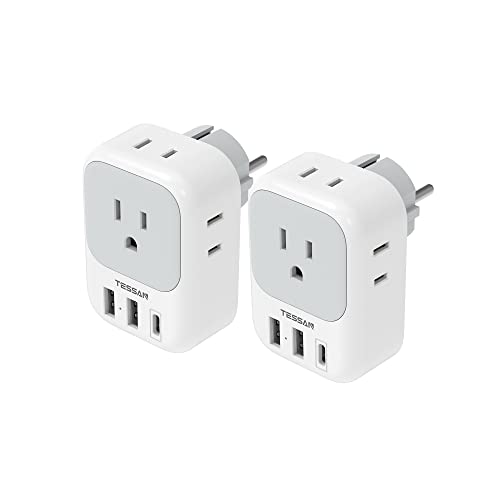
TESSAN Type E/F Adapter, 4 Outlets has four American outlets, more than the two- and three-outlet options here, alongside three USB ports including one USB-C port. Its maker says the USB-C port has a maximum 15W output; the adapter supports charging up to seven devices at once. The two-pack suits travelers sharing a room or carrying a spare, and its dimensions are 3.15 by 2.24 by 2.75 inches.
This is a plug adapter, not a voltage converter. Check device voltage labels before use, and note that the USB-C output is limited to 15W maximum.
Bottom line: Choose it when you need four outlets and a USB-C port in each adapter.
Type E/F Adapter, 2 Outlets

Type E/F Adapter, 2 Outlets is the smallest option by the dimensions provided: 2.36 by 1.97 by 1.65 inches, with a weight of 2.9 ounces. It combines two American outlets with three USB ports, two of them USB-C, for up to five devices at once. The maker gives a maximum capacity of 2,500 watts at 250 volts and 10 amps, a useful limit to compare with the combined load of connected devices.
With fewer AC outlets than TESSAN Type E/F Adapter, 4 Outlets or Type E/F Adapter, 3 Outlets, it is a better fit for a light kit than a group needing several wall-powered devices. It does not replace a voltage converter.
Bottom line: Pick it for a compact setup that needs two USB-C ports.
Type E/F Adapter, 3 Outlets

Type E/F Adapter, 3 Outlets pairs three American outlets with four USB ports, including two USB-C, giving it the largest USB count among these options. The maker specifies a maximum 3,250-watt capacity at 250 volts and 16 amps, and says it can charge seven devices simultaneously. Its two-pack is useful when two travelers or two destinations need the same port mix.
The feature set favors USB charging, but the maker does not establish a USB-C wattage rating. If fast charging is a requirement, confirm that the USB-C output meets the device’s needs before choosing this adapter.
Bottom line: Choose it when two USB-C connections and four USB ports matter most.
Amazon Basics Type E/F Adapter, 3-Pack
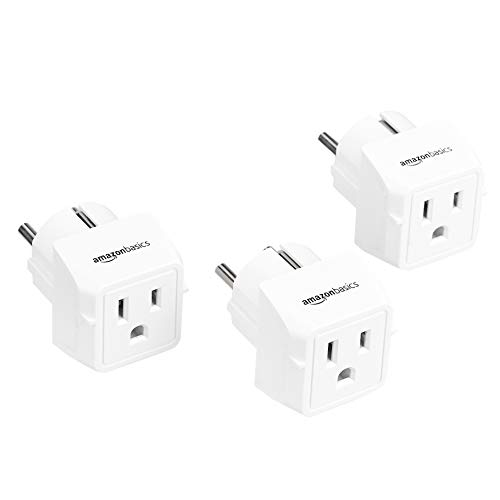
Amazon Basics Type E/F Adapter, 3-Pack is the only plug-only option and the only three-pack, giving you a separate Type E/F adapter for each bag or traveler. Each unit accepts standard North American two- or three-prong flat-pin plugs, including polarized plugs, and provides one 5-15R socket. Its rating is 250 volts and 10 amps. Unlike the multiport choices, it does not add USB charging connections, so USB devices need their own compatible charger.
The maker explicitly says this adapter does not convert voltage. Use it only with dual-voltage devices and check the device label; a plug fitting the socket does not make a 110V-only device suitable for a 220–250V supply.
Bottom line: Pick the three-pack when you need basic plug adaptation in several bags.
How to choose a Type F plug adapter
Choose by the number and type of devices you need to connect, then check electrical compatibility. A plug adapter changes the shape of a plug; it does not step voltage up or down. European mains are commonly 230 volts, so a device marked 100–240V can usually accept that range, while a 120V-only appliance needs a suitable voltage converter. Check the device label, not just the charger plug.
For AC appliances, add their wattage and keep the total below the adapter’s maximum. A 10-amp adapter rated at 250 volts has a theoretical 2,500-watt ceiling, but appliances with motors or heating elements can draw more at startup. For phones and tablets, compare USB-C output wattage with the device’s charging requirement; port count alone does not indicate charging speed.
Type E and Type F socket fit
Type E/F adapters are intended for the common European socket combination that accepts compatible E and F plugs, but socket fit is not universal across every country or building. Type F outlets have two round holes and grounding contacts on the sides; Type E outlets use a grounding pin projecting from the socket. A combined adapter design is intended to work with both styles where its pins and grounding arrangement match.
Do not force an adapter into a socket that does not accept it smoothly, and do not treat physical fit as proof of electrical compatibility. Some destinations use other plug types, and older buildings can have unusual or worn outlets. Confirm the local socket type for each stop, especially on multi-country itineraries, and inspect the adapter for damage before travel.
Adapter type and connection count
Use this guide to choose between a basic shape adapter and a multiport travel adapter. More outlets and USB ports can reduce the number of separate chargers, but they do not increase the available circuit power.
| Adapter style | Useful when | Trade-off |
|---|---|---|
| Plug-only Type E/F | Several bags need a basic socket adapter | USB devices need separate chargers |
| Multi-outlet adapter | Several AC plugs need access at once | Combined appliance load must stay within its rating |
| USB multiport adapter | Phones and accessories use USB charging | Port count does not determine wattage per port |
Choose a plug-only multi-pack when separate units matter more than consolidating devices. Pick a multiport unit when the mix of AC and USB connections matches your actual chargers.
Safe use of travel plug adapters
Check voltage, current and wattage before connecting an appliance, and keep the combined load under the adapter’s rating. High-wattage hair dryers, kettles and irons deserve particular care: many single-voltage models are not suitable for European mains even when their plug fits. A travel adapter is not a transformer, and a USB port does not change the mains voltage supplied to the AC outlets.
Keep adapters dry, avoid daisy-chaining one adapter into another, and stop using a unit that feels unusually hot, smells burnt or has loose pins. Grounded appliances need a properly grounded adapter connection; a two-prong adapter cannot safely substitute for a grounding path. When a device’s voltage range or grounding requirement is unclear, leave it disconnected until verified.
Frequently Asked Questions
Does a Type F plug adapter convert voltage?
No. A Type F plug adapter changes the plug connection, not the voltage; European mains are commonly 230 volts. Check the appliance label for a range such as 100–240V before plugging it in.
Can I use a 120V hair dryer in Europe?
Only if the hair dryer is rated for the local voltage or paired with a correctly rated voltage converter. Many 120V-only dryers are not suitable for 230V mains, and their high wattage can exceed a small travel converter’s capacity.
What is the difference between Type E and Type F sockets?
Type F sockets use grounding contacts on the sides, while Type E sockets have a grounding pin that projects from the outlet. A combined E/F adapter is intended for compatible versions of both socket styles, but it will not fit every plug type used worldwide.
How many watts can a 10 amp adapter handle?
At 250 volts, 10 amps corresponds to a 2,500-watt maximum rating. Keep the combined load below the adapter’s limit and account for appliances that draw extra current when starting.
Can several devices share one travel adapter?
Yes, if the adapter has enough outlets or USB ports and the total load stays within its rated capacity. For USB charging, check the output wattage as well as the number of ports, since more ports do not guarantee faster charging.