
Home AC Stop Leak: 4 Sealers Compared by Fit

For a home AC stop leak with sealing, UV dye and moisture removal in one product, Leak Saver Ultimate 3-in-1 is the most versatile match. Choose another option if your priority is a simpler sealer or a refrigerant range; confirm refrigerant compatibility before treatment.
Refrigerant leak sealer is injected into an HVAC system, so it is not a substitute for locating the leak or repairing damaged components.
We earn a commission if you buy through links on this page. As an Amazon Associate I earn from qualifying purchases. Products are compared on manufacturer specifications, not hands-on testing.
- Best overall: Leak Saver Ultimate 3-in-1 – Combines sealer, moisture remover and UV dye for systems up to 5 tons.
- Best for a basic sealer: Leak Saver Direct Inject – A direct inject sealer for systems up to 5 tons without added dye or moisture remover.
- Best for stated refrigerant coverage: ENVIRO-SAFE ProSeal XL4 with UV Dye – Names several residential refrigerants and combines sealing with UV dye.
- Best for UV leak detection: Leak Saver Direct Inject UV – Adds UV dye to a sealer compatible with a range of refrigerants.
| Product | Best for | System capacity | UV dye | Other function | Shop |
|---|---|---|---|---|---|
| Leak Saver Ultimate 3-in-1 | Added moisture removal | Up to 5 tons | Yes | Moisture remover | Check Price on Amazon |
| Leak Saver Direct Inject | Simple direct injection | Up to 5 tons | No | Sealer | Check Price on Amazon |
| ENVIRO-SAFE ProSeal XL4 with UV Dye | Specified refrigerants | 1.5–5 tons | Yes | Sealer | Check Price on Amazon |
| Leak Saver Direct Inject UV | Large leak detection | Up to 5 tons | Yes | Sealer | Check Price on Amazon |
Home AC stop leak products
Compare the system capacity, dye features and product-specific limits before choosing a sealer.
Leak Saver Ultimate 3-in-1
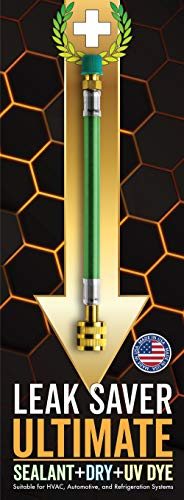
Leak Saver Ultimate 3-in-1 differs from the other options by combining sealer, moisture remover and UV dye in one treatment for HVAC systems up to 5 tons. The maker says it can seal leaks when the complete refrigerant charge has not been lost within 7 days, and that it works with most HVAC systems and refrigerants. That combination suits someone seeking both leak identification and moisture removal alongside sealing. The limitation is important: the window excludes systems that have already lost their full charge, and the product is not a replacement for finding and repairing a failed component.
Bottom line: Pick this if you want dye and moisture remover in a sealer for a system up to 5 tons.
Leak Saver Direct Inject

Leak Saver Direct Inject is the straightforward sealer option: it is intended for systems up to 5 tons and does not add UV dye or a moisture-removal function. The maker says it works with all systems and refrigerants except ammonia, including central AC, heat pumps, mini-splits and refrigeration equipment. It also says the sealer targets small leaks when the full refrigerant charge has not been lost within 7 days. This may suit a buyer who wants a basic treatment rather than combined detection features. A leak that has emptied the system falls outside that stated condition.
Bottom line: Choose this for a basic direct inject sealer when the system is within its capacity.
ENVIRO-SAFE ProSeal XL4 with UV Dye

ENVIRO-SAFE ProSeal XL4 with UV Dye stands out for naming a residential refrigerant range, including R-410A, R-22, R-32, R-454B and R-134a, and for including UV dye in the same injection. The product is intended for 1.5- to 5-ton central AC, heat pump and mini-split systems. The maker says the dye circulates with the sealer and can make leak sites visible under UV light. It is not for ammonia or carbon dioxide systems, so check the equipment nameplate rather than assuming broad compatibility. The capacity also makes this a poor fit for systems below 1.5 tons.
Bottom line: Pick this when the system is 1.5 to 5 tons and its refrigerant is among the compatible types.
Leak Saver Direct Inject UV

Leak Saver Direct Inject UV pairs a direct inject sealer with UV dye aimed at detecting larger leaks, rather than offering the moisture-removal feature found in Leak Saver Ultimate 3-in-1. It is intended for AC, refrigeration and automotive systems up to 5 tons, and the maker says it is compatible with all refrigerants. The maker also says it can seal small leaks when the complete refrigerant charge has not been lost within 72 hours. This option suits a buyer who wants dye with a sealer, but the 72-hour condition is narrower than the 7-day window stated for some alternatives.
Bottom line: Choose this when UV dye matters and the system meets the capacity and charge condition.
How to choose a home AC stop leak
Start with the unit’s refrigerant and capacity, then decide whether dye or moisture removal matters. Residential central AC systems are commonly sized in tons, with 1 ton equal to 12,000 BTU per hour; select a product whose capacity includes the equipment. Refrigerant names such as R-410A, R-22, R-32 and R-454B are not interchangeable, so match the equipment nameplate to the sealer’s compatibility. UV dye can help reveal a leak under a UV lamp, while a sealer without dye focuses on sealing. A useful decision rule is to skip any product whose capacity does not include your system, even if its refrigerant appears compatible.
Refrigerant handling is regulated: EPA Section 608 prohibits intentional venting, and servicing most stationary AC equipment requires certified technicians. Have a qualified technician assess the leak and choose the treatment.
How UV dye and leak sealer differ
UV dye helps locate refrigerant that has escaped; sealer is intended to close some small leaks inside a system. Dye is not itself a repair, and a visible leak may still need component replacement. Leak detection commonly uses electronic detectors, bubble solution at accessible joints, or fluorescent dye; the appropriate method depends on leak location and equipment. A product that combines dye and sealer may reduce the need for separate treatment steps, but it does not guarantee that every leak can be sealed. Large leaks, damaged coils and failed joints need diagnosis rather than repeated additions of sealant. Ask the technician to identify the leak source and confirm the refrigerant before any injection.
The table distinguishes what each product adds beyond sealing.
| Need | Product distinction | Choice |
|---|---|---|
| Moisture-removal function | Sealer, UV dye and moisture remover | Leak Saver Ultimate 3-in-1 |
| Simple sealer | No dye or moisture remover | Leak Saver Direct Inject |
| Named refrigerant range | UV dye and listed refrigerant types | ENVIRO-SAFE ProSeal XL4 with UV Dye |
| UV dye for leak detection | Dye with sealer | Leak Saver Direct Inject UV |
Refrigerant compatibility and system fit
Check the system nameplate for both refrigerant and capacity before selecting a stop leak. The product range here includes options for systems up to 5 tons, while one specifies 1.5 to 5 tons; a ton is a cooling-capacity measure, not the unit’s weight. Compatibility claims differ: one product excludes ammonia, another excludes ammonia and carbon dioxide, and some use broad compatibility language. Newer refrigerants may have different safety classifications, so a general phrase such as “all refrigerants” is not enough to determine safe service procedure. Never mix refrigerants or use a product that excludes the system’s refrigerant. A technician can confirm the equipment type and whether the product is appropriate for its components.
When a home AC stop leak is the wrong fix
A stop leak is not a universal repair: a fully discharged system, a major rupture or a leaking mechanical connection needs diagnosis and repair. Refrigerant loss can reduce cooling, but repeatedly topping off refrigerant without addressing the cause leaves the leak unresolved and may release refrigerant. In the United States, intentional venting is prohibited under EPA Section 608; stationary AC service generally belongs with an appropriately certified technician. A practical condition is to stop considering sealant when the system has lost its full charge, since multiple product makers explicitly limit their sealing claims to systems that retain charge. Have the technician find the leak, recover refrigerant properly when needed, and determine whether a component repair is required.
Frequently Asked Questions
Can home AC stop leak fix a large leak?
No product here promises to seal every large leak. The conditions for several options require that the system has not lost its complete refrigerant charge, so a fully discharged system needs professional diagnosis.
How do I check which refrigerant my AC uses?
Read the equipment nameplate, which identifies the refrigerant type; common residential labels include R-410A and R-22. Match that label to the product’s compatibility statement before treatment.
Does UV dye stop an air conditioner leak?
No, UV dye is for locating escaped refrigerant, not sealing the leak by itself. A UV lamp can reveal dye at a leak point, but the damaged part may still need repair or replacement.
Can I add stop leak to a mini split?
Some products in this comparison name mini-splits as compatible, but capacity and refrigerant still matter. Have a qualified HVAC technician confirm compatibility and use appropriate procedures before injecting anything.
Is it safe to mix different AC refrigerants?
No; do not mix refrigerants in an AC system. Confirm the type on the equipment nameplate, since refrigerants have distinct handling and safety requirements.