
12 Volt Connectors and Plugs: Types Compared by Use

For a vehicle accessory that plugs into a cigarette lighter socket, choose YONHAN Fused Cigarette Lighter Plug for its built-in 15A fuse and 16 AWG leads; the right choice otherwise depends on whether your device needs a barrel, SAE or waterproof two-pin connection. Pick a different type if you need a battery-side SAE lead or a small DC barrel connector rather than a socket plug.
We earn a commission if you buy through links on this page. As an Amazon Associate I earn from qualifying purchases. Products are compared on manufacturer specifications, not hands-on testing.
- Best overall: YONHAN Fused Cigarette Lighter Plug – A fused cigarette lighter male plug with a connection-status LED and 16 AWG leads.
- Best for DC barrel devices: MILAPEAK 2.1 × 5.5mm Barrel Pigtails – Male and female 2.1mm × 5.5mm pigtails with 18 AWG wire and a 5A rating.
- Best for SAE extensions: SKARORING 1-Foot SAE Extension Leads – Eight 1-foot SAE extension leads use 12 AWG wire and clearly marked polarity.
| Product | Best for | Connector type | Wire gauge | Shop |
|---|---|---|---|---|
| YONHAN Fused Cigarette Lighter Plug | Vehicle accessories | Cigarette-lighter male | 16 AWG | Check Price on Amazon |
| MILAPEAK 2.1 × 5.5mm Barrel Pigtails | DC barrel devices | 2.1 × 5.5mm barrel | 18 AWG | Check Price on Amazon |
| SKARORING 1-Foot SAE Extension Leads | SAE extensions | 2-pin SAE | 12 AWG | Check Price on Amazon |
| BFXM 12AWG Cigarette Lighter Plug | Heavy-gauge leads | Cigarette-lighter male | 12 AWG | Check Price on Amazon |
12 Volt Connectors and Plugs Compared
Match the connector interface to the device or socket first, then compare wire gauge and electrical rating.
YONHAN Fused Cigarette Lighter Plug
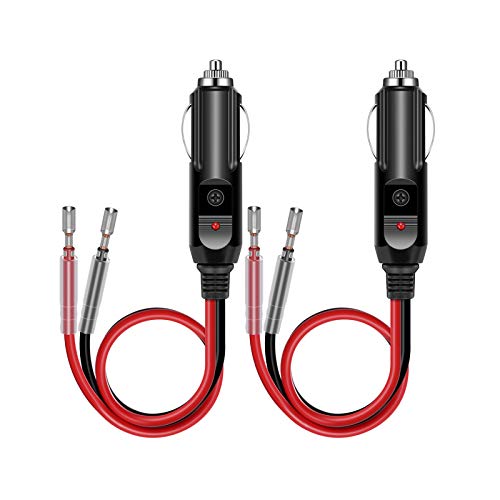
For accessories that use a vehicle cigarette lighter socket, this replacement male plug includes a 15A built-in fuse and a red-and-black 1-foot lead. Its LED indicator makes the connection status visible, including in dim conditions. The 16 AWG copper leads terminate as bare wires for a replacement or wiring project, so the installer must connect positive and negative correctly. It is a socket plug, not a barrel, SAE or waterproof two-pin connector; choose another style if your device requires one of those interfaces. The maker says it fits 12V/24V vehicle sockets, but verify that the accessory’s current draw is within the fuse and vehicle socket limits.
Bottom line: Choose this for a fused replacement plug for a vehicle accessory.
MILAPEAK 2.1 × 5.5mm Barrel Pigtails
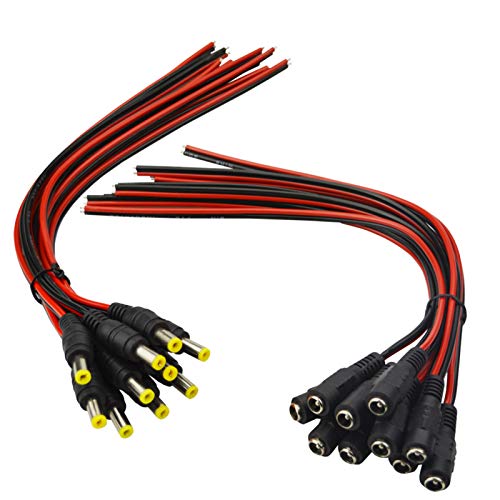
Small DC equipment with a 2.1mm × 5.5mm barrel jack needs a different interface from a car-socket plug, and this set includes 10 male-and-female pigtail pairs. Each cable uses 18 AWG wire; the maker rates the connectors for 5A. The red and black leads support straightforward polarity matching when wiring compatible equipment such as a camera or router. These pigtails suit fixed DC power connections and DIY wiring, not a vehicle cigarette lighter socket or an SAE battery connection. Confirm the device’s barrel dimensions, polarity and current requirement before connecting; a matching outside diameter alone does not guarantee compatibility.
Bottom line: Pick these for compatible 2.1 × 5.5mm DC barrel connections.
SKARORING 1-Foot SAE Extension Leads

For extending an SAE connection, these eight 1-foot leads use 12 AWG wire and mark red as positive and black as negative. The maker describes them for solar-panel-to-battery connections and vehicle or tractor battery use. Their SAE interface is distinct from the cigarette lighter plug and barrel pigtail styles, and polarity needs attention when mating leads or adapters. These are extension cables, not a plug-in adapter for a standard vehicle socket. The maker does not give a current rating, so verify the cable and connected equipment ratings for the intended load before use; do not infer capacity from wire gauge alone.
Bottom line: Choose these when an SAE extension and marked polarity suit the setup.
BFXM 12AWG Cigarette Lighter Plug

For a cigarette lighter-style connection with a heavier lead, this plug has 12 AWG wire, a 3.3-foot cable, an LED indicator and a fuse box that accepts 20A and 30A fuses. Its phenolic-plastic shell and copper spring are described by the maker as heat resistant and conductive. The cable also has an O-ring terminal connector for battery-terminal connections. It is longer and uses heavier wire than YONHAN Fused Cigarette Lighter Plug, but the fuse options do not establish that a vehicle socket can safely carry either rating. Confirm the socket, device and selected fuse ratings before use; this is not a substitute for a correctly rated battery circuit.
Bottom line: Choose this for a longer, heavier-wire cigarette lighter lead after checking circuit limits.
How to choose a 12 volt connector
Start with the mating interface, because a 12V label alone does not make plugs interchangeable. A cigarette lighter male plug fits a vehicle socket; a 2.1mm × 5.5mm barrel plug fits a matching DC jack; SAE connectors join compatible battery or solar leads; and sealed two-pin connectors are for inline wire joints. Check both the connector dimensions and polarity before wiring. Then match the current rating of the connector, cable, fuse and device to the load: the safe circuit limit is set by the lowest-rated component, not the thickest wire. For a device drawing more current than the connector rating, choose a properly rated connection instead of upsizing only the fuse.
Wire gauge is another selection factor, but it does not replace a published current rating. Longer cable runs have more voltage drop, so high-current or long-run installations need careful sizing against the load and cable length.
Connector types and best-fit uses
Connector shape determines the job: a socket plug connects to a vehicle accessory outlet, barrel pigtails wire small DC devices, SAE leads extend compatible battery connections, and sealed two-pin pairs join wires. Use this table to narrow the interface before considering wire gauge or fuse size.
| Connection need | Matching style | Check before connecting |
|---|---|---|
| Vehicle accessory outlet | Cigarette lighter male plug | Socket and fuse limits |
| Small DC device jack | 2.1 × 5.5mm barrel | Dimensions and polarity |
| Battery or solar lead | SAE extension | Polarity and circuit rating |
| Inline vehicle wire joint | Sealed 2-pin pair | Mating fit and seal |
A connector that physically mates can still have reversed polarity or inadequate electrical capacity. For battery and solar wiring, verify polarity at both ends with a meter before connecting sensitive equipment.
Wire gauge, fuse and load limits
A fuse protects wiring by opening when current exceeds its rating; it does not increase what a socket or accessory can carry. Automotive accessory outlets commonly have circuit protection in the 10A to 20A range, but the vehicle’s manual or outlet marking controls. Match the plug fuse to the device and vehicle circuit, and never substitute a larger fuse simply to stop it from blowing. The connector or cable rating may be lower than the fuse rating, so use the lowest applicable limit.
Wire gauge numbers run in reverse: 12 AWG is thicker than 16 AWG, which is thicker than 18 AWG. For longer runs or high-current loads, voltage drop matters; keep leads short where possible and use a properly rated cable rather than judging capacity from gauge alone.
Safe wiring and fit checks
Disconnect power before cutting or joining 12V wires, and identify positive and negative before making a connection. A reversed polarity can damage electronics even when the plug fits. A vehicle battery can deliver very high fault current, so protect battery-side wiring with a fuse close to the positive terminal and cover exposed conductors to prevent short circuits.
On outdoor, marine or vehicle wiring, a rubber seal reduces ingress only when the connector halves match and the seal seats correctly; it does not make every joint suitable for immersion. For socket plugs, check that the plug stays secure and that the accessory’s draw is below the outlet rating. Stop using a connector that becomes hot, smells of burning or shows melted insulation, and inspect crimps for looseness or corrosion before reconnecting.
Frequently Asked Questions
How do I identify a 2.1mm barrel plug?
A 2.1mm × 5.5mm barrel connector has a 5.5mm outer diameter and 2.1mm inner contact. Measure the plug and device jack or check their markings, then verify polarity because center-positive and center-negative devices both exist.
Can a 12V plug work in a 24V vehicle?
Only if the accessory and plug are rated for 24V operation. Check the device input range and vehicle socket rating; a 12V-only accessory can be damaged by a 24V supply.
What fuse size should a 12V accessory use?
Use the fuse specified for the accessory and ensure it does not exceed the wiring or outlet rating. Many vehicle accessory circuits fall around 10A to 20A, but the vehicle’s marking or manual is the controlling limit.
Does thicker wire always allow more current?
Thicker wire generally has lower resistance, but it does not set the safe current by itself. Connector, insulation, fuse, cable length and installation conditions also limit the circuit; voltage drop becomes more significant on long runs.
Are SAE connectors polarity-proof?
No; SAE connector polarity can vary by wiring and adapters. Confirm positive and negative with a meter before connecting solar panels, batteries or sensitive electronics.