
Burlap for Grass Seed: 5 Rolls Compared by Coverage

For grass seed, Natural Jute Erosion Control Blanket, 4 x 50 ft is the closest match because its open jute erosion mesh is made to hold soil and seed on slopes while covering 200 square feet. Choose a different roll if you need a denser fabric for broader plant or craft uses rather than a seed-holding erosion blanket.
We earn a commission if you buy through links on this page. As an Amazon Associate I earn from qualifying purchases. Products are compared on manufacturer specifications, not hands-on testing.
- Best overall: Natural Jute Erosion Control Blanket, 4 x 50 ft – Open woven mesh designed to hold loose topsoil and seed, with 200 square feet of coverage.
- Best for longer patches: Tcevily Natural Jute Burlap Roll, 40 in x 24 ft – A 40-inch-wide roll extends 24 feet for cutting into narrower covers.
- Best for wide coverage: Buryeah Natural Jute Burlap Roll, 60 in x 33 ft – The 60-inch width covers broad areas in fewer strips.
| Product | Best for | Width | Length | Construction | Shop |
|---|---|---|---|---|---|
| Natural Jute Erosion Control Blanket, 4 x 50 ft | Seeded slopes | 48 in | 50 ft | Open woven mesh | Check Price on Amazon |
| Natural Jute Burlap Roll, 40 in x 5 ft | Small seed patches | 40 in | 5 ft | Tight weave | Check Price on Amazon |
| Tcevily Natural Jute Burlap Roll, 40 in x 24 ft | Long narrow patches | 40 in | 24 ft | Breathable burlap fabric | Check Price on Amazon |
| RAINFLOW Natural Jute Burlap Roll, 19.7 in x 13 ft | Narrow garden strips | 19.7 in | 13 ft | Tight weave | Check Price on Amazon |
| Buryeah Natural Jute Burlap Roll, 60 in x 33 ft | Wide garden coverage | 60 in | 33 ft | Tight weave, 24 x 26 density | Check Price on Amazon |
Burlap for Grass Seed
Compare mesh style and roll dimensions to choose the right cover for your seeded area.
Natural Jute Erosion Control Blanket, 4 x 50 ft

Natural Jute Erosion Control Blanket, 4 x 50 ft is the only roll here specifically described as an erosion control blanket for grass seeding. Its open woven jute mesh is intended to hold loose topsoil, seeds, and fertilizer while reducing runoff and wind erosion. At 4 feet wide by 50 feet long, it covers up to 200 square feet; the instructions call for securing it with landscape nails, and it can be cut with household scissors. This makes it the clearest fit for slopes or broad seeded patches. Its open mesh is not a dense, continuous fabric cover, so buyers wanting solid soil coverage should choose another type.
Bottom line: Choose it for seed coverage on slopes where loose soil needs to be held in place.
Natural Jute Burlap Roll, 40 in x 5 ft

Natural Jute Burlap Roll, 40 in x 5 ft is a short, tightly woven jute fabric rather than a purpose-described erosion blanket. The 40-inch width and 5-foot length make it suited to a small patch or a narrow strip, and the fabric can be cut for garden uses. Choose it where a compact piece of fabric is useful; for a larger seeded area or runoff control, the open erosion mesh is the closer match.
Bottom line: Pick it for a small, flat patch that needs a short piece of woven cover.
Tcevily Natural Jute Burlap Roll, 40 in x 24 ft

Tcevily Natural Jute Burlap Roll, 40 in x 24 ft offers the longest 40-inch-wide roll among the fabric options, making it easier to cover a narrow bed or divide into several short sections. It is breathable natural jute fabric that can be cut or folded, with seed cover among its intended garden uses. Unlike the erosion blanket, it is not described as open stabilization netting, so buyers dealing with a steep slope or moving topsoil should favor mesh made for erosion control. For small, relatively level seeded areas, the extra length offers more flexibility than a short patch roll.
Bottom line: Choose it for a long, narrow seed area where cuttable fabric is useful.
RAINFLOW Natural Jute Burlap Roll, 19.7 in x 13 ft
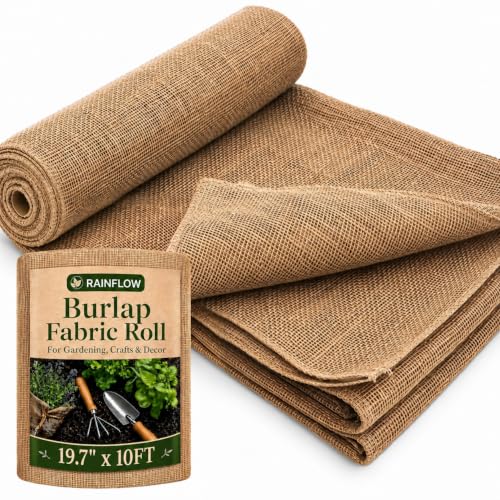
RAINFLOW Natural Jute Burlap Roll, 19.7 in x 13 ft is the narrowest roll in this group at 19.7 inches wide, which can suit a slim strip or a small area where minimizing overlap matters. Its 13-foot continuous length is cuttable, and the breathable jute is presented for garden applications including soil covering and landscaping. This is general burlap fabric, not the open erosion control blanket intended to hold grass seed and loose topsoil on a slope. The narrow width also means more adjacent strips for broad lawn coverage, so it is a less convenient choice for larger seeded sections.
Bottom line: Use it for narrow, level strips rather than broad or sloped seeding.
Buryeah Natural Jute Burlap Roll, 60 in x 33 ft

Buryeah Natural Jute Burlap Roll, 60 in x 33 ft is the widest roll in this group at 60 inches, giving broad areas more width per strip than the 40-inch fabrics. It is a dense, breathable jute fabric with selvage and a roughly 24 x 26 weave density; it can be cut for soil covering and garden use. Those traits make it a general fabric alternative, not a purpose-described erosion mesh for holding seed on hillsides. The maker advises keeping the roll dry and away from heat or flames before use, so it needs dry storage rather than being left damp before installation.
Bottom line: Choose it for broad, level areas where a wide fabric strip is the priority.
How to choose burlap for grass seed
Open erosion control mesh is the better starting point when seed or soil could wash downhill; general woven burlap is more suited to small, level areas. Match the cover to the hazard: a slope exposed to runoff needs a net that can be secured across the soil, while a flat patch may only need light cover. For broad work, calculate the area before choosing a roll: divide the area by the roll’s width in feet to estimate the total linear feet needed, then add overlap between strips. Keep seams overlapped and anchor edges, especially along the top and sides of a slope. Do not assume that all burlap marketed for gardening is designed to stabilize soil.
Jute mesh versus woven burlap
Jute erosion mesh has open spaces that let air and water pass while catching loose soil and seed; tightly woven burlap behaves more like a fabric sheet. Use mesh when erosion control is the deciding job, especially where rain or wind could move seed before it establishes. A fabric roll can work as a temporary cover on small, relatively level areas, but it is not interchangeable with an erosion blanket. For grass seed, keep the cover in contact with the ground rather than stretched taut above it, and secure it so wind cannot lift the edges. The open mesh option in this group is specifically described for grass seeding and slope stabilization.
Size and installation for seeded areas
Roll width determines how many lanes a project needs: a 48-inch roll covers a wider strip than a 19.7-inch roll, while long rolls reduce the number of end seams. Measure the seeded area, plan for overlap, and cut only after checking the layout. On slopes, work from the top down and fasten the upper edge and sides before securing the rest; landscape nails are the fastening method for the erosion blanket here. Avoid leaving loose corners that can catch wind or water. A practical decision rule is to use the open erosion mesh for slopes and reserve tightly woven fabric for small, flatter patches where broad continuous coverage is not essential.
| Project need | Cover type | Reason |
|---|---|---|
| Slopes with loose soil | Open jute erosion mesh | Holds seed and topsoil while allowing flow through mesh |
| Small, level patch | Cut burlap fabric | Compact pieces can cover a limited area |
| Broad, flat section | Wide fabric roll or mesh | Greater width means fewer adjacent strips |
Care and common mistakes with seed covers
Keep natural jute dry before installation when the maker gives that care instruction, and avoid placing damp burlap in storage where moisture can linger. A common mistake is choosing by the word “burlap” alone: weave structure matters more than the label when runoff is the concern. Another is underestimating coverage by using the roll’s length without accounting for width, slope contours, or overlap. Cut edges and seams should be secured so they do not lift, and the cover should not be stretched so tightly that it cannot sit against uneven ground. For a large or steep slope, plan fastening and strip layout before spreading seed so the cover can be anchored promptly.
Frequently Asked Questions
Does burlap need to touch the grass seed?
Yes, keep the cover close against the soil so seed is not left exposed beneath a raised sheet. Secure the edges and seams, especially on slopes where wind and runoff can lift loose fabric.
Can regular burlap stop grass seed from washing away?
Regular woven burlap may cover a small, level patch, but open erosion control mesh is the more suitable type where runoff can move seed and topsoil. Choose the mesh for sloped areas and anchor it across the soil.
How much burlap do I need for a lawn patch?
Measure the patch area and divide by the roll width in feet to estimate the needed linear length, then allow extra for seams and trimming. For example, a 4-foot-wide roll needs 25 linear feet to cover 100 square feet before overlap.
Should I overlap burlap strips for grass seed?
Yes, overlap adjacent strips so soil is not exposed along the seam. The amount depends on the ground shape and fastening, so use enough overlap to keep edges from separating under wind or water.
How do you secure burlap on a grass seed slope?
Secure the upper edge and sides first, then fasten the cover across the slope so it cannot lift or slide. The erosion blanket here specifies landscape nails; plan enough anchors for seams and exposed edges.