
Styrofoam Balls in Different Sizes: 5 Sets Compared

For a broad size range and the largest assortment, 500-Piece Foam Ball Set includes 500 balls in sizes from 0.8 to 3 inches. Choose a smaller set if you need fewer pieces or an even number of each diameter.
Craft foam balls are lightweight spheres used for decorating, modeling, and school projects; diameter and quantity determine how well a set fits a project.
We earn a commission if you buy through links on this page. As an Amazon Associate I earn from qualifying purchases. Products are compared on manufacturer specifications, not hands-on testing.
- Best overall: 500-Piece Foam Ball Set – The 500-piece assortment includes five sizes from 0.8 to 3 inches.
- Best for even counts: LOKIPA 60-Piece Foam Balls – The 60-piece set includes 12 balls in each of five sizes.
- Best for painting: hesmartly 50-Piece Foam Balls – The 50-piece set includes two painting brushes and five sizes.
| Product | Best for | Piece count | Size range | Size distribution | Shop |
|---|---|---|---|---|---|
| 500-Piece Foam Ball Set | Large projects | 500 | 0.8–3 in | 15, 60, 60, 160, 205 | Check Price on Amazon |
| 240-Piece Foam Craft Balls | Mixed crafts | 240 | 0.8–2 in | 15, 40, 80, 105 | Check Price on Amazon |
| LOKIPA 60-Piece Foam Balls | Even size counts | 60 | 0.79–1.97 in | 12 each across 5 sizes | Check Price on Amazon |
| hesmartly 50-Piece Foam Balls | Painting projects | 50 | 1–2.36 in | 30, 10, 5, 3, 2 | Check Price on Amazon |
| Pllieay 20-Piece Foam Balls | Small assortments | 20 | 1–2.4 in | 1, 2, 5, 6, 6 | Check Price on Amazon |
Styrofoam balls in different sizes
Compare the diameter range and how the pieces are divided before choosing an assortment.
500-Piece Foam Ball Set

The 500-piece set has the largest quantity and broadest size span among these assortments, with 15 balls at 3 inches and the rest divided among 0.8-, 1.2-, 1.6-, and 2-inch sizes. That mix suits classrooms or projects that need many smaller spheres plus a few larger ones. The five sizes are not evenly represented: 205 pieces are 0.8 inch, while only 15 are 3 inches. Choose another set if you need equal counts by diameter or want a compact assortment.
Bottom line: Pick this set when a project needs hundreds of pieces and a few large spheres.
240-Piece Foam Craft Balls

The 240-piece set concentrates on four sizes through 2 inches, unlike the larger assortment that adds 3-inch balls. It contains 105 balls at 0.8 inch, 80 at 1.2 inches, 40 at 1.6 inches, and 15 at 2 inches, so it favors small-scale work. The foam is described as high density and is intended for drawing and gluing. Its largest sphere is 2 inches, which may be limiting when a model needs a larger base or prominent focal piece.
Bottom line: Choose this mix for projects that need many small balls and no 3-inch size.
LOKIPA 60-Piece Foam Balls
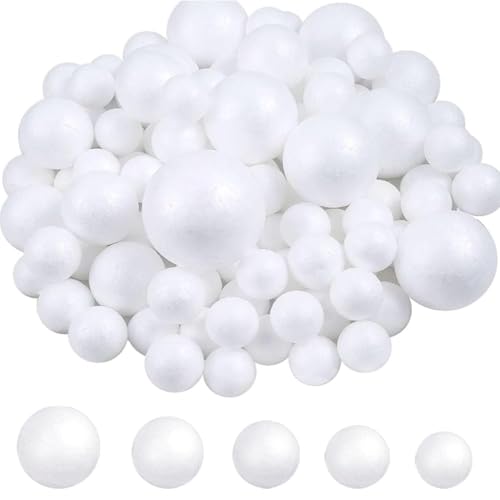
The LOKIPA assortment is the only one here with equal counts at every size: 12 balls each at 0.79, 0.98, 1.18, 1.57, and 1.97 inches. That makes it useful when a project needs matching groups across several diameters rather than a large pile of the smallest size. The balls are white polystyrene with a smooth surface for customization. The set tops out just under 2 inches, so it is not the right choice when the design calls for larger spheres.
Bottom line: Pick it when equal quantities across five sizes matter more than total volume.
hesmartly 50-Piece Foam Balls

The hesmartly set is the only assortment that includes two painting brushes, and its 50 smooth white polystyrene balls span five sizes from 1 to 2.36 inches. Thirty of the balls are 1 inch, while only two are 2.36 inches, so the distribution is weighted toward small projects. The brushes make it a straightforward option for painting-focused activities. Buyers needing many of the largest size should look elsewhere, since the biggest diameter has the lowest count.
Bottom line: Choose this set for painting projects that use mostly 1-inch spheres.
Pllieay 20-Piece Foam Balls

The Pllieay set is the smallest assortment here, with 20 balls across five sizes from 1 to 2.4 inches. Its mix includes one 2.4-inch ball, two 2-inch balls, five 1.6-inch balls, six 1.2-inch balls, and six 1-inch balls. The solid foam is intended for crafts and decoration, and the balls can be pierced with a needle for stringing. The low piece count is a drawback for group projects or designs that require many matching spheres.
Bottom line: Pick this assortment for a small project that needs several diameters but few pieces.
How to choose foam ball sizes
Start with the largest sphere your design needs, then check how many of that diameter the set actually includes. A size range alone can be misleading: the 500-piece assortment has only 15 balls at its largest, while its smallest size accounts for 205 pieces. For repeated components, count each diameter separately rather than relying on the total. Measure the intended space across its widest point; a sphere’s size is its diameter, so a 2-inch ball needs roughly a 2-inch-wide opening, with some room for coverings or attached decorations.
For a project requiring equal numbers of several sizes, an assortment with balanced counts is easier to plan around than a bulk pack weighted toward small pieces. If matching counts matter, compare each size distribution before choosing.
Foam ball materials and decorating
White polystyrene foam balls provide a light base for craft decoration, but the finish and application method affect the result. Water-based acrylic craft paint is commonly used on polystyrene; solvent-based products containing acetone can dissolve or damage it. Test an unfamiliar coating on a spare piece first, and avoid spraying solvent-based paint onto foam.
For attaching decorations, use adhesives labeled safe for foam. Hot glue can deform some foam, so low-temperature glue or a foam-safe craft adhesive is a more cautious choice. Pins and needles can pierce foam for stringing, but sharp tools should be handled by an adult and kept away from young children.
Compare craft foam ball assortments by project
Use the project’s required diameter and count to choose among mixed-size sets; the largest total does not guarantee many large spheres. The table shows the quantity profile and largest size in each assortment.
| Project need | Set fit | Reason |
|---|---|---|
| Hundreds of pieces | 500-piece set | Broadest span here, but counts favor the smallest size |
| Same count per size | LOKIPA 60-piece set | 12 balls at each of five diameters |
| Painting with brushes | hesmartly 50-piece set | Includes two painting brushes |
| Few pieces in a compact mix | Pllieay 20-piece set | Five sizes, 20 pieces total |
When a project needs a diameter above 2 inches, check the largest size carefully: only two of these sets include spheres larger than 2 inches, and their large-piece counts differ substantially.
Safe handling and storage
Small foam balls are a choking hazard for children under 3 years old; keep them and detached decorations out of reach. Supervise older children when projects involve needles, pins, scissors, or small embellishments, and store leftover balls in a closed container after crafting.
Foam balls can dent or flatten under heavy pressure, so avoid stacking heavy supplies on top of finished models. Keep them away from open flames and high heat, and check the paint or adhesive label for foam compatibility before use. For a classroom activity, sort sizes into separate containers and count them before cleanup to avoid leaving small pieces on the floor.
Frequently Asked Questions
What does the size of a foam ball measure?
The size refers to its diameter, measured straight across the sphere through its center. A 2-inch ball is about 2 inches wide, so allow extra room if paint, fabric, or other decoration will add thickness.
Can I use acrylic paint on polystyrene foam balls?
Water-based acrylic craft paint is commonly used on polystyrene foam. Avoid solvent-based coatings containing acetone, which can dissolve or damage foam, and test unfamiliar products on a spare ball first.
Which adhesive is safe for craft foam balls?
Choose an adhesive labeled safe for foam, since some solvents can damage polystyrene. Low-temperature glue is a more cautious option than hot glue, which can deform some foam.
Are small craft foam balls safe for toddlers?
No; small balls can pose a choking hazard for children under 3 years old. Keep the balls and small decorations out of reach, and supervise older children using pins, needles, or other sharp tools.
How can I keep foam balls from getting dented?
Store foam balls in a closed container where heavy objects cannot press on them. Avoid high heat and open flames, which can deform or damage foam.