
Best Torque Screwdriver for Electricians: 4 Compared

For most electricians, VEVOR Digital Torque Screwdriver Set is the most flexible pick because its digital range spans 2.65 to 70.67 in-lb and includes 8 presets. Choose coobeast Preset Torque Screwdriver Set instead if you prefer a manual preset tool with 12 bits, or GROWNEER Upgraded Ratchet Digital if a ratcheting handle matters more than a lower starting torque.
Torque screwdrivers limit how tightly fasteners are turned; matching the tool range to the equipment maker’s specified torque is essential, since a wider range alone does not establish suitability.
We earn a commission if you buy through links on this page. As an Amazon Associate I earn from qualifying purchases. Products are compared on manufacturer specifications, not hands-on testing.
- Best overall: VEVOR Digital Torque Screwdriver Set – Its 2.65–70.67 in-lb range, ±2% accuracy claim, and 8 presets cover the broadest range of use.
- Best manual preset: coobeast Preset Torque Screwdriver Set – A 10–70 in-lb setting range and 12 S2 bits suit buyers wanting a non-digital option.
- Best for ratcheting: GROWNEER Upgraded Ratchet Digital – The ratchet design avoids turning the handle a full 360 degrees between strokes.
| Product | Best for | Torque range | Accuracy | Bit set | Shop |
|---|---|---|---|---|---|
| VEVOR Digital Torque Screwdriver Set | Broad digital range | 2.65–70.67 in-lb | ±2% claimed | 13 pieces | Check Price on Amazon |
| GROWNEER Upgraded Ratchet Digital | Ratchet access | 3.5–70.8 in-lb | ±2% claimed | — | Check Price on Amazon |
| GROWNEER Digital Torque Screwdriver | Low torque work | 2.66–53.1 in-lb | ±2% claimed | 27 pieces | Check Price on Amazon |
| coobeast Preset Torque Screwdriver Set | Manual preset use | 10–70 in-lb | ±2 in-lb claimed | 13 pieces | Check Price on Amazon |
Torque screwdrivers for electricians
Compare range, adjustment style, and included bits against the torque required for your electrical fasteners.
VEVOR Digital Torque Screwdriver Set

VEVOR Digital Torque Screwdriver Set has the widest range among these digital options, from 2.65 to 70.67 in-lb, plus 8 presets and a backlit LCD. The set includes bits and a case, and the tool records up to 500 values according to the maker. That combination suits electricians who want repeatable digital settings across a broad span and need to read the display in dim work areas. The maker claims accuracy up to ±2%. Its digital controls and recorded values may be more than needed for occasional single-setting work.
Bottom line: Choose this if your work calls for digital settings across its 2.65–70.67 in-lb range.
GROWNEER Upgraded Ratchet Digital
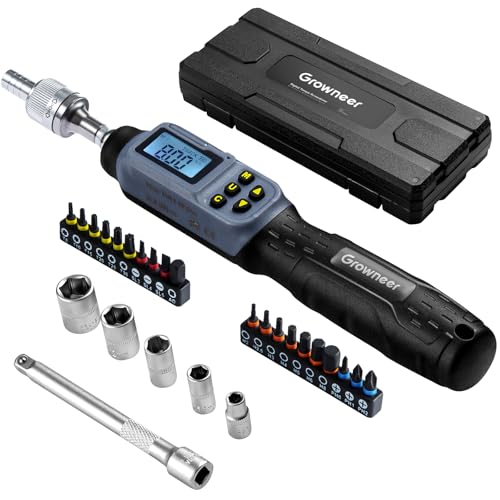
GROWNEER Upgraded Ratchet Digital stands apart with a ratcheting digital handle, so tightening does not require turning the handle through a full 360 degrees each stroke. Its 3.5–70.8 in-lb range reaches slightly higher than VEVOR Digital Torque Screwdriver Set, but starts at a higher torque. The maker claims ±2% accuracy and describes a magnetic, quick-change bit holder with buzzer and LED indicators. This is a practical fit where access restricts handle movement. The higher minimum can rule it out for fasteners whose required torque is below 3.5 in-lb; confirm the equipment specification first.
Bottom line: Pick this when a ratcheting handle helps in tight access and the required torque is at least 3.5 in-lb.
GROWNEER Digital Torque Screwdriver

GROWNEER Digital Torque Screwdriver starts at 2.66 in-lb and tops out at 53.1 in-lb, making its lower end useful when a job calls for less torque than the 10 in-lb floor of coobeast Preset Torque Screwdriver Set. The maker claims ±2% accuracy, six preset modes, a buzzer and LED indicator, and storage for up to 500 readings. Its 27-in-1 set and magnetic rapid-change head provide multiple bit choices. The range stops below the two higher-capacity digital picks, so it is a weaker fit when a specified fastener torque exceeds 53.1 in-lb.
Bottom line: Choose this for low-torque digital work within its 2.66–53.1 in-lb range.
coobeast Preset Torque Screwdriver Set

coobeast Preset Torque Screwdriver Set is the only manual preset option here, with a 10–70 in-lb range, 1 in-lb increments, and 12 S2 bits in a case. The maker claims ±2 in-lb accuracy, so the tolerance should be considered alongside the required torque rather than treating the adjustment increment as precision. A magnetic 1/4-inch bit holder supports quick bit changes. This set suits jobs with target torques inside its range where a manual scale is preferred. Its 10 in-lb minimum excludes lower-torque applications, and it lacks the digital presets and readouts of the other choices.
Bottom line: Pick this when a manual preset scale and 10–70 in-lb range match the fasteners.
How to choose an electrician torque screwdriver
Match the tool’s range to the equipment maker’s torque specification before comparing convenience features. A driver cannot accurately set a target below its minimum or above its maximum, and a 1 in-lb adjustment increment is not the same as ±1 in-lb accuracy. Digital models can show a target and signal when it is reached; a manual preset tool uses a scale and mechanical setting. If you expect to tighten fasteners below 10 in-lb, eliminate tools that start at 10 in-lb. For repeat work, preset memory can reduce repeated entry, but the work specification—not the largest range—decides which tool fits.
Torque units and electrical fastener fit
Electrical equipment may specify torque in inch-pounds, foot-pounds, or newton-meters, so convert the target before setting an inch-pound driver. One foot-pound equals 12 inch-pounds, and 1 newton-meter is about 8.85 inch-pounds. Do not confuse inch-pounds with inch-ounces: 1 inch-pound equals 16 inch-ounces. A useful decision rule is to choose a tool whose range contains the specified torque with room to set it accurately, rather than selecting a tool that merely reaches the target at its limit. Check the equipment label or service instructions for the required value; never substitute a generic electrical torque value.
Digital and preset torque drivers compared
Digital tools provide a numeric display and may add alerts or stored settings; manual preset drivers use a mechanical scale. The table shows the practical distinction, not a ranking.
| Type | Useful when | Check before choosing |
|---|---|---|
| Digital | Targets change or a display and alert help | Range, accuracy claim, and setting increments |
| Manual preset | Repeated work uses a narrow range | Scale readability and reset procedure |
For both types, use the correct bit profile and fully seat it in the fastener. A slipping or mismatched bit can damage the screw head before the target torque is reached.
Safe torque screwdriver use and care
Use a torque screwdriver only for the specified fastener and target; overtightening can damage terminals, insulation, or equipment, while undertightening can leave a connection insecure. Keep the driver aligned with the fastener and apply force smoothly rather than using an extension that changes leverage. Torque tools can drift with wear or impact, so professional tools are commonly recalibrated about every 12 months or 5,000 cycles, whichever comes first; heavy use can call for more frequent checks. Store the tool protected from drops and moisture, and avoid using a torque mechanism as a general-purpose breaker tool. Follow the applicable equipment procedure and electrical safety practices.
Frequently Asked Questions
Can a torque screwdriver measure inch-pounds and newton-meters?
Some digital drivers show both units, while a manual scale may use only inch-pounds. Convert the target when needed: 1 N·m is about 8.85 in-lb, and verify the selected unit before tightening.
How often should a torque screwdriver be calibrated?
A common service interval for professional torque tools is about 12 months or 5,000 cycles, whichever comes first. Frequent use, drops, or uncertain readings are reasons to check calibration sooner.
What happens if an electrical screw is overtightened?
Overtightening can strip threads, damage a terminal, or harm the equipment around the fastener. Use the torque value specified for the exact device rather than applying a general value to all electrical screws.
Does a 1 in-lb increment mean the tool is accurate to 1 in-lb?
No; increment describes how finely the setting can change, while accuracy describes how close the applied torque is to the target. For example, a tool with 1 in-lb increments may still claim a wider ±2 in-lb tolerance.
Can I use a torque screwdriver to loosen fasteners?
A torque screwdriver is intended to control tightening, and reverse operation may not measure torque accurately. Use a suitable hand driver to loosen fasteners unless the tool maker explicitly supports torque measurement in reverse.