
Best Shock Collar for Stubborn Dogs: 5 Compared

INVIROX Ultra K9 3/4-Mile is the strongest match for most buyers who need long-range control, with a 3/4-mile range and 124 levels across beep, vibration and static modes. Choose BLACKDOG Military Dog Collar if night visibility and rugged outdoor use matter more, or Bousnic 3300FT Dual-Channel Collar if you need a two-dog setup.
A remote training collar sends a signal to a receiver worn on the dog; these models include static stimulation, so begin with reward-based training and use the least intrusive effective mode.
We earn a commission if you buy through links on this page. As an Amazon Associate I earn from qualifying purchases. Products are compared on manufacturer specifications, not hands-on testing.
- Best overall: INVIROX Ultra K9 3/4-Mile – Combines a 3/4-mile range, 124 levels and an IP67 waterproof receiver.
- Best for night visibility: BLACKDOG Military Dog Collar – Includes a remote flashlight and collar-mounted strobe, plus an IP67 rating.
- Best for two dogs: Bousnic 3300FT Dual-Channel Collar – Its dual-channel remote supports training two dogs at once.
| Product | Best for | Remote range | Modes and levels | Shop |
|---|---|---|---|---|
| INVIROX Ultra K9 3/4-Mile | Long-range training | 3/4 mile | Beep, vibration, static; 124 levels | Check Price on Amazon |
| BLACKDOG Military Dog Collar | Night visibility | 4,200 ft | 4 modes | Check Price on Amazon |
| 4500FT IPX8 Remote Collar | Maximum stated range | 4,500 ft | 4 modes; levels vary by mode | Check Price on Amazon |
| Bousnic 3300FT Dual-Channel Collar | Two-dog training | 3,300 ft | Beep 1–8, vibration 1–16, shock 1–99 | Check Price on Amazon |
| INVIROX Ultra K9 3300FT | Precise adjustments | 3,300 ft | Beep, vibration, static; 124 levels | Check Price on Amazon |
Shock Collars for Stubborn Dogs
Compare these remote training collars by range, adjustment options and the conditions they are built to handle.
INVIROX Ultra K9 3/4-Mile
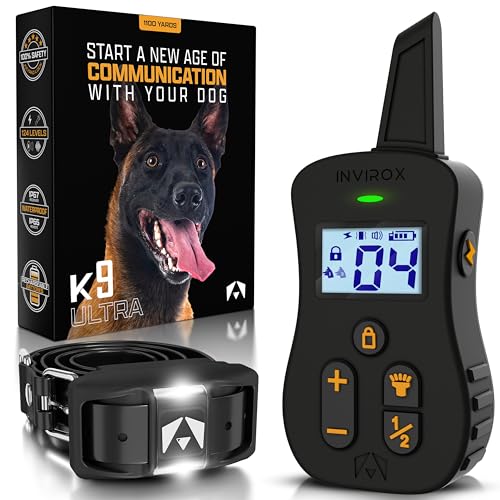
For the longest range among these five, INVIROX Ultra K9 3/4-Mile reaches 3/4 mile and provides 124 levels across beep, vibration and static modes. The maker positions it for recall, off-leash practice and hunting preparation; its IP67 receiver and night-light mode also suit outdoor sessions. The fine adjustment can help a handler start at a low setting and increase only if needed, while keeping non-static cues available. The tradeoff is range: BLACKDOG Military Dog Collar and 4500FT IPX8 Remote Collar claim longer maximum distances, so this is not the pick if that figure is your deciding factor.
Bottom line: Choose it for varied outdoor training and fine-grained mode adjustment.
BLACKDOG Military Dog Collar

Unlike the other options, BLACKDOG Military Dog Collar pairs a remote flashlight with a collar-mounted strobe, making visibility its defining feature for dark trails. The maker says the collar has a 4,200-foot range, four training modes, a three-month battery and a reinforced casing rated for 500 pounds of crush force and 100,000-plus bite cycles. Its IP67 rating is specified as immersion in 1 meter of water for 30 minutes. The fit range is 5–150 pounds, but weight alone does not confirm collar fit; measure the dog’s neck and check contact-point placement before choosing.
Bottom line: Choose it when night visibility and a broad stated weight range matter.
4500FT IPX8 Remote Collar

4500FT IPX8 Remote Collar has the greatest remote range here at 4,500 feet and lists four modes, including an emergency shock mode. Its beep ranges from 1–8, vibration from 1–16, and shock from 1–99 levels; the maker also specifies a security lock and IPX8 waterproofing. The dog-weight range is 10–120 pounds. The emergency stimulation option is a meaningful difference, not a default training approach: use reward-based cues first and avoid escalating a correction for confusion or fear. This model starts at 10 pounds, so smaller dogs fall outside its fit.
Bottom line: Choose it if a 4,500-foot range and IPX8 rating fit your priorities.
Bousnic 3300FT Dual-Channel Collar
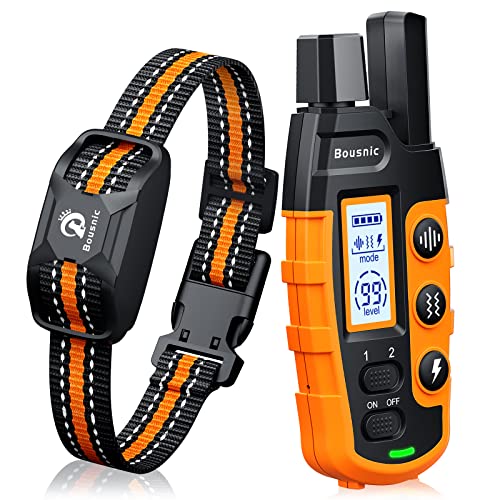
Bousnic 3300FT Dual-Channel Collar stands apart with a dual-channel remote for training two dogs, and the maker gives its range as 3,300 feet. It offers beep levels 1–8, vibration levels 1–16 and shock levels 1–99, plus a security on/off switch. The collar is intended for dogs weighing 5–120 pounds. This combination suits households that need separate control for two dogs, but the range is shorter than the 4,200- and 4,500-foot claims from BLACKDOG Military Dog Collar and 4500FT IPX8 Remote Collar. The waterproof claim has no rating in the specifications, so do not assume a particular immersion depth.
Bottom line: Choose it for two-dog control and a 5-pound minimum fit.
INVIROX Ultra K9 3300FT
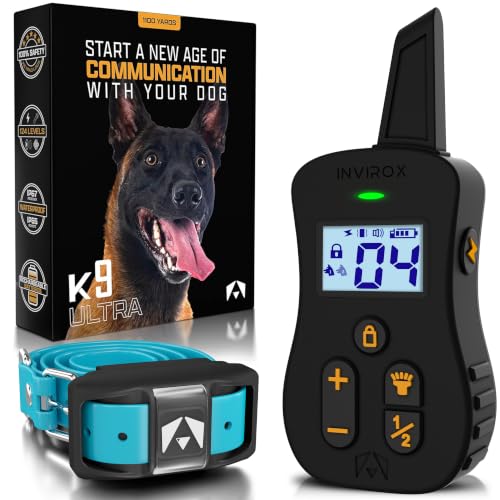
INVIROX Ultra K9 3300FT offers the same 124-level range of beep, vibration and static modes as INVIROX Ultra K9 3/4-Mile, but its range is 3,300 feet rather than 3/4 mile. The maker describes it as designed for reactive, stubborn or hard-to-train dogs and specifies an IP67 receiver and night-light mode. That makes it a closer match for shorter-range recall practice where granular adjustment and water resistance matter. Its shorter stated range is the limitation for open fields or hunting preparation across large areas; compare the usable distance in your intended setting before selecting a remote collar.
Bottom line: Choose it for fine mode adjustment at a shorter stated range.
How to Choose a Remote Training Collar
Start with training method, then compare range and control options. Reward-based training uses food, play or praise to reinforce a desired behavior; a remote collar adds a signal at a distance and should not replace teaching the cue. Begin in a quiet, enclosed area with a known command, then gradually add distance and distractions. Use the least intrusive effective signal, and do not use static stimulation to punish fear, aggression or a behavior you have not taught an alternative for. Remote range figures are maximum claims, not guaranteed working distances: terrain, buildings and signal obstruction can reduce practical range. If reliable recall is not established, keep a leash or long line attached rather than relying on a remote collar.
Fit and Contact-Point Checks
Choose by neck fit and contact placement, not weight alone. A collar that is too loose can shift; one that is too tight can irritate or injure skin. Fit the receiver snugly enough to maintain contact without restricting breathing or movement, and check the skin at least daily while the dog wears it. Move the receiver periodically and remove it when training is over; avoid leaving contact points in one spot for extended periods. Fur length and coat density can affect contact, so confirm that the contact points suit the dog’s coat. A collar’s weight range is a starting filter, not a substitute for checking neck circumference and receiver fit.
Remote Range and Water Ratings
Match advertised range to the training environment rather than choosing the largest number automatically. Open, unobstructed ground is more favorable to a remote signal than wooded trails, hills or buildings, where the usable distance can shrink. IP67 generally means dust-tight protection and temporary immersion in water up to 1 meter for 30 minutes under controlled test conditions; IPX8 indicates immersion resistance under conditions set by the manufacturer, not a universal depth. A generic “waterproof” claim cannot be compared directly with either rating. Rinse mud from a receiver after use and dry charging ports before charging; never charge wet equipment.
Safer Training Steps Before Static Stimulation
Teach the behavior first with rewards and a clear cue, then practice at a distance where the dog can still respond. Use a leash or long line during early recall work, and increase distance in small steps only after repeated success. If a dog reacts by freezing, fleeing, barking or showing stress, stop the session and return to an easier setting rather than increasing stimulation. Static stimulation can cause distress or worsen behavior when used incorrectly; consult a credentialed, reward-based trainer or veterinary behavior professional for persistent reactivity. A remote collar is not a substitute for supervision, fencing or leash control near traffic, livestock or other hazards.
Frequently Asked Questions
How long should a dog wear a remote training collar?
Use a remote collar for supervised training sessions, then remove it rather than leaving contact points in one place for long periods. Check the skin daily and reposition the receiver between sessions.
Can a remote collar train reliable recall?
Recall training usually starts on leash or a long line in a low-distraction area, then adds distance gradually. Keep the dog physically secured near roads or other hazards even if a remote signal is available.
Does IP67 mean a collar can be used underwater?
IP67 protection covers immersion up to 1 meter for 30 minutes under controlled test conditions. It does not mean the collar is designed for prolonged underwater use, and charging equipment should be dry before connection.
What should I do if my dog reacts to collar stimulation?
Stop using static stimulation if the dog freezes, flees or shows distress, and return to reward-based training at an easier level. Persistent fear or reactivity warrants help from a qualified reward-based trainer or veterinary behavior professional.
How do I check whether a training collar fits?
Measure the dog’s neck and check that the receiver stays in contact without shifting or restricting movement. The collar’s weight range alone does not confirm correct fit, especially when coat length affects contact.