
Malibu Low Voltage Transformer: 3 Models Compared

For a Malibu low voltage transformer, Malibu 300W Landscape Transformer is the practical middle-capacity choice, with 300 watts and multiple timer options. Choose Malibu 120W Power Pack for a smaller load or Malibu 600W Landscape Transformer when you need more capacity.
A low-voltage landscape transformer converts household power to 12V AC for outdoor fixtures; match its capacity to the total fixture load and wiring layout.
We earn a commission if you buy through links on this page. As an Amazon Associate I earn from qualifying purchases. Products are compared on manufacturer specifications, not hands-on testing.
- Best overall: Malibu 300W Landscape Transformer – Its 300-watt capacity sits between the 120-watt and 600-watt options, and it offers several scheduling modes.
- Best for smaller loads: Malibu 120W Power Pack – Its 120-watt capacity suits a smaller lighting setup, with five control modes and overload protection.
- Best for larger loads: Malibu 600W Landscape Transformer – Its 600-watt capacity is the largest of the three and includes a detachable photocell with a 56-inch cable.
| Product | Best for | Capacity | Input / output | Shop |
|---|---|---|---|---|
| Malibu 300W Landscape Transformer | Mid-size systems | 300 W | 120 V AC / 12 V AC | Check Price on Amazon |
| Malibu 600W Landscape Transformer | Larger systems | 600 W | 120 V AC / 12 V AC | Check Price on Amazon |
| Malibu 120W Power Pack | Smaller systems | 120 W | 120 V / 12 V | Check Price on Amazon |
Malibu low voltage transformers
Compare these models by transformer capacity and the voltage supplied to the landscape-lighting circuit.
Malibu 300W Landscape Transformer

At 300 watts, this model falls between the 120-watt and 600-watt choices. It supplies 12V AC from a 120V AC input and offers dusk-to-dawn, countdown, and scheduled on/off modes. The maker recommends limiting connected fixture wattage to 75% of the transformer’s rating, or 225 watts for this unit. Built-in overload protection is also described by the maker. Choose it for a system whose planned load fits that guidance; it is not the right match if you need more than 225 watts of connected fixtures under that recommendation.
Bottom line: Choose this for a mid-size setup that stays within the maker’s 225-watt load guidance.
Malibu 600W Landscape Transformer
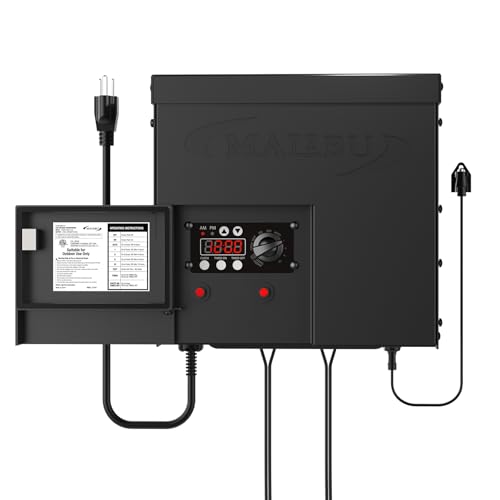
The 600-watt capacity is twice that of the 300-watt model and five times the 120-watt model, making this the largest option here. The maker says its five modes include manual control, dusk-to-dawn operation, countdowns, and personalized scheduling. A detachable photocell has a 56-inch cable, which can help position the light sensor apart from the transformer. ETL listed. Its higher capacity may be unnecessary for a small group of fixtures, so size the transformer to the connected load rather than choosing capacity alone.
Bottom line: Choose this when your planned 12V lighting load calls for the largest capacity in this comparison.
Malibu 120W Power Pack
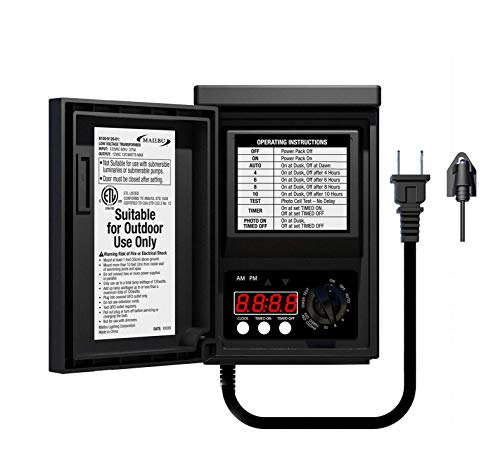
The 120-watt power pack is the smallest of these three options, making capacity its clearest distinction. The maker describes five modes, including manual operation, dusk-to-dawn control, countdown settings, and scheduled on/off times. It also has built-in circuit protection against overload and a memory function that preserves the selected mode. This compact-capacity choice can suit a modest set of landscape fixtures, but it leaves less room for expansion than the 300-watt and 600-watt models. Add up fixture wattages before choosing it.
Bottom line: Choose this for a smaller fixture load that does not need the capacity of the other models.
How to size a Malibu low voltage transformer
Choose transformer capacity by adding the wattage of every fixture on the circuit, then leave room for wiring losses and future additions. The maker of the 300-watt model recommends limiting connected fixtures to 75% of its rating, which equals 225 watts; use that as a model-specific ceiling, not a universal rule for every transformer. A 120-watt unit is the smallest option here, while 600 watts provides the most headroom. For long wire runs, voltage drop can make distant fixtures dimmer, so a larger transformer alone may not solve a wiring problem. If the planned load is close to the transformer’s limit, select a higher-capacity unit and verify the fixture and cable requirements.
Compare the capacities and controls
These three models all convert household input to low-voltage power for landscape lights, but their capacities and control features differ. The 300-watt model has stated 120V AC input and 12V AC output; the 600-watt model has the same voltage conversion. The 120-watt model’s name gives 120V input and 12V output without specifying AC. The maker describes five scheduling modes for the 120-watt and 300-watt models, while the 600-watt model’s features include five modes and a removable photocell sensor with a 56-inch cable. Compare the core differences here.
| Need | Model choice | Capacity |
|---|---|---|
| Smaller lighting load | Malibu 120W Power Pack | 120 W |
| Middle capacity | Malibu 300W Landscape Transformer | 300 W |
| Largest capacity here | Malibu 600W Landscape Transformer | 600 W |
Plan wire runs and fixture placement
Low-voltage landscape systems commonly use 12-gauge or 14-gauge cable, and longer runs or higher loads increase voltage drop. Divide fixtures among multiple runs when practical instead of putting every light at the end of one long cable. A common layout is a home run from the transformer to each group, or a loop that feeds fixtures from both directions; each layout behaves differently, so check voltage at the farthest fixture when setting up. Do not exceed the fixture maker’s voltage range. If lights at the end of a run appear dimmer, shortening the run, using thicker cable, or splitting the load can help more than increasing transformer wattage alone.
Install and operate an outdoor transformer safely
Outdoor lighting transformers connect a 120V supply to a 12V lighting circuit, so treat the input side as household mains voltage. Use an outdoor receptacle with GFCI protection, keep plugs and connections protected from water, and follow local electrical requirements; have a qualified electrician handle any fixed 120V wiring. A weather shield does not by itself confirm that every installation location or connection is weatherproof. Place a photocell where it can sense natural daylight rather than a nearby lamp, which could interfere with dusk switching. Before adding fixtures, turn off power and recalculate the total wattage so the connected load remains within the chosen transformer’s capacity.
Frequently Asked Questions
How many watts of lights can a 300-watt transformer run?
The maker recommends a connected fixture load no greater than 75% of the 300-watt rating, which is 225 watts. Add the wattage of all fixtures on that transformer before connecting them.
Does a 12V landscape transformer output AC or DC?
The 300-watt and 600-watt models specify 12V AC output. Check fixture requirements before connecting lights, since a fixture designed for a different voltage or current type may not be compatible.
How far can low voltage landscape lighting cable run?
There is no single maximum distance that fits every layout; voltage drop rises with cable length and connected wattage. For longer runs, thicker cable such as 12 gauge and splitting fixtures across multiple runs can reduce drop compared with a long, heavily loaded 14-gauge run.
Should a landscape lighting transformer use a GFCI outlet?
Use GFCI protection for an outdoor receptacle supplying landscape lighting, as required by applicable electrical code. Keep the 120V plug and connections protected from moisture, and use a qualified electrician for fixed wiring.