
Shoes to Wear After Broken Ankle: 5 Recovery Options

For ankle recovery, a clinician-prescribed CAM walker such as Jewlri Short Air CAM Walker Boot is the closest match here because its rigid frame is made to protect and support an injured foot and ankle. Choose a post-op shoe only if your care plan calls for one; it is a different style of support and may not stabilize the ankle like a walker boot.
These options are recovery footwear, not ordinary everyday shoes. Follow your clinician’s weight-bearing instructions, and confirm the required boot or shoe type and fit before choosing.
We earn a commission if you buy through links on this page. As an Amazon Associate I earn from qualifying purchases. Products are compared on manufacturer specifications, not hands-on testing.
- Best overall: Jewlri Short Air CAM Walker Boot – A rigid-frame CAM walker designed for injured-foot and ankle support.
- Best for adjustable air support: Honprodu Air Walking Boot – An air cushion lets you adjust support as swelling changes.
- Best for closed-toe coverage: BraceAbility Closed-Toe Medical Walking Shoe – The square toe has room for swelling, socks, or casts.
| Product | Best for | Design | Size | Weight | Shop |
|---|---|---|---|---|---|
| Jewlri Short Air CAM Walker Boot | Rigid ankle support | Short CAM walker | Medium | 1.74 lb | Check Price on Amazon |
| Honprodu Air Walking Boot | Air-adjustable support | CAM walker with air cushion | Medium | 1.94 lb | Check Price on Amazon |
| BraceAbility Closed-Toe Medical Walking Shoe | Closed-toe protection | Closed-toe post-op shoe | Women’s 7–9.5 / men’s 6–8.5 | 0.53 lb | Check Price on Amazon |
| Darco Original Med-Surg Shoe | Post-op shoe option | Med-surg shoe / sandal | Women’s small / size 4 | 0.45 lb | Check Price on Amazon |
| Air Cam Walking Boot Covers, 2-Pack | Boot weather cover | Waterproof boot covers | X-Large | — | Check Price on Amazon |
Shoes to Wear After a Broken Ankle
These recovery options differ in how much of the foot and ankle they cover and support.
Jewlri Short Air CAM Walker Boot
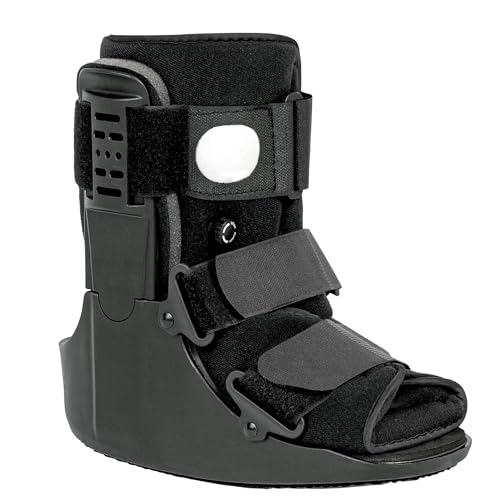
For a walker-style option with a rigid frame, Jewlri Short Air CAM Walker Boot is designed to protect and support an injured foot after injury or surgery. The unisex boot fits either foot, has a removable liner that can be washed in cold water, and includes a soft, thick insole. Its maker recommends measuring injured-foot length and ankle width because swelling can change fit. This is a short CAM walker, so choose it only if its coverage and height match your care plan; a clinician may prescribe a different boot or immobilization approach for a particular ankle fracture.
Bottom line: Choose this if your clinician recommends a short, rigid-frame CAM walker.
Honprodu Air Walking Boot

For adjustable pneumatic support, Honprodu Air Walking Boot has an air cushion intended to adapt to changing swelling stages, along with adjustable straps and a non-slip sole. The boot fits either foot, and the maker advises measuring and checking the size chart before selecting a size. This option may suit someone whose treatment plan calls for a CAM walker and air-cushion adjustment. The maker identifies a medium size but gives no boot height, so confirm the required coverage and fit with your clinician before choosing it for an ankle fracture.
Bottom line: Choose this if your care plan calls for a CAM walker with adjustable air support.
BraceAbility Closed-Toe Medical Walking Shoe

Unlike the CAM walkers, BraceAbility Closed-Toe Medical Walking Shoe is a closed-toe post-op walking shoe with a spacious square toe box for swelling, socks, or a cast. It is unisex, fits either foot, and is intended for recovery support after foot procedures or injuries. Its medium size corresponds to women’s 7–9.5 or men’s 6–8.5. The shoe is not the same as a rigid ankle walker, so it is a partial match for a broken-ankle search; use it only if your clinician says a post-op shoe is appropriate for your injury.
Bottom line: Choose this if your clinician specifically recommends a closed-toe post-op shoe.
Darco Original Med-Surg Shoe

Darco Original Med-Surg Shoe is the only option here identified as a sandal-style med-surg shoe, rather than a CAM walker or closed-toe shoe. The product name identifies a women’s small, and its size is 4. It may suit a recovery plan that calls for a post-op shoe, but the maker does not identify ankle immobilization features. That makes it a partial match for a broken-ankle search: a shoe designed for foot surgery or broken toes is not automatically suitable to support an ankle fracture.
Bottom line: Choose this only when your care plan calls for a med-surg shoe.
Air Cam Walking Boot Covers, 2-Pack

Unlike the footwear options, Air Cam Walking Boot Covers, 2-Pack is a pair of covers for an existing walking boot, not a shoe or brace. The maker says the covers are waterproof, washable, and designed with silicone grips underneath; compatibility includes walking boots, fracture boots, and some post-op shoes. The X-large size is the only size identified here.
Bottom line: Choose these only as covers for a compatible boot you already wear.
How to Choose Shoes After a Broken Ankle
Start with the immobilization and weight-bearing plan from your treating clinician, not the shoe style that looks most comfortable. A CAM walker is a rigid removable boot; a post-op shoe protects the foot but is not interchangeable with an ankle walker. Some fractures are treated with a cast or surgery rather than a removable boot, so the correct footwear depends on the injury and treatment stage. Ask whether the plan permits walking, how much weight can go through the injured leg, and whether the boot must stay on during sleep or bathing. If the plan specifically calls for a walker boot, do not substitute a post-op shoe. Seek prompt medical advice for increasing pain, numbness, color change, or swelling that makes the device feel tight.
Fit and Swelling for a Broken-Ankle Boot
Measure the injured foot while wearing the sock or dressing you expect to use, and compare the measurement with the product’s size chart. Swelling often changes during recovery, so straps and liners should hold the foot securely without pressure points; a boot that becomes increasingly tight needs clinical attention. The heel should sit fully back in the boot, and the toes should not be forced against the front. For the two CAM options here, one maker specifically calls for measuring foot length and ankle width, while the other advises measuring the foot. Do not size up or tighten straps by guesswork if swelling changes substantially; ask the treating clinician or orthotics provider to reassess fit.
CAM Walker Boots Versus Post-Op Shoes
CAM walkers and post-op shoes serve different roles: walkers are boot-like devices with rigid support, while post-op shoes are shorter footwear intended to protect the foot. A post-op shoe may not control ankle motion like a walker, so select it only when the prescribed plan allows it. Boot covers are accessories that fit over existing footwear; they do not stabilize a fracture. A useful decision rule is simple: if your clinician prescribes ankle immobilization, choose the specifically prescribed walker or cast rather than a post-op shoe or cover. The table separates these categories by function, so it can help rule out a mismatched type before comparing size.
| Option type | Role | Choose when |
|---|---|---|
| CAM walker | Rigid boot-style support | Your care plan prescribes a walker |
| Post-op shoe | Foot protection | Your care plan allows a surgical shoe |
| Boot cover | Cover for existing footwear | You already have a compatible boot |
Walking and Safety During Ankle Recovery
Use a walking aid if your clinician prescribes one, and follow the exact weight-bearing limit; “as tolerated,” partial, and non-weight-bearing instructions are not the same. A boot can change leg height and balance, so use extra care on stairs, uneven ground, and wet surfaces. Avoid driving with a boot on the driving foot because it can interfere with pedal control; ask your clinician when driving is safe. Do not remove prescribed immobilization to make ordinary shoes fit, and do not use a boot cover as a reason to walk on slippery ground. New numbness, worsening pain, or toes that look unusually pale or blue warrants prompt medical guidance.
Frequently Asked Questions
Can I wear regular shoes with a broken ankle?
Usually, regular shoes are not a substitute when a clinician has prescribed a cast or walker boot. Follow the weight-bearing and immobilization plan; only transition to regular footwear when your clinician clears it.
Should a walking boot feel tight around my ankle?
A walking boot should secure the foot without causing increasing pressure or numbness. If swelling makes the straps feel tight or your toes change color, contact your treating clinician promptly rather than forcing the fit.
Can I walk in a boot with a broken ankle?
Only if your clinician’s plan allows weight-bearing. Instructions may range from no weight on the leg to weight as tolerated, and using a boot does not by itself mean walking is permitted.
Can I drive while wearing a walking boot?
Do not drive with a boot on the foot used for the pedals because it can interfere with control. Ask your clinician when driving is safe, and do not drive if pain or medication affects alertness.
How should I protect a walking boot from rain?
A compatible boot cover can help keep a walking boot dry outdoors, but it does not prevent slips or replace the boot. Avoid wet, muddy, or icy surfaces when balance or traction is uncertain.