
Lithium-Ion Battery Jump Start: 4 Options Compared

For most drivers, Schumacher SL1639 1,000A Lithium Jump Starter is the clearest lithium-ion jump-start choice because it is explicitly identified as lithium-ion and pairs 1,000 peak amps with a compact form. Choose another option if you need a built-in tire inflator, or if your vehicle’s engine falls outside its compatibility.
A lithium-ion jump starter is a portable battery pack that supplies a brief burst of 12-volt power through clamps to help start a vehicle with a depleted battery.
We earn a commission if you buy through links on this page. As an Amazon Associate I earn from qualifying purchases. Products are compared on manufacturer specifications, not hands-on testing.
- Best overall: Schumacher SL1639 1,000A Lithium Jump Starter – Its lithium-ion chemistry and 1,000 peak amps are specified, alongside USB ports and an emergency light.
- Best for higher stated output: DBPOWER G16 5,000A Lithium-Ion Jump Starter – It lists 5,000 peak amps and an 80.66Wh battery, though its engine-size claims conflict.
- Best for tire inflation: 4,500A Jump Starter with 150 PSI Inflator – The jump starter is combined with a 150 PSI air compressor and four inflation modes.
- Best for a compact combo: 4,500A Jump Starter with 150 PSI Tire Inflator – It combines a 4,500A jump starter with a 150 PSI tire inflator in a compact body.
| Product | Best for | Peak current | Engine compatibility | Added function | Shop |
|---|---|---|---|---|---|
| Schumacher SL1639 1,000A Lithium Jump Starter | Compact essentials | 1,000A | 8.0L gas / 6.0L diesel | USB, LED light | Check Price on Amazon |
| DBPOWER G16 5,000A Lithium-Ion Jump Starter | Higher peak output | 5,000A | Conflicting claims | 80.66Wh battery | Check Price on Amazon |
| 4,500A Jump Starter with 150 PSI Inflator | Inflation combo | 4,500A | 8.5L gas / 7.0L diesel | 150 PSI inflator | Check Price on Amazon |
| 4,500A Jump Starter with 150 PSI Tire Inflator | Tire care combo | 4,500A | 9.0L gas / 7.5L diesel | 150 PSI inflator | Check Price on Amazon |
Lithium-Ion Battery Jump Start Options
Compare the chemistry information, stated engine range and extra roadside functions before choosing a portable jump starter.
Schumacher SL1639 1,000A Lithium Jump Starter

Schumacher SL1639 1,000A Lithium Jump Starter is the only option here that clearly identifies its battery as lithium-ion while giving a specific 1,000A peak output. The maker says it can start engines up to 8.0L gas or 6.0L diesel, and it includes two USB output ports plus an LED light with steady, SOS and strobe modes. Its dimensions are 8.75 by 5.88 by 2.63 inches, which helps when planning storage space. The tradeoff is lower peak current than the other portable jump packs; drivers seeking a compressor or more peak amps should consider another type.
Bottom line: Pick it if you want a clearly identified lithium-ion unit with USB charging and an emergency light.
DBPOWER G16 5,000A Lithium-Ion Jump Starter

DBPOWER G16 5,000A Lithium-Ion Jump Starter stands apart with its 5,000A peak output and 80.66Wh battery capacity, plus smart USB output and an LED flashlight. Its engine limits conflict: the product name gives 8.0L gas and 6.5L diesel, while the maker says 10.0L gas and 8.0L diesel. Because that difference can determine whether a jump pack suits a vehicle, confirm the compatible engine size before ordering. At 7.5 by 3.4 by 1.4 inches and 1.35 pounds, it is a compact choice for drivers who prioritize a power bank as well as jump-starting.
Bottom line: Choose it for its capacity and compact size after confirming the correct engine fit.
4,500A Jump Starter with 150 PSI Inflator
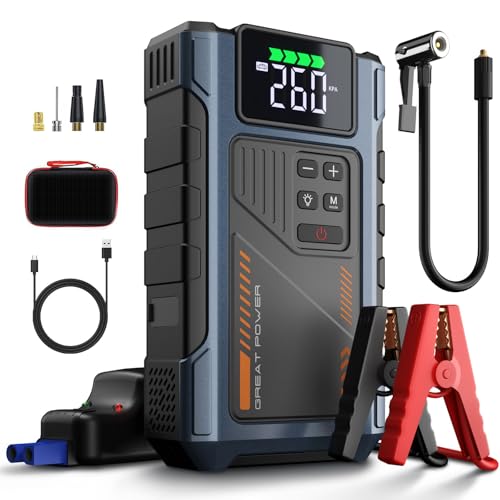
4,500A Jump Starter with 150 PSI Inflator adds a cordless tire inflator to its jump-starting functions, making it the most explicit choice for drivers who want to carry one roadside device for a dead battery or low tire. The maker gives a 4,500A peak current and an engine range of up to 8.5L gas or 7.0L diesel, as well as four inflation modes and a 150 PSI maximum. It also includes pressure detection, lighting and power-bank functions.
Bottom line: Pick it when tire inflation is as important as jump-starting.
4,500A Jump Starter with 150 PSI Tire Inflator

4,500A Jump Starter with 150 PSI Tire Inflator is another jump starter and compressor combination, with a 150 PSI inflator and 4,500A peak current. Its claimed engine limits are up to 9.0L gas or 7.5L diesel, which differ from the other compressor combo’s range.
Bottom line: Choose it if the engine range and tire-pressure monitoring suit your needs.
How to choose a lithium-ion jump starter
Start with your vehicle’s engine compatibility, then compare the extra functions you will actually carry. Peak-amp figures are not a direct guarantee of fit: cold weather, battery condition and engine size all affect starting demand, so use the maker’s engine guidance as a screening point. For a lithium-ion-specific purchase, check that the product explicitly identifies its battery chemistry; a jump starter with unspecified chemistry may be a related option but does not confirm that requirement.
For ordinary roadside use, prioritize secure clamps, clear polarity markings and a pack that is charged before it goes in the vehicle. Avoid guessing based only on a larger peak-current number. The options here also differ by function: USB charging and a light support electronics and visibility, while an air compressor addresses tire inflation rather than battery fit.
Engine fit and output claims
Match the engine size and fuel type before comparing peak amps. A gasoline and diesel engine of the same displacement can place different demands on a starter, and colder temperatures make a weak vehicle battery harder to crank. Choose a unit whose maker’s range covers your vehicle; when the range conflicts, confirm the applicable limit before ordering.
Jump packs do not replace a correctly sized vehicle battery or repair a failed charging system. Keep clamps clear of belts and fans, and connect red to positive and black to the designated negative/ground point according to the vehicle and jump-pack instructions. Stop if a battery is cracked, leaking or visibly frozen.
| Need | What to prioritize |
|---|---|
| Confirmed lithium-ion chemistry | Explicit battery chemistry in the product specification |
| Inflating a tire roadside | Built-in compressor and its maximum pressure |
| Vehicle compatibility | Stated engine size and fuel type that cover your vehicle |
Jump starter safety and storage
Correct polarity matters: reversing positive and negative clamps can cause sparks or damage vehicle electronics. Keep the clamps from touching each other, attach them only to the designated terminals or grounding point, and remove them in the sequence given by the vehicle and jump-pack makers. Do not jump a damaged or frozen battery, and keep the pack away from hot engine components while connected.
Lithium-ion packs should be stored dry and away from direct heat; inspect the case and cables before use and recharge according to the maker’s instructions. A pack left discharged may not be ready when needed, so check its charge periodically. Do not leave a power pack unattended while charging, and stop use if it becomes swollen, unusually hot or damaged.
Frequently Asked Questions
How often should I recharge a jump starter?
Recharge the pack after use and check its charge every few months while it is stored. Lithium-ion packs can gradually lose charge in storage, and temperature extremes can shorten battery life.
Can a jump starter start a diesel engine?
Yes, but only when its diesel engine limit covers your vehicle. Diesel engines generally require more cranking power than similar-size gas engines, so check the pack’s diesel rating rather than relying on its gas rating.
Can I use a jump starter in freezing weather?
Cold reduces battery performance, including the vehicle battery’s ability to crank an engine. Check the jump pack’s operating-temperature range and do not use a vehicle battery that is visibly frozen.
Should I disconnect the car battery before jump starting?
No; a portable jump starter is generally connected to the installed battery’s designated positive and ground points. Follow the vehicle-specific connection procedure, since terminal locations and grounding points vary.
What does a 150 PSI tire inflator rating mean?
It is the compressor’s maximum pressure rating, not the pressure to use in a tire. Inflate to the vehicle’s door-jamb tire-pressure label, and use a gauge to verify pressure because the tire’s recommended pressure is usually far below 150 PSI.