
Best Golf Cart Battery Meter 36 Volt: 4 Compared

The 10L0L 36V LED Meter suits most 36-volt golf carts because it is designed for lead-acid batteries and shows charge level on a simple LED bar. Choose Drok 10–100V LCD Monitor instead if you want an LCD voltage reading and configurable percentage, or 12–72V 10-Segment LED Meter if your battery chemistry or voltage differs.
A golf cart battery meter estimates remaining charge from voltage or a capacity scale; matching the meter to the battery chemistry and system voltage is essential.
We earn a commission if you buy through links on this page. As an Amazon Associate I earn from qualifying purchases. Products are compared on manufacturer specifications, not hands-on testing.
- Best overall: 10L0L 36V LED Meter – Its 36-volt lead-acid fit and simple LED charge display suit a straightforward cart installation.
- Best for LCD readings: Drok 10–100V LCD Monitor – It supports 10–100V systems and lets you pair a percentage with a voltage.
- Best for selectable voltage: 12–72V 10-Segment LED Meter – The 10-segment LED gauge supports selectable 12V through 72V systems.
| Product | Best for | Battery compatibility | Display | Installation | Shop |
|---|---|---|---|---|---|
| 10L0L 36V LED Meter | Lead-acid carts | 36V lead-acid | LED bar, 1–0 scale | Positive and negative leads | Check Price on Amazon |
| Drok 10–100V LCD Monitor | LCD voltage readings | 10–100V, multiple chemistries | LCD voltage and temperature | Programmable percentage | Check Price on Amazon |
| Stone River 36vSRP Meter | Replacement meter | 36V cart meter | Analog style | Meter only | Check Price on Amazon |
| 12–72V 10-Segment LED Meter | Multi-voltage systems | 12–72V selectable | 10-segment LED bar | 37 × 25 mm panel cutout | Check Price on Amazon |
36 Volt Golf Cart Battery Meters
Match the meter to the pack voltage and chemistry before choosing a display style.
10L0L 36V LED Meter

The 10L0L 36V LED Meter is a purpose-specific choice for 36-volt lead-acid packs, with a compact LED bar that indicates charge from “1” (full) to “0” (empty). The maker says its waterproof, shock-resistant design suits rugged environments, and its application list includes E-Z-Go, Club Car, and Yamaha carts. Positive and negative connections keep the basic wiring straightforward, though a wiring diagram may be needed for an unfamiliar setup. Buyers with lithium packs or a need for numeric voltage readings should choose a different style.
Bottom line: Choose this for a 36-volt lead-acid cart needing a simple charge bar.
Drok 10–100V LCD Monitor

The Drok 10–100V LCD Monitor stands apart with numeric voltage and a temperature readout rather than only a row of charge lights. The maker says it supports 10–100V lithium, lead-acid, lithium iron phosphate, and nickel-metal hydride batteries; its default setting is 36-volt lead-acid. Percentage can be programmed to correspond with voltage, which makes setup important because voltage-to-charge behavior differs by chemistry. The temperature shown is the meter’s internal temperature, not ambient air temperature, so buyers seeking a cabin or battery-temperature sensor should not rely on that display.
Bottom line: Pick this when a configurable LCD voltage display matters more than a basic bar gauge.
Stone River 36vSRP Meter
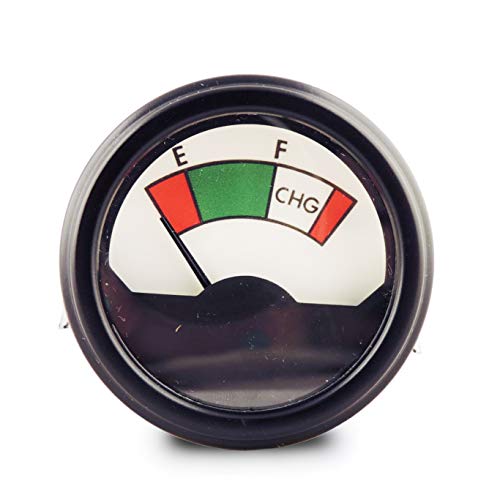
The Stone River 36vSRP Meter is an analog-style replacement meter, unlike the LED and LCD options, and is intended for buyers replacing a compatible existing gauge. Its analog design does not drain batteries while the cart is stored, according to the maker. This is the meter alone; wiring is not included, so it suits a cart that already has compatible wiring or an owner sourcing the wiring separately. The specifications identify it as a 36-volt meter but do not give a battery chemistry, so confirm compatibility with the cart’s pack before ordering.
Bottom line: Choose this for an analog replacement when the cart’s wiring is already handled.
12–72V 10-Segment LED Meter

The 12–72V 10-Segment LED Meter covers a wider range of system voltages than the 36-volt-specific gauges, with selectable settings from 12V through 72V and a 10-segment LED bar. Its scale uses one red, two yellow, and seven green segments, making the display more granular than a simple full-to-empty indicator. The maker says it works with acid and lithium batteries and describes a 37 × 25 mm panel cutout for installation. Because it must be set for the battery system, it is a better fit for mixed-voltage equipment than for someone seeking a plug-in, fixed-voltage replacement.
Bottom line: Pick this if you need selectable voltage or a 10-segment charge display.
How to choose a 36 volt golf cart battery meter
Start by matching the meter’s supported voltage and battery chemistry to the cart’s pack; a 36-volt label alone does not guarantee accurate state-of-charge readings. Battery voltage changes with chemistry, load, and rest time, so a meter calibrated for lead-acid may misread a lithium pack. For a basic readout, an LED bar is easy to scan; choose a voltmeter-style LCD when you want a numeric voltage value. A typical six-cell lead-acid battery is 12 volts nominal, so a 36-volt cart pack commonly uses three 12-volt batteries in series. Confirm the pack configuration and meter setting before connecting positive and negative leads.
Voltage readings and battery state of charge
Voltage is most useful as a state-of-charge estimate after the battery has rested, not while the cart is accelerating or charging. A 36-volt lead-acid pack is nominally 36 volts, but full-charge and low-charge readings vary by battery type and whether the pack is flooded, AGM, or another lead-acid design. For a more stable voltage check, let the cart sit unplugged for several hours and measure across the complete pack, rather than judging a single battery. Under load, voltage sag can temporarily make the gauge appear lower; after the load stops, voltage may rebound. A percentage display is only as trustworthy as its voltage-to-charge calibration for that chemistry.
Display types and installation fit
Choose a display based on what you need to see and how the cart’s dash is laid out. LED bar meters favor quick glances; LCD monitors can provide voltage and, on some models, additional readings; analog meters offer a familiar needle-style presentation. Panel-mounted meters require enough flat dash area and a correctly sized cutout, while replacement-only meters may depend on existing wiring. One selectable-voltage model here calls for a 37 × 25 mm cutout. Measure the available panel space first, then check terminal polarity and wiring route; reversing positive and negative leads can damage some meters. Keep wiring away from moving parts and protect connections from moisture.
| Need | Meter type to consider | Before fitting |
|---|---|---|
| Quick glance at remaining charge | LED bar gauge | Match chemistry and pack voltage |
| Numeric battery voltage | LCD voltage monitor | Set the voltage-to-percentage calibration |
| Replacement for an existing gauge | Analog replacement meter | Check wiring compatibility |
Battery meter mistakes to avoid
The most common error is choosing by voltage alone and overlooking chemistry. Lithium batteries have a different voltage curve from lead-acid batteries, so a percentage scale calibrated to one type may not track the other accurately. Another mistake is reading voltage during heavy acceleration or immediately after charging; both conditions can skew a simple estimate. Use a meter setting that matches the actual battery pack, and check pack voltage at rest if the reading seems inconsistent. A dash gauge also does not replace routine battery maintenance: for flooded lead-acid batteries, inspect electrolyte levels according to the battery maker’s schedule, and never open sealed batteries. Wear eye protection around batteries and avoid sparks near charging batteries.
Frequently Asked Questions
Can I use a 36 volt meter with lithium batteries?
Use a meter that supports the lithium chemistry and its voltage range, rather than assuming a lead-acid gauge will read correctly. Lithium and lead-acid packs have different voltage-to-charge curves, so percentage calibration matters.
Why does my golf cart battery meter drop while driving?
Battery voltage normally sags under acceleration or another heavy load, so a voltage-based gauge can briefly show less charge. Compare readings after the cart has rested unplugged for several hours for a steadier estimate.
How many batteries make a 36 volt golf cart pack?
A common 36-volt lead-acid configuration uses three 12-volt batteries connected in series. Other battery layouts are possible, so check the actual pack voltage before selecting the meter setting.
Does a golf cart battery meter need wiring?
A powered meter generally needs positive and negative connections to the battery system. A replacement meter may not include its wiring, so check whether compatible wiring is already present before installation.
Where should a golf cart battery meter be mounted?
Mount a panel-style gauge where it is visible while driving and where the dash can accommodate its cutout. Measure the available space first; one selectable-voltage model requires a 37 × 25 mm opening.