
Dog Barriers for SUV Cargo Areas Compared by Fit

For most SUV cargo areas, Gtongoko Adjustable Steel Mesh Barrier is the strongest starting point because its adjustable steel mesh panels span 60.6 inches and attach at the headrests. Choose Petboda Foldable Cargo Barrier instead if foldable panels and slide-rail adjustment matter more; measure your cargo opening before selecting either barrier.
We earn a commission if you buy through links on this page. As an Amazon Associate I earn from qualifying purchases. Products are compared on manufacturer specifications, not hands-on testing.
- Best overall: Gtongoko Adjustable Steel Mesh Barrier – Adjustable steel mesh, headrest knobs and elastic ropes provide a combination of separation and attachment options.
- Best for wider openings: NOAMOO 61.9-Inch Wire Mesh Barrier – Its maximum extension is 61.9 inches, with a 38-inch main panel and two side panels.
- Best for folding storage: Petboda Foldable Cargo Barrier – The foldable design uses slide rails for adjustment and bungee cords at the rear headrests.
| Product | Best for | Maximum width | Panel height | Mounting | Shop |
|---|---|---|---|---|---|
| Gtongoko Adjustable Steel Mesh Barrier | Steel mesh separation | 60.6 in | — | Headrest knobs, elastic ropes | Check Price on Amazon |
| NOAMOO 61.9-Inch Wire Mesh Barrier | Wider cargo openings | 61.9 in | 16.1 in | — | Check Price on Amazon |
| Petboda Foldable Cargo Barrier | Foldable adjustment | 62 in | 16 in | Bungee cords, rear headrests | Check Price on Amazon |
Dog Barriers for SUV Cargo Areas
Compare the panel dimensions and attachment methods, then check that a barrier fits your vehicle’s cargo opening and headrests.
Gtongoko Adjustable Steel Mesh Barrier
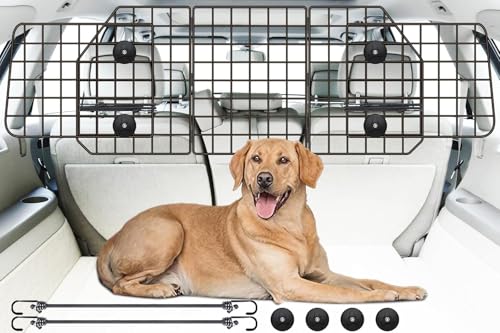
Gtongoko Adjustable Steel Mesh Barrier stands out for its steel-wire mesh construction and four headrest knobs, with elastic ropes included to help stabilize the barrier. The panels adjust across an overall stated size of 60.6 inches by 16.5 inches, making this option a fit to consider when the measured cargo opening is no wider than its span. Smooth edges and rounded corners are also part of the maker’s design. The maker says installation requires no tools or drilling. Its 16.5-inch overall size may leave open space above the divider, so buyers needing a taller barrier should compare the opening height before choosing.
Bottom line: Choose it if steel mesh and headrest attachment points suit your SUV.
NOAMOO 61.9-Inch Wire Mesh Barrier

NOAMOO 61.9-Inch Wire Mesh Barrier offers the widest extension among these three SUV cargo dividers: up to 61.9 inches. Its main panel measures 38 by 16 inches, while the two side panels measure 16.6 by 12.2 inches each. That layout may suit buyers who want a broad center panel and separate side coverage, provided the opening and side contours match. The maker says it is intended for SUVs, vans, Jeeps, hatchbacks and trucks. The panel dimensions should be checked against the vehicle rather than relying on the universal-fit wording; a wide overall span alone does not guarantee coverage at the corners.
Bottom line: Pick it when its wide span and multi-panel layout match the cargo opening.
Petboda Foldable Cargo Barrier

Petboda Foldable Cargo Barrier differs with a slide-rail adjustment and foldable construction, which may appeal to owners who want to remove or store a cargo divider between trips. It extends to 62 inches overall; the main panel is 35 by 16 inches and each side panel is 15.5 by 16 inches. The maker says installation uses the rails and included bungee cords attached to the rear headrests, and describes fit for most SUVs, vans, Jeeps and hatchbacks with rear headrests. The 16-inch panels do not cover every cargo opening height, so measure vertically as well as across before deciding.
Bottom line: Choose it if foldable panels and a 62-inch maximum span fit your SUV.
How to Measure an SUV Cargo Opening
Measure the opening where the barrier will sit, not the widest point of the cargo area. Measure horizontally between the interior trim or other surfaces the panels must cover, then measure vertically from the barrier’s attachment area to the floor or cargo cover. SUV openings can narrow near the roof or flare toward the floor, so take width measurements at both the top and bottom. Compare the smaller usable width with the barrier’s maximum span; allow room for adjustment rather than choosing a divider that must stretch to its limit. Check whether the rear headrests provide accessible attachment points, since the first and third options use them. Keep the barrier from blocking the driver’s rear view or interfering with seat movement.
Choosing Panel Height and Side Coverage
Panel height affects how much of the cargo opening a divider covers, while side-panel shape affects gaps around the vehicle’s interior. These three barriers have stated panel heights around 16 inches, but SUV openings vary in height and contour. Measure from the planned attachment point down to the cargo floor, and look for uncovered space a dog could climb through or push against. A center panel can span the opening while shorter side panels leave gaps near curved trim; compare each panel’s dimensions with the shape of your vehicle. If the barrier cannot meet the attachment points securely or leaves a large opening, choose a different restraint setup rather than assuming a universal-fit label guarantees a snug fit.
Dog Barrier Types and Attachment Styles
Steel-wire mesh barriers use a grid to separate the cargo space from the passenger area, while panel dividers rely on a broad center section and side wings to close the opening. Attachment is as important as material: headrest knobs, bungee cords, elastic ropes and tension supports work in different ways and need compatible surfaces. A barrier attached only at the headrests may shift if the cords are loose or the panels do not fit the opening. Use this comparison to narrow by design, then confirm your vehicle’s headrests and cargo-area shape match.
| Need | Design to consider | Fit check |
|---|---|---|
| Steel mesh construction | Wire-mesh panels | Opening width and headrest attachment |
| Broad center section | Main panel with side panels | Center and side-panel coverage |
| Foldable storage | Foldable, rail-adjusted panels | Maximum span and rear headrests |
Using a Barrier Safely in an SUV
A cargo barrier separates a dog from the passenger area, but it is not a substitute for a crash-tested pet restraint. For crash protection, use a properly fitted travel crate or a crash-tested harness secured as its maker directs; do not attach a leash to a barrier. Before driving, check that the divider cannot slide, that cords or hooks do not interfere with seat belts, and that the dog cannot push through a gap. Keep loose cargo from pressing against the barrier, since shifting objects can add force during a sudden stop. Recheck the fit after moving seats or removing headrests, because those changes can alter the barrier’s support.
Frequently Asked Questions
Are SUV dog barriers crash-tested restraints?
A cargo barrier separates the dog from the passenger compartment, but a barrier alone should not be treated as a crash-tested restraint. For crash protection, use a travel crate or a crash-tested harness secured according to its maker’s directions.
How wide should an SUV dog barrier be?
The barrier must span the usable width where it will sit, including the narrowest point if the opening tapers. Measure at the top and bottom and compare the smaller width with the barrier’s adjustable range.
Can I use a dog barrier behind the front seats?
Only use a barrier in a position its design and attachment system support. Cargo dividers that attach to rear headrests are intended for the cargo opening, while other styles may be designed for different seating positions.
Will a universal dog barrier fit every SUV?
No; SUV cargo openings differ in width, height, trim shape and headrest layout. Measure the opening and confirm that the barrier’s panels and attachment points align before driving.
How can I stop a dog barrier from rattling?
A stable fit depends on secure attachment and panels that match the opening without excess slack. Tighten the included supports as directed, check for movement before each trip, and avoid driving if the barrier shifts.