
Best Baitcasting Combos Under 100: 4 Picks Compared

For a compact setup with rod, reel, line, and lures, choose Kithwild DC 6-ft Travel Combo; its four-section rod packs to under 24 inches. Choose Sougayilang Fiberglass 5.9-ft Medium instead if you want a medium-action fiberglass rod for beginner practice, or KastKing Lethal Phantom 6-ft 2-in M for a two-piece graphite rod with a spare tip.
The phrase “under 100” does not establish a product’s current price, so compare the specifications and confirm the price before choosing.
We earn a commission if you buy through links on this page. As an Amazon Associate I earn from qualifying purchases. Products are compared on manufacturer specifications, not hands-on testing.
- Best overall: Kithwild DC 6-ft Travel Combo – The travel kit includes a four-section carbon rod, reel, line, lures, and a bag.
- Best for beginners: Sougayilang Fiberglass 5.9-ft Medium – Its two-piece fiberglass rod has a medium action and is presented for beginner practice.
- Best for a spare tip: KastKing Lethal Phantom 6-ft 2-in M – The two-piece graphite rod comes with a matching backup tip section.
| Product | Best for | Rod length | Power or action | Rod sections | Shop |
|---|---|---|---|---|---|
| Kithwild DC 6-ft Travel Combo | Compact travel kit | 6 ft | — | 4 | Check Price on Amazon |
| KastKing Lethal Phantom 6-ft 2-in M | Backup tip | 6 ft 2 in | Medium | 2 + spare tip | Check Price on Amazon |
| KastKing Max Steel 7-ft Medium-Heavy | Heavier presentations | 7 ft | Medium-heavy | — | Check Price on Amazon |
| Sougayilang Fiberglass 5.9-ft Medium | Beginner practice | 5.9 ft | Medium action | 2 | Check Price on Amazon |
Baitcasting combos compared
Match rod length, action, and packability to the water and fishing style you have in mind.
Kithwild DC 6-ft Travel Combo

For a compact all-in-one setup, this combo pairs a four-section, 6-foot carbon rod with a baitcasting reel, rod bag, 100 meters of line, lures, and accessories. The rod is under 24 inches when collapsed, which suits hiking or camping where a one-piece rod is awkward to carry. The maker describes the reel as having a smart digital brake. This kit makes sense for anglers who want several starter components together; its short rod may be less suitable when you need extra casting reach or leverage.
Bottom line: Choose this when compact packing and the included tackle matter more than a longer rod.
KastKing Lethal Phantom 6-ft 2-in M
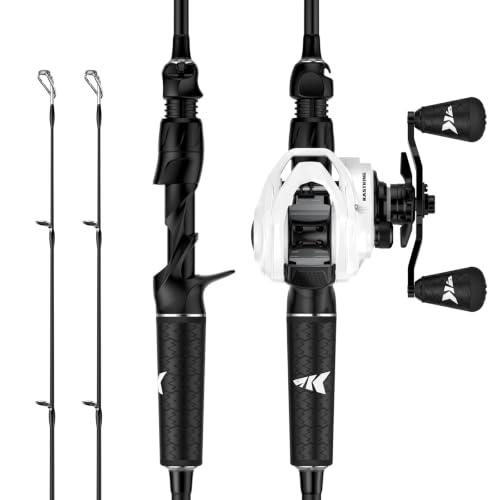
A spare matching tip section distinguishes this two-piece graphite combo from the other choices here. Its 6-foot-2-inch medium rod uses IM6 graphite, aluminum oxide guides, and a Superpolymer grip; the reel is right-handed. The Power Transition System is intended to give the assembled rod a one-piece feel while retaining two-piece portability. Consider it if you want a travel-friendly rod with a backup tip. Its medium power is not the same choice as the medium-heavy rod in KastKing Max Steel 7-ft Medium-Heavy, so match power to the lures and cover you fish.
Bottom line: Pick this if a spare tip and a medium-power graphite rod fit your needs.
KastKing Max Steel 7-ft Medium-Heavy

It uses an IM6 graphite blank, stainless steel guides with aluminum oxide rings, and an EVA handle; the combo is described as a baitcasting setup. Those traits suit anglers seeking more rod length and backbone than a medium-power option offers. The size details identify a left-handed reel, despite the product name saying right-handed, so verify reel-hand orientation before ordering. A longer rod can also be less convenient to transport than a sectional travel setup.
Bottom line: Choose this for a 7-foot medium-heavy rod, after confirming the reel hand.
Sougayilang Fiberglass 5.9-ft Medium

Fiberglass construction sets this two-piece, 5.9-foot combo apart from the graphite and carbon options. The maker presents its medium-action rod as a beginner-friendly freshwater setup for lakes, rivers, and streams, with flexibility intended to absorb sudden force. That can suit practice sessions where durable handling matters more than a longer rod or a compact multi-section travel kit. The specifications do not establish the reel hand, so check that fit before purchase if you need a specific retrieve orientation. Its shorter length offers less reach than the 7-foot option.
Bottom line: Pick this for beginner practice with a short, medium-action fiberglass rod.
How to choose a baitcasting combo
Choose rod power by lure weight and cover, then choose length for casting room and transport. Medium rods are a common all-around bass choice; medium-heavy power is useful when fishing heavier lures or pulling fish through thicker cover. A 6-foot rod is easier to maneuver in tight spaces, while a 7-foot rod can help with casting distance when you have room. Rod action describes where the blank bends: fast action bends mostly near the tip, while moderate action bends farther down. Compare the lure and line ratings printed on the rod before pairing it with tackle; those ratings are more useful than power labels alone.
Reel hand matters too: right- and left-handed baitcasting reels put the handle on different sides. Confirm which retrieve hand suits you, particularly if product naming and size details disagree.
Rod length and packability
Rod length and section count tell you how much carrying space a combo needs. A 5.9- to 7-foot rod is roughly 71 to 84 inches assembled, while a four-section rod under 24 inches collapsed is easier to pack in a day bag. Two-piece rods separate for transport but still need space for a long section. A spare tip is useful as a replacement if a tip breaks, but does not make the rod shorter when packed.
Measure your vehicle, storage tube, or backpack before choosing. If your available storage length is under 24 inches, a rod explicitly described as collapsing below that length is the clearest fit among these options; otherwise, check the dimensions of each rod section.
Baitcaster setup and casting control
Baitcasters use a rotating spool, so spool speed must stay controlled as line leaves during a cast. Beginners commonly encounter backlash when the spool overruns the lure; set the spool tension and braking system for the lure weight, then make short, smooth casts before increasing distance. A familiar starting range for bass baitcasting setups is 10- to 17-pound monofilament or 30- to 50-pound braid, but the rod’s own line rating should take priority.
A digital brake is a reel feature, not a substitute for learning spool control. Start with a lure that falls smoothly under spool tension, keep a thumb ready on the spool, and avoid casting into a strong headwind until you can manage overruns.
Match the combo to your fishing
Match length and construction to the place you fish: shorter rods are easier around brush and tight banks, while longer rods provide more reach in open water. Graphite is generally more sensitive and lighter than fiberglass, while fiberglass tends to flex more; these are material tendencies, not guarantees of a particular catch or casting distance. Medium power suits a broad range of lighter bass lures, while medium-heavy power better accommodates heavier presentations and cover.
Keep hooks covered or secured in the rod’s hook keeper during transport, and never cast when another person is within the hook’s path. For travel, protect rod tips from pressure and keep the sections separated or bagged so they do not strike each other.
Frequently Asked Questions
What line should I use on a baitcasting combo?
A common bass setup uses 10- to 17-pound monofilament or 30- to 50-pound braid. Stay within the rod’s printed line rating, since that takes precedence over a general range.
Is a medium rod different from medium-heavy?
Yes; medium-heavy power is generally suited to heavier lures or thicker cover than medium power. Check the rod’s lure-weight rating because power labels can vary among manufacturers.
How do I reduce backlash when starting out?
Set the reel’s braking and spool tension for the lure, then practice short, smooth casts with your thumb ready to slow the spool. Wind or a lure that is too light for the setup can make overruns harder to control.
How much space does a travel rod need?
A four-section rod under 24 inches collapsed needs less than 2 feet of storage length. Two-piece rods have longer individual sections, so measure the storage space against the section length before packing.
Can I use a baitcasting combo for freshwater?
Yes, baitcasting combos are commonly used for freshwater bass fishing. Match the lure and line ratings to your target species and cover, and practice spool control before casting around other people.