
Sledgehammer Weed Killer: 5 Nutsedge Options Compared

Sedgehammer Plus 13.5 g Packets is the closest match for most Sedgehammer weed killer shoppers because each premeasured 13.5-gram packet treats 1,000 square feet when mixed with a gallon of water. Choose another option if you want a measuring scoop, a hose-end sprayer, or a different formulation.
Nutsedge herbicides are selective weed controls intended for sedges in established lawns; turf type and label directions determine whether a product is suitable.
We earn a commission if you buy through links on this page. As an Amazon Associate I earn from qualifying purchases. Products are compared on manufacturer specifications, not hands-on testing.
- Best overall: Sedgehammer Plus 13.5 g Packets – Its premeasured packet treats 1,000 square feet per gallon and includes surfactant.
- Best for measured concentrate: Sedgehammer 1.33 oz Concentrate – The bottle includes a scoop and makes about 40 gallons of spray.
- Best for hose-end spraying: Ortho Nutsedge Killer Ready-to-Spray – The ready-to-spray bottle attaches to a garden hose.
| Product | Best for | Package / format | Surfactant | Spray preparation | Shop |
|---|---|---|---|---|---|
| Sedgehammer Plus 13.5 g Packets | Premeasured packets | 0.48 oz packets, 2-pack | Built in | 1 packet per gallon; 1,000 sq ft | Check Price on Amazon |
| Sedgehammer 1.33 oz Concentrate | Measured concentrate | 1.33 oz bottle | Separate surfactant required | 0.9 g per gallon; about 40 gal | Check Price on Amazon |
| Atticus Empero 1.33 oz | Concentrate alternative | 1.33 oz concentrate | Separate surfactant required | 1 scoop and 2 tsp per gallon | Check Price on Amazon |
| Atticus Empero Q-Pak 2-Pack | Premeasured alternative | 2 premeasured packets | Built in | 1 packet per gallon | Check Price on Amazon |
| Ortho Nutsedge Killer Ready-to-Spray | Hose-end application | 32 fl oz hose-end sprayer | Included in ready-to-spray format | Connect hose and spray | Check Price on Amazon |
Sedgehammer Weed Killer and Nutsedge Alternatives
Compare these options by format, surfactant requirements and how you prepare the spray.
Sedgehammer Plus 13.5 g Packets
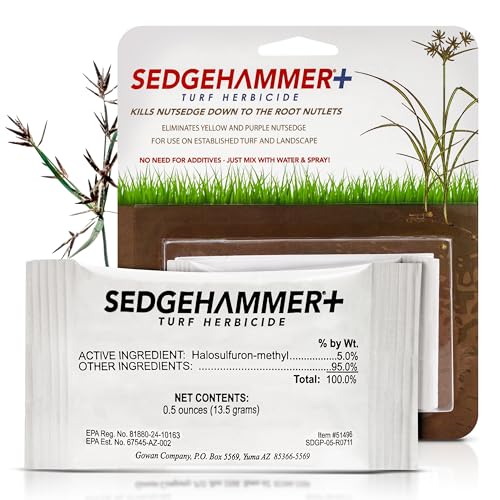
Sedgehammer Plus 13.5 g Packets is the premeasured Sedgehammer option: each 0.48-ounce packet includes a non-ionic surfactant, so no separate surfactant is needed. The maker says it controls purple and yellow nutsedge and kyllinga, with leaves usually yellowing in 10 to 14 days and full results in 3 to 4 weeks. One packet mixes with a gallon of water to treat 1,000 square feet. It is intended for established turf, including several warm- and cool-season grasses. The limitation is its single packet size, which is less flexible than measuring concentrate for a smaller spray batch.
Bottom line: Choose this if you want a premeasured dose with surfactant included.
Sedgehammer 1.33 oz Concentrate
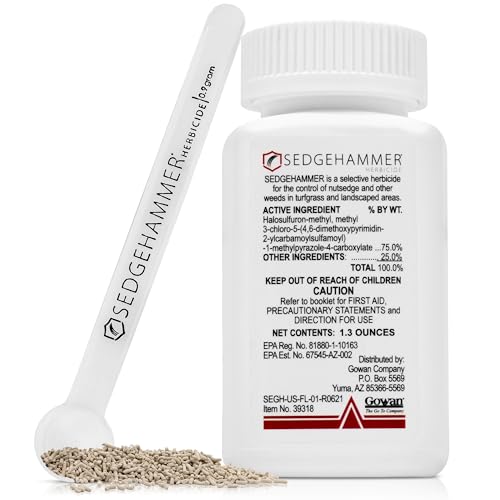
Sedgehammer 1.33 oz Concentrate is the measured-concentrate version of Sedgehammer, with an included scoop rather than premeasured packets. The maker says the 75% halosulfuron-methyl formula controls purple and yellow nutsedge and kyllinga, with visible yellowing usually in 10 to 14 days and full results in 3 to 4 weeks. This format suits treating multiple areas or batches. It requires buying and accurately measuring surfactant separately.
Bottom line: Pick this if you prefer measured concentrate and can add surfactant.
Atticus Empero 1.33 oz

Atticus Empero 1.33 oz offers a halosulfuron-methyl concentrate alternative to the Sedgehammer products. The maker identifies the active ingredient as 75% and says Empero travels down to the tubers; it is intended for most established warm- and cool-season turf, including bluegrass, fescue, Bermuda and zoysia. Mixing calls for one level scoop and 2 teaspoons of surfactant per gallon, and the surfactant is not included. This can suit buyers seeking a concentrate with a scoop. Unlike a ready-mixed packet, the formula requires a separate surfactant and measured mixing, so account for both when planning the application.
Bottom line: Choose this if a scooped concentrate suits your mixing routine.
Atticus Empero Q-Pak 2-Pack
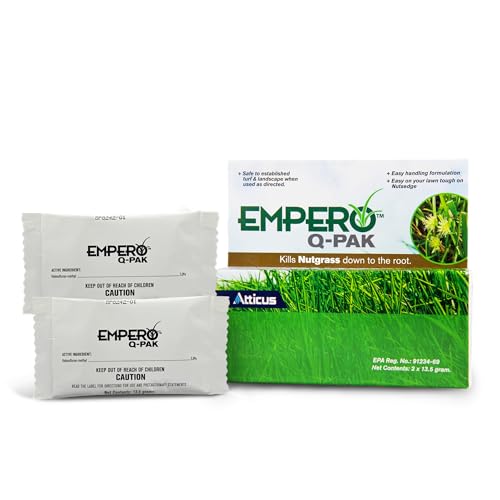
Atticus Empero Q-Pak 2-Pack is the packet-format Empero option, with each packet premeasured and mixed with surfactant. The maker says it contains 5% halosulfuron-methyl and controls nutsedge by reaching the tubers; the intended sites include established lawns, ornamental turfgrass and landscape areas. Each packet goes into a gallon of water, avoiding scoop measurements and separate surfactant. This suits someone who wants a prepared dose but prefers Empero to the Sedgehammer product. The tradeoff is that packet dosing is less adjustable than concentrate when you need a small or unusually sized batch.
Bottom line: Pick this if you want Empero in premeasured, surfactant-included packets.
Ortho Nutsedge Killer Ready-to-Spray
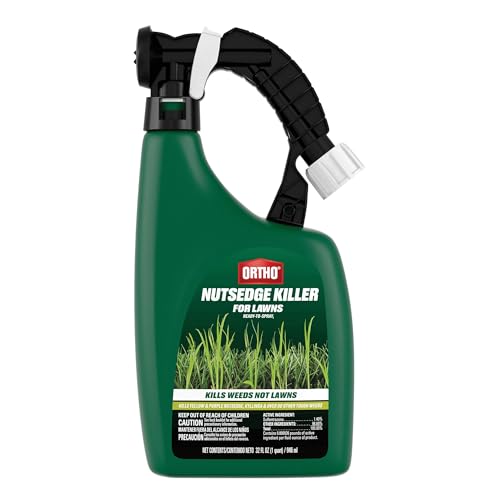
Ortho Nutsedge Killer Ready-to-Spray differs from the concentrates and packets because it is a ready-to-spray hose-end product. The maker says it controls nutsedge, kyllinga and more than 50 listed weeds, including some broadleaf weeds, and may be used on well-established cool- and warm-season turf. Application uses the attached sprayer: connect a garden hose and spray evenly over the target area. This format suits people who want to avoid mixing concentrate by hand. Its broader weed-control scope may not matter to someone treating only nutsedge, and the facts do not establish a coverage rate for comparing it with the gallon-mix products.
Bottom line: Choose this if hose-end spraying is your preferred application method.
How to choose a nutsedge weed killer
Start with the label’s turf and target-weed fit, then choose the application format you can measure accurately. Post-emergent sedge herbicides are applied to actively growing foliage; many use halosulfuron-methyl, a selective herbicide that moves through the plant toward underground growth. A non-ionic surfactant can help spray adhere to the waxy sedge leaves, but use it only when the product label calls for it. Packets simplify dosing, concentrates allow measured batches, and hose-end products avoid manual dilution. The deciding rule is practical: choose a packet when your spray volume matches its dose, and a concentrate when you can accurately measure the smaller amount needed. Confirm that the specific label permits use on your turf species and target sedge.
Match the format to your application
Packet, concentrate and hose-end products call for different preparation steps, so the application method should fit the area and equipment. Concentrates are mixed in a tank or sprayer; a packet dose may be less adjustable for small patches, while a hose-end bottle avoids separate dilution. Follow the exact label rather than transferring a rate from one product to another. A gallon of spray does not cover a universal area: coverage depends on the product rate and how evenly the sprayer applies it. The comparison below shows preparation style, not interchangeable application rates.
| Format | Preparation | Useful when |
|---|---|---|
| Premeasured packet | Mix packet with label-directed water volume | You want a ready dose |
| Concentrate | Measure product and any required surfactant | You need batch-size flexibility |
| Ready-to-spray | Connect hose and apply as directed | You prefer hose-end application |
Check turf fit and application safety
Selective does not mean safe for every lawn: turf tolerance depends on the active ingredient, grass species, establishment and label rate. Some products list multiple turf types but exclude specific uses, such as putting greens, so check the label for the exact site before spraying. Keep people and pets away during application and until the label’s re-entry instructions allow them back; do not infer a safe interval from another brand’s claims. Avoid spray drift onto ornamental plants, garden crops or water, and wear the label-required protective equipment. If the lawn is newly seeded, stressed, or a mixed-species planting, verify the label’s restrictions before treatment.
Set expectations for nutsedge control
Nutsedge is a perennial sedge that can regrow from underground tubers, so removing only visible leaves may not resolve an established patch. Post-emergent products need foliage to contact, and maker-provided expectations for Sedgehammer describe yellowing after 10 to 14 days and full results in 3 to 4 weeks. Avoid judging control immediately after spraying or repeating an application sooner than the label permits. Dense patches, regrowth and varying weather can affect what you see, so read the product’s retreatment interval and seasonal maximum carefully. A key mistake is using a standard broadleaf lawn weed killer that is not labeled for sedges; verify nutsedge or the specific sedge appears on the label.
Frequently Asked Questions
How long does Sedgehammer take to show results?
The maker says leaves usually yellow in 10 to 14 days, with full results in 3 to 4 weeks. Do not use that timing as a reason to reapply before the label allows.
Does Sedgehammer need a surfactant added?
The Plus packet version includes a non-ionic surfactant, while the 1.33-ounce concentrate directions call for 2 teaspoons per gallon. Use the instructions for the specific formulation rather than assuming the products mix alike.
Can nutsedge herbicide be used on every lawn?
No; turf tolerance is specific to the product and grass species. Check the label for your exact turf, and avoid treating putting greens with products that exclude that use.
Why does nutsedge return after pulling?
Nutsedge can regrow from underground tubers, so removing visible leaves may leave the underground growth behind. Avoid digging or disturbing a large patch if doing so could spread tubers through the soil.
When can children and pets return to a treated lawn?
Use the re-entry interval on the specific pesticide label; there is no single interval that applies to every formulation. Keep people and pets off the treated area until that label permits re-entry.