
Stretch String for Bracelets: 5 Cord Options Compared

For most bracelet makers, FIVEIZERO Clear Elastic Cord Set is the most versatile starting point because its six clear cord sizes range from 0.4 mm to 1 mm. Choose JULIMAIDONG Clear Round 0.8 mm Cord or Paxcoo White Flat Elastic Cord instead if you already know you want a single clear or white cord size, and consider the colored sets when color matters more than a transparent finish.
We earn a commission if you buy through links on this page. As an Amazon Associate I earn from qualifying purchases. Products are compared on manufacturer specifications, not hands-on testing.
- Best overall: FIVEIZERO Clear Elastic Cord Set – Six clear sizes from 0.4 mm to 1 mm let you match cord to different bead holes.
- Best for clear round cord: JULIMAIDONG Clear Round 0.8 mm Cord – The 0.8 mm round cord comes in a 200-foot roll.
- Best for color options: Three-Color 1 mm Stretch Cord Set – Three 1 mm cord colors are supplied in separate 165-foot rolls.
| Product | Best for | Cord size | Total length | Material | Shop |
|---|---|---|---|---|---|
| FIVEIZERO Clear Elastic Cord Set | Mixed bead sizes | 0.4–1 mm, round | — | Plastic rubber | Check Price on Amazon |
| JULIMAIDONG Clear Round 0.8 mm Cord | Clear round cord | 0.8 mm, round | 200 ft | Polyester spandex | Check Price on Amazon |
| Three-Color 1 mm Stretch Cord Set | Colored bracelets | 1 mm | 495 ft total | Nylon polyester fabric and braided rubber | Check Price on Amazon |
| LUSTEMBER Black and White 1 mm Cord | Black-and-white cord | 1 mm | — | Nylon polyester fabric and braided rubber | Check Price on Amazon |
| Paxcoo White Flat Elastic Cord | Flat white cord | 1 mm wide × 0.7 mm thick | 328 ft | Polyester spandex | Check Price on Amazon |
Stretch String for Bracelets Compared
Match cord size and shape to bead holes first, then compare color, material and roll length.
FIVEIZERO Clear Elastic Cord Set

Six cord diameters make this set the most flexible choice when a project uses beads with different hole sizes. It includes round clear strands at 0.4, 0.5, 0.6, 0.7, 0.8 and 1 mm, covering finer seed beads through larger-hole styles. The maker says the material resists abrasion and aging, including exposure to sunlight and moisture. This set suits makers who want several sizes and a transparent look; it is less convenient if you need only one size, since you must select and store multiple strands.
Bottom line: Choose this set when your bead collection includes varied hole sizes.
JULIMAIDONG Clear Round 0.8 mm Cord

Unlike the flat styles, this cord is round and 0.8 mm thick, making it a straightforward single-size pick for beads whose holes accommodate that diameter. The clear polyester-spandex strand comes as a 200-foot roll, with a fine profile intended to help conceal a knot among beads. The maker says it is strong yet easy to tie. It suits projects calling for a transparent round cord in one size; makers working with tiny-hole beads should compare the cord diameter with the hole before starting.
Bottom line: Pick this when you want a single clear, round 0.8 mm cord.
Three-Color 1 mm Stretch Cord Set

Three separate colors distinguish this set: black, white and rainbow, with each roll measuring 165 feet for 495 feet total. The cord is about 1 mm thick and is made from nylon-polyester fabric and braided rubber. The maker says it stretches and returns to its original length within its allowable elastic range. This option suits bracelets where cord color is part of the look or where separate colors are useful for different projects. Its 1 mm thickness may be too large for beads with narrow holes, so test a sample through the smallest bead first.
Bottom line: Choose this set for 1 mm cord in three colors.
LUSTEMBER Black and White 1 mm Cord

Two black and two white rolls set this option apart from the three-color assortment, while the cord size remains 1 mm. The maker identifies a nylon-polyester fabric and braided-rubber construction and says the cord is flexible and easy to cut and knot. Its color pairing fits makers who want dark and light strands for separate designs without a transparent finish. The 1 mm thickness is the main constraint: beads with smaller holes may not accept it, so check hole fit rather than relying on a bead’s outside diameter.
Bottom line: Pick this when black and white are the colors you need.
Paxcoo White Flat Elastic Cord
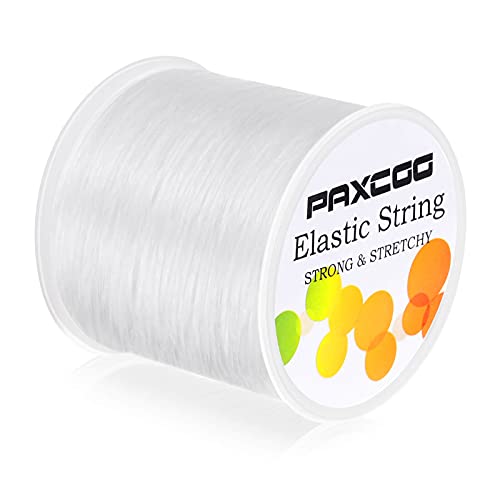
The flat cross-section is the key distinction here: this white polyester-spandex cord measures 1 mm wide and 0.7 mm thick, rather than being a round 1 mm strand. It comes in a 328-foot roll. The maker says its flexible shape threads through both small and large beads and allows a small knot to be tucked among them. This is a useful option when a flat profile suits the design, but bead holes are round and the cord’s width and thickness both affect whether it passes through; test the actual strand with the beads before stringing a full bracelet.
Bottom line: Choose this if you specifically want white flat cord.
How to Choose Bracelet Stretch Cord
Choose cord by the smallest bead hole in the bracelet, not by the largest bead. Cord needs enough clearance to pass through each bead, and a bead with a 1 mm hole may not accept a full 1 mm strand easily because hole size and shape vary. Start with a cord clearly narrower than the measured hole, then test a short piece through the tightest bead. Round and flat cord also fit differently: for flat cord, check both width and thickness against the hole. If one strand must pass through beads more than once, allow for the doubled cord when checking clearance.
Round and Flat Cord Fit
Round elastic cord has one diameter to compare with the bead hole, while flat cord has both a width and a thickness. For a round cord, a practical starting point is to leave about 0.2 mm of clearance between the cord diameter and the hole; a snug or irregular hole may need more. A flat 1 mm by 0.7 mm strand can pass through a hole differently depending on how it turns, so test a sample rather than treating its dimensions as a round diameter. Avoid forcing cord through a bead: friction can abrade elastic and make threading harder.
The table gives a quick starting comparison; the tightest hole in the project should decide the final fit.
| Bead-hole situation | Starting approach |
|---|---|
| Hole near 1 mm | Try cord smaller than 0.8 mm |
| Hole comfortably over 1 mm | Test 0.8 mm or 1 mm cord |
| Mixed hole sizes | Choose size for the smallest hole, or use different cord |
| Flat cord preferred | Check both width and thickness through the hole |
Knotting and Finishing Elastic Bracelets
A square knot is a common finish for elastic bracelets: pass the left end over and under the right, then the right over and under the left, and snug the knot without pulling sharply. Stretch the strand gently before stringing to reduce later slack, but do not overstretch it; repeated high tension can fatigue elastic. Leave enough tail to tighten the knot and test it with a gentle pull before trimming. Some jewelry makers add a small amount of flexible jewelry adhesive, but adhesive suitability depends on the cord material; let it cure fully before wearing and avoid getting glue on beads.
Care and Common Cord Mistakes
Elastic cord wears faster when repeatedly stretched to its limit, dragged across sharp bead edges or exposed to heat and sunlight for long periods. Remove a bracelet before activities that put sustained strain on it, and inspect the cord near bead holes if it starts to look fuzzy, flattened or discolored. Replace a bracelet when elastic shows visible wear rather than waiting for it to snap. Another common mistake is tying a knot before confirming that all beads fit over the cord; test the tightest hole first, particularly with irregular glass or stone beads, and keep sharp-edged beads away from high-tension sections.
Frequently Asked Questions
What size elastic cord fits bracelet beads?
Cord smaller than the bead hole is the safest starting point; about 0.2 mm of clearance is a useful target for round cord. Test the tightest hole in the set because bead holes can vary, and allow more room if the strand must pass through twice.
How do I stop an elastic bracelet knot from slipping?
A snug square knot is a common starting finish, and a gentle tug test can reveal slippage before trimming. If using jewelry adhesive, choose one compatible with the cord and let it cure fully before wearing.
Should I stretch elastic cord before making a bracelet?
Gently pre-stretching the strand can reduce slack after stringing, but do not pull it to its limit. Excessive tension can fatigue elastic, especially when a bracelet is already tight on the wrist.
Can I use flat elastic cord with round beads?
Yes, if the bead hole can pass the cord in its orientation. Check both cord width and thickness and test one bead first, since a flat strand can catch when it twists.
When should I replace a stretch bracelet cord?
Replace it when the cord becomes fuzzy, flattened, discolored or visibly worn near bead holes. Sharp bead edges and frequent stretching can abrade elastic, so inspect high-friction areas periodically.