
Grain Dispenser for Kitchen: 3 Types Compared

For most kitchens, Lifewit 25.4-lb Rice Container is the strongest choice because its 25.4-pound capacity, measured dispensing and 13-by-6-by-16.8-inch footprint suit bulk grain storage. Choose Xilei 5-Grid Wall-Mount Dispenser if wall mounting and five separate grain types matter more, or 360° Rotating 6-Grid Dispenser if you want six varieties in a rotating countertop design.
A grain dispenser stores dry staples and releases them without repeatedly opening a jar; check available shelf or wall space before choosing a format.
We earn a commission if you buy through links on this page. As an Amazon Associate I earn from qualifying purchases. Products are compared on manufacturer specifications, not hands-on testing.
- Best overall: Lifewit 25.4-lb Rice Container – Its 25.4-pound capacity and measurement marks suit bulk storage and portion control.
- Best for wall mounting: Xilei 5-Grid Wall-Mount Dispenser – It can be mounted or set on a counter and separates five grain types.
- Best for variety storage: 360° Rotating 6-Grid Dispenser – Six compartments and a rotating design accommodate several dry foods.
| Product | Best for | Capacity or compartments | Dimensions | Dispensing style | Shop |
|---|---|---|---|---|---|
| Lifewit 25.4-lb Rice Container | Bulk rice storage | 25.4 lb | 13 × 6 × 16.8 in | One-button | Check Price on Amazon |
| Xilei 5-Grid Wall-Mount Dispenser | Wall-mounted variety | 5 grain types; up to 22 lb | 15 × 5.7 × 12.8 in | Press funnel | Check Price on Amazon |
| 360° Rotating 6-Grid Dispenser | Rotating variety storage | 6 grain types | — | Rotating | Check Price on Amazon |
Grain Dispensers for Kitchen Storage
Compare capacity, compartment layout and dispensing format to match your dry staples and available space.
Lifewit 25.4-lb Rice Container

For a single bulk supply, this container holds 25.4 pounds of rice and releases grain with a button; measurement marks on the container and cup help track stock and portions. Its dimensions are 13 inches long, 6 inches wide and 16.8 inches high, so measure the shelf before setting aside a spot. Food-grade PP and a silicone sealing ring are part of its construction. The one-container format is less suited to kitchens that want separate dispensers for many grain varieties; choose it for bulk storage of rice, beans or similar small grains.
Bottom line: Choose this for one large supply with measured dispensing.
Xilei 5-Grid Wall-Mount Dispenser

Unlike a single bulk bin, this dispenser separates five grain types and can hang on a wall or sit on a counter. Its maximum capacity is 10 kilograms, about 22 pounds, and the press-funnel design releases grain without opening the lid each time. A transparent body makes the stored contents visible. The dimensions are about 15 inches long, 5.7 inches wide and 12.8 inches high. Wall installation calls for usable mounting space, while households that want a sealed lid or specific measured portions should consider a different format.
Bottom line: Pick this when five grain choices and wall mounting are priorities.
360° Rotating 6-Grid Dispenser
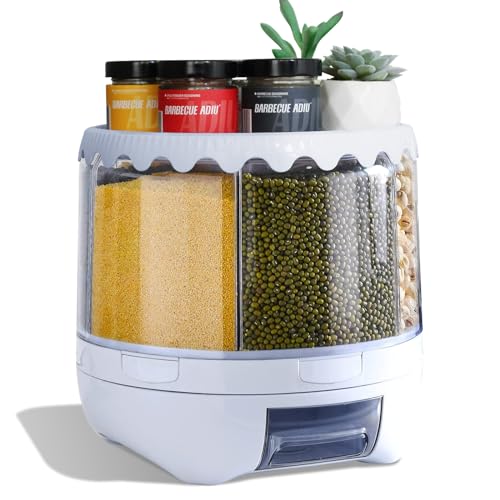
This countertop unit differs from the others by rotating between six grain compartments, making it the option for households that want several varieties in one footprint. A sealed top with a silicone ring is designed to keep moisture and dust out, and the upper lid can hold spices. The maker advises against placing tall bottles on that lid because they could fall. The product is described for small, dense grains such as rice and lentils.
Bottom line: Choose this for rotating access to six varieties and a spice-storage top.
How to Choose a Grain Dispenser for Kitchen Use
Choose by the amount and variety of dry food you actually store: a large single bin suits bulk rice, while separate compartments suit households rotating among grains. Capacity alone does not tell you the footprint, so compare the container dimensions with the shelf or counter, including room to dispense and remove a cup. Most dry grains pour best from a clean, dry container; moisture can cause clumping and spoilage. For grain you use slowly, smaller compartments can make it easier to keep varieties separate rather than mixing fresh and older stock. If portioning matters, look for clear measurement marks rather than assuming a button releases a fixed serving.
Wall, Countertop and Rotating Dispenser Formats
Wall-mounted, countertop and rotating dispensers solve different space problems. A wall unit frees counter surface but needs a suitable mounting location and access to its release mechanism; countertop bins avoid installation but occupy shelf or counter depth. Rotating multi-compartment units trade a single large reservoir for access to more varieties in one station. The useful decision rule is to choose a wall unit only if you have a clear mounting area and can reach the outlet comfortably; otherwise, reserve a measured counter or shelf footprint. Measure height as well as width, since overhead cabinets can prevent a tall container from being used conveniently.
| Format | Best suited to | Space to plan |
|---|---|---|
| Single-capacity bin | Bulk supply of one staple | Shelf or counter footprint |
| Wall-mount multi-grid | Several grain types | Clear wall area and reach |
| Rotating multi-grid | Several varieties at one station | Counter access and top clearance |
Capacity, Portions and Grain Compatibility
Capacity is most useful when expressed in pounds, but the number of pounds a container holds can vary with grain type and how it is filled. Rice and small, dense grains work with many gravity-fed or press-release designs; bulky pieces may bridge or dispense unevenly, so match the mechanism to the food. Measurement marks can help estimate portions, but they do not guarantee a particular serving size unless the product specifies a release quantity. Keep each compartment for one dry food and refill it only after cleaning and fully drying it. This limits stale residue and avoids trapping moisture beneath a fresh batch.
Keeping Stored Grains Dry and Clean
Dry storage protects texture: keep dispensers away from sinks, steam, direct heat and damp countertops, and use clean, dry hands or utensils when handling grain. Airtight seals help limit exposure to humid air, but a seal does not make wet or spoiled food safe. Wipe spills promptly so grain does not collect around release openings, where residue can interfere with dispensing. Check that removable cups and bins are completely dry before reassembly. For pantry pests, inspect dry goods when refilling and discard any food showing insects or webbing rather than transferring it into a clean container.
Frequently Asked Questions
Can a grain dispenser store beans as well as rice?
Many dispensers work with small, dense grains and beans, but very large or irregular pieces can jam narrow outlets. Use a compartment for foods that flow freely through its release opening.
How much space should I leave above a dispenser?
Leave enough clearance to remove the lid or cup and replenish the container; measure the cabinet opening as well as the dispenser height. For units with an upper storage lid, avoid placing tall containers there if they can fall.
Do measurement marks show an exact serving size?
Measurement marks show volume, not necessarily a standardized serving. Use a kitchen scale when a recipe calls for a specific weight, since grain type and packing affect the weight of a scoop.
How should I clean a grain dispenser between refills?
Empty remaining grain, clean removable parts, and let every surface dry fully before refilling. Trapped moisture can clump grains and encourage spoilage.
Are grain dispensers suitable for flour or powdered foods?
Most dispenser mechanisms are intended for grains that flow as individual pieces, and fine powders can clog outlets or leave residue. Store flour in a container designed for powders instead.