
Cabot Australian Timber Oil: Colors and Formulas Compared

Cabot Australian Timber Oil Natural in a gallon suits most buyers who want a penetrating exterior wood treatment, with a water reducible gallon as the main alternative for a different formula. Choose the quart if you need less product, or a colored option when you want a wood-toned finish rather than Natural.
We earn a commission if you buy through links on this page. As an Amazon Associate I earn from qualifying purchases. Products are compared on manufacturer specifications, not hands-on testing.
- Best overall: Cabot Australian Timber Oil Natural, 1 Gallon – The Natural gallon is described as penetrating dense exotic hardwoods in one coat.
- Best for small projects: Cabot Australian Timber Oil Natural, 1 Quart – The Natural quart is a smaller container for outdoor wood projects.
- Best for water-reducible formula: Cabot Australian Timber Oil Water Reducible Natural, 1 Gallon – This Natural gallon is explicitly identified as water reducible.
- Best for brown color: Cabot Australian Timber Oil Jarrah Brown, 1 Gallon – Jarrah Brown gives a named color alternative in a gallon.
| Product | Best for | Formula | Color | Container (quarts) | Shop |
|---|---|---|---|---|---|
| Cabot Australian Timber Oil Natural, 1 Gallon | Natural finish | Penetrating oil | Natural Wood | 4 quarts | Check Price on Amazon |
| Cabot Australian Timber Oil Water Reducible Natural, 1 Gallon | Water reducible option | Water reducible | Natural | 4 quarts | Check Price on Amazon |
| Cabot Australian Timber Oil Low VOC Mahogany Flame, 1 Gallon | Mahogany Flame color | Water reducible | Mahogany Flame | 4 quarts | Check Price on Amazon |
| Cabot Australian Timber Oil Jarrah Brown, 1 Gallon | Jarrah Brown color | Oil protection | Jarrah Brown | 4 quarts | Check Price on Amazon |
| Cabot Australian Timber Oil Natural, 1 Quart | Small projects | Oil protection | Natural | 1 quart | Check Price on Amazon |
Cabot Australian Timber Oil options
Compare the formula, shade and container first, then match the finish to your exterior wood project.
Cabot Australian Timber Oil Natural, 1 Gallon

Its superfine pigments are described as resisting peeling and brush marks. It suits buyers covering a larger outdoor surface who want Natural rather than a named brown shade. The tradeoff is its gallon container: someone treating a small railing or a single piece of furniture may prefer the quart size instead.
Bottom line: Choose this when you want a Natural gallon and the one-coat claim suits your project.
Cabot Australian Timber Oil Water Reducible Natural, 1 Gallon

The water reducible formula is the distinguishing feature of this Natural gallon, rather than a different container size. It is intended for decks, siding, railings and outdoor furniture, and the specifications specify that it is not intended for interior surfaces. This option suits someone prioritizing the named formula for exterior wood. Its Natural color and gallon size overlap with other choices, so it is less distinct if color or a smaller container is the deciding factor.
Bottom line: Pick this when a water reducible formula is your priority for exterior wood.
Cabot Australian Timber Oil Low VOC Mahogany Flame, 1 Gallon
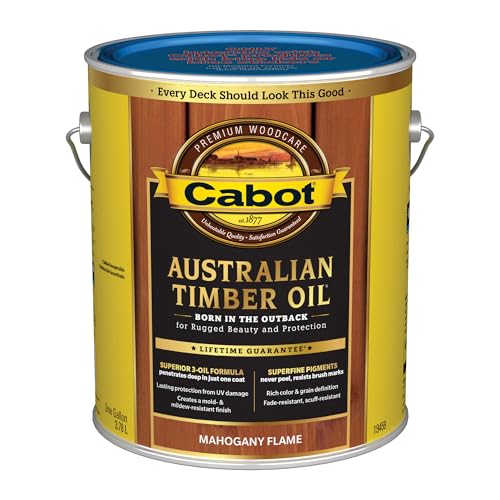
Mahogany Flame separates this gallon from the Natural options, giving the exterior wood a named wood-toned color. It suits a project where the richer color is part of the plan. The main limitation is that it is a gallon in one specific shade; choose another option if you need Natural or a quart.
Bottom line: Choose this for an exterior project calling for Mahogany Flame in a gallon.
Cabot Australian Timber Oil Jarrah Brown, 1 Gallon

Jarrah Brown is the defining difference for this gallon, while its features emphasize oil protection and penetration into dense, resin-rich woods. It is positioned for outdoor projects and for bringing out wood depth and patina. This choice fits buyers who want a brown tone rather than Natural or Mahogany Flame. It is only offered here in a gallon, so it is a poor match for a small touch-up or a project that calls for a water reducible formula.
Bottom line: Pick this when Jarrah Brown is the color you want for an outdoor wood surface.
Cabot Australian Timber Oil Natural, 1 Quart

This quart is the smallest container among these options, which makes it the practical choice for a limited area rather than a broad deck. The features describe a blend of oils intended to penetrate dense, resin-rich wood and enhance natural color; the finish is Natural. It suits smaller outdoor furniture or a railing where buying a gallon would be more than the task calls for. Its limitation is the quart volume, which means it is not the efficient match for a large surface.
Bottom line: Choose this for a modest outdoor wood project that needs less than a gallon.
How to choose an Australian Timber Oil formula
Start with the formula and intended surface: the options here are for exterior wood, and the water reducible products explicitly exclude interior use. Water reducible describes a cleanup or dilution characteristic, not proof that a coating is safer or performs better. Conventional penetrating oils and water reducible stains can differ in application and cleanup, so confirm compatibility with the existing finish before coating old wood. For decks, siding, railings and outdoor furniture, choose the product whose use matches the surface; do not assume every finish works on every substrate. If the product type, base or prior coating is uncertain, verify compatibility before applying a full coat.
Choose a color and container size
Choose the color sample on the same wood species and in the same surface condition, because grain, age and prior coatings change the finished appearance. Natural is available in both quart and gallon choices here; Jarrah Brown and Mahogany Flame are gallon choices. A quart covers less area than a gallon, so base the container decision on the project area and the product’s coverage guidance rather than the container dimensions. For a small railing or furniture piece, start with the quart; for an expansive deck, estimate the square footage and compare it with the manufacturer’s coverage rate before purchase. Keep the chosen shade consistent across the surface to avoid visible variation.
Prepare exterior wood before applying stain
Clean and dry the wood before coating; moisture trapped under an oil finish can interfere with penetration and appearance. Many exterior stains call for wood moisture near or below 15%, though the allowable range depends on the product and local conditions. Remove loose finish and sanding dust, then allow washed wood to dry fully. Dense hardwoods can absorb coatings differently from softwood, while weathering and previous sealers also affect uptake. A small test patch is useful for checking color and absorption before treating the whole area. Do not apply over a film-forming finish unless the coating instructions explicitly allow it.
Use oil stains safely on outdoor surfaces
Oil-based coatings can contain flammable solvents, so keep them away from flames, sparks and hot surfaces during use and storage. Rags soaked with drying oils can heat up as they oxidize; lay them flat outdoors to dry completely or store them submerged in water in a sealed metal container, then follow local disposal rules. Wear gloves and eye protection, and work with ventilation even outdoors when applying near enclosed spaces. Keep people and pets off the surface until the coating has dried and the product guidance permits contact. Follow the container label for application conditions and cleanup.
Frequently Asked Questions
Can Australian Timber Oil be used indoors?
The water reducible options here are explicitly not intended for interior surfaces. These choices are described for outdoor wood such as decks, siding, railings and furniture, so use an interior-rated finish for indoor surfaces.
How many coats of Australian Timber Oil should I apply?
The Natural gallon’s features claim penetration into dense exotic hardwoods in one coat. Wood species and condition change absorption, so test a small area and use the product’s directions for the surface you have.
How long should wood dry before staining?
Let washed wood dry thoroughly before coating; many exterior stains call for moisture near or below 15%. Rain, shade, dense wood and cool weather can extend drying time, so check moisture rather than relying only on elapsed hours.
Can I apply timber oil over an old deck stain?
Only apply over an old stain if the new coating is compatible with that finish. Film-forming coatings can block penetration, so remove loose or peeling material and test an inconspicuous patch before covering the whole deck.