
Permanent Marker for Metal Surfaces: 5 Options Compared

For most general metal marking, Klein Tools Skribes Fine Tip is the practical choice because its fine tip is designed for wet, oily, dusty, and abrasive surfaces. Choose DAPAWIN Oil-Based Paint Markers, 8 Colors instead for opaque, colorful craft marks, or Mkobon Long-Nib Markers, 15 Pack when a mark must reach into a narrow hole.
We earn a commission if you buy through links on this page. As an Amazon Associate I earn from qualifying purchases. Products are compared on manufacturer specifications, not hands-on testing.
- Best overall: Klein Tools Skribes Fine Tip – Fine-tip markers are made for wet, oily, dusty, and abrasive jobsite surfaces.
- Best for colorful crafts: DAPAWIN Oil-Based Paint Markers, 8 Colors – Eight oil-based colors offer opaque marks and the maker says they dry within a minute.
- Best for recessed marks: Mkobon Long-Nib Markers, 15 Pack – The 20 mm long nose reaches into screw recesses and narrow gaps.
| Product | Best for | Tip | Pack size | Ink or surface focus | Shop |
|---|---|---|---|---|---|
| Klein Tools Skribes Fine Tip | Jobsite marking | Fine | 4 markers | Wet, oily, dusty surfaces | Check Price on Amazon |
| DAPAWIN Oil-Based Paint Markers, 8 Colors | Colorful craft marks | Medium | 8 markers | Oil-based paint ink | Check Price on Amazon |
| Overseas Oil-Based Paint Pens, 5 Colors | Small color set | Medium | 5 markers | Oil-based paint ink | Check Price on Amazon |
| Mkobon Long-Nib Markers, 15 Pack | Deep-hole marking | 20 mm long nose | 15 markers | Metal and dry surfaces | Check Price on Amazon |
| MAGIC TAG Fine-Point Lab Markers, 3 Pack | Chemical-resistant labels | 1 mm fiber tip | 3 markers | Wet surfaces; chemical-resistant ink | Check Price on Amazon |
Permanent Markers for Metal Surfaces
Match the marker to the metal’s condition, the line width you need, and whether the mark is for crafts or worksite identification.
Klein Tools Skribes Fine Tip

For work areas where metal may be wet or oily, this four-marker set is the clearest match among these options. Klein says the fine-tip ink writes on wet, dry, oily, dusty, and abrasive surfaces, and has a 72-hour cap-off life. The triangular barrel resists rolling, while a hard-hat clip and lanyard loop support jobsite carry. Choose it for compact, controlled identification marks rather than broad colored fills. Its assorted red, blue, black, and green inks also suit color coding, but the fine tip is less suited to large, highly visible craft lettering.
Bottom line: Choose this set for fine jobsite marks on metal that may be oily or wet.
DAPAWIN Oil-Based Paint Markers, 8 Colors

For colorful, opaque marks rather than a narrow identification line, this eight-color set stands apart. The maker says its oil-based ink is waterproof, lightfast, and dry within a minute; each pen holds 5 ml. The medium tip and multicolor assortment suit metal art alongside wood, glass, plastic, and other craft surfaces. The formula is described as xylene-free and acid-free, with no baking or sealing required. A medium tip makes this a less precise choice than fine-point markers when a metal part needs small labels or tight lettering.
Bottom line: Pick this set for opaque, multicolor craft marks on metal.
Overseas Oil-Based Paint Pens, 5 Colors

For a smaller assorted paint-pen set, this five-color pack uses medium round nibs and 5 ml of ink per marker. The maker says the opaque oil-based ink is lightfast and dries within a minute, and describes it as odorless and non-toxic. The pens are intended for metal as well as materials such as glass, wood, rubber, and canvas. They fit craft marking where a paint-like line is useful. The medium nib is not as narrow as a fine-point marker, so choose another option for tiny labels or marks inside a close-fitting recess.
Bottom line: Choose this pack for medium-width painted marks in five colors.
Mkobon Long-Nib Markers, 15 Pack

For marking metal inside a screw recess or narrow gap, the 20 mm nose is the defining feature of this 15-marker set. It includes three each in white, black, green, blue, and red, allowing color coding across a job. The maker says the marks dry instantly and resist water, fading, and wear; listed suitable surfaces include smooth, dry metal, glass, wood, and plastic. The extra reach helps where a standard marker body cannot approach the mark directly. Because the use is on dry surfaces, it is not the best pick for oily or wet metal.
Bottom line: Pick this set when the mark is recessed beyond a standard tip’s reach.
MAGIC TAG Fine-Point Lab Markers, 3 Pack
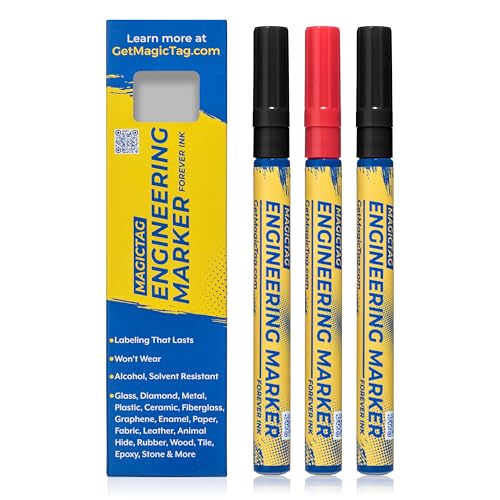
For laboratory or industrial metal labels exposed to solvents or harsh conditions, this three-pack has a 1 mm fiber tip and unusually broad resistance claims. The maker says its ink resists alcohols, acids and bases, bleach, water, UV light, freezing, and high-temperature processing, and adheres to wet or moist surfaces. It also names glass, plastic, and metal as compatible materials. Choose it for compact labeling where chemical exposure matters more than color variety. The pack is black, and its fine-point is intended for controlled labels, not broad paint-marker coverage.
Bottom line: Choose these when fine labels need the maker-claimed chemical resistance.
How to Choose a Metal Marker
Choose by the metal’s condition and the line width before comparing colors. Paint markers use opaque paint-like ink for stronger coverage on dark or uneven backgrounds; fine-point permanent markers make narrower labels and identifiers. A practical rule is to choose a fine tip for small part numbers and a medium tip for marks that need to be seen at arm’s length. For recessed holes, a long-nose design can reach past the marker barrel. Smooth metal can be slick, so remove oil, dirt, and loose residue when the task allows; contamination can interfere with adhesion. On wet or oily work, select a marker expressly intended for those conditions rather than assuming all permanent ink will hold.
Paint Pens and Fine-Point Markers Compared
Paint pens and fine-point markers solve different metal-marking problems: paint pens emphasize opaque coverage, while fine points favor smaller controlled marks. Oil-based paint pens in this group use medium tips and include multiple colors, while the jobsite and lab options use fine tips. A 1 mm fiber tip is useful for compact labels, but it will not fill a broad area as quickly as a medium paint-marker nib. Use this comparison to match the ink style to the mark rather than treating “permanent” as one uniform performance level.
| Need | Marker style | Reason |
|---|---|---|
| Colorful opaque craft mark | Oil-based paint pen | Medium tip and paint-like coverage |
| Small part label | Fine-point marker | More controlled line |
| Mark inside a recess | Long-nose marker | Extended reach |
| Wet or oily jobsite surface | Marker made for wet or oily surfaces | Designed for those conditions |
Preparing Metal Before Marking
Clean, dry metal is the safest starting point for a durable mark unless the marker is specifically designed to write on wet or oily surfaces. Finger oils, cutting fluids, and dust can separate ink from the substrate, so wipe the marking area with a suitable cleaner and let it dry when shop procedures permit. On bare steel, rust or scale can create a rough, discontinuous line; a clean patch improves legibility. Test the mark on a hidden area when appearance matters, since paint ink may be difficult to remove. Keep marker ink away from flames and use ventilation when working with solvent-containing products; consult the product label for handling and disposal precautions.
Keeping Metal Marks Legible
Legibility depends on contrast, line width, and exposure. Use a light ink on dark metal or a dark ink on a light surface, and make the mark wide enough to remain readable after handling. For metal exposed to solvents, heat, or outdoor UV, choose a marker whose maker specifically claims resistance to the relevant exposure; ordinary permanent ink should not be assumed to survive every process. Do not mark a surface that will be coated, welded, heated, or chemically treated without checking shop procedures, because inks and coatings can react or obscure one another. For critical labels, verify readability after the intended process on a sample part first.
Frequently Asked Questions
How long do oil-based paint markers take to dry?
The paint-marker makers in this group say their ink dries within a minute. Allow longer before stacking or handling parts if a thick line or cool conditions leave the surface tacky.
Can permanent markers write on oily metal?
Some are intended for oily surfaces, while ordinary craft paint pens may not be. Choose a marker whose maker specifically claims oily-surface use; if the surface can be cleaned safely, removing oil usually gives a more dependable mark.
What marker tip works for small metal labels?
A fine-point or a 1 mm fiber tip gives more control for compact lettering than a medium paint-marker nib. Leave enough space between characters so the label remains readable after handling.
How do you make marker ink stick to metal?
Start with clean, dry metal whenever the job allows, since oil and dust can weaken adhesion. On slick or coated metal, test a small hidden area first because ink behavior depends on the finish.
Will permanent marker ink survive solvents on metal?
Do not assume ordinary permanent ink will withstand solvents. For chemical exposure, select an ink whose maker claims resistance to the specific solvent, and test a sample label before relying on it.