
Heavy Duty Truck Ramps for Oil Change: 5 Compared

Fworkleft 20-Ton Steel Ramps suits most buyers seeking heavy duty truck ramps for an oil change because its maker rates the steel pair for 40,000 pounds and tires up to 15.4 inches wide. Choose TCE 20-Ton Steel Ramps if its 10.63-inch tire-width limit fits your truck and you want a shorter ramp; the lighter poly options are for vehicles within their lower ratings.
We earn a commission if you buy through links on this page. As an Amazon Associate I earn from qualifying purchases. Products are compared on manufacturer specifications, not hands-on testing.
- Best overall: Fworkleft 20-Ton Steel Ramps – The maker rates the steel pair for 40,000 pounds and tires up to 15.4 inches wide.
- Best for narrower tires: TCE 20-Ton Steel Ramps – It has a 40,000-pound pair rating and a 10.63-inch tire-width limit.
- Best for poly construction: TOWKING 16,000-Pound Poly Ramps – The impact-resistant poly pair is rated for 16,000 pounds and provides up to 7.1 inches of lift.
| Product | Best for | Pair capacity | Lift height | Ramp length | Shop |
|---|---|---|---|---|---|
| Fworkleft 20-Ton Steel Ramps | Wide truck tires | 40,000 lb | 11 in | 54 in | Check Price on Amazon |
| TCE 20-Ton Steel Ramps | Narrower truck tires | 40,000 lb | 9.21 in | 45.67 in | Check Price on Amazon |
| TOWKING 16,000-Pound Poly Ramps | Poly ramp preference | 16,000 lb | 7.1 in | 35.6 in | Check Price on Amazon |
| ROBLOCK 8-Inch Poly Ramps | Eight-inch lift | 20,000 lb | 8 in | 43.3 in | Check Price on Amazon |
| Ironton 12,000-Pound Poly Ramps | Lower-rated vehicles | 12,000 lb | 8.5 in | 35.5 in | Check Price on Amazon |
Heavy Duty Truck Ramps for Oil Change
Compare rated capacity, ramp height and length, then confirm the tire-width limit and vehicle fit before choosing.
Fworkleft 20-Ton Steel Ramps
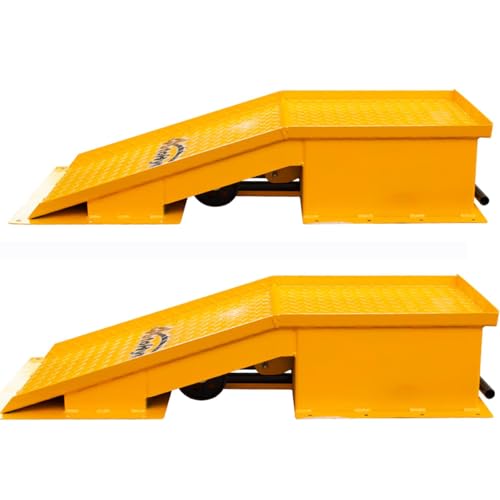
Fworkleft 20-Ton Steel Ramps stands out for its 15.4-inch tire-width capacity and 54-inch length, making it the widest-fit steel option here. Its maker rates the pair at 40,000 pounds and describes the ramps as 6 mm patterned steel. At 19 inches wide and 11 inches high, the pair is intended for large trucks and commercial vehicles needing underbody access. Check that your tire width stays within 15.4 inches and that the ramp’s footprint fits your work area; its 467-pound weight may make frequent repositioning difficult.
Bottom line: Choose it if your truck has wide tires and you can accommodate the heavy, long steel ramps.
TCE 20-Ton Steel Ramps

TCE 20-Ton Steel Ramps combines the same 40,000-pound pair rating as Fworkleft 20-Ton Steel Ramps with a shorter, narrower footprint: 45.67 inches long and 13.39 inches wide. The maker specifies 6 mm patterned steel, a tire-width limit of 10.63 inches, and a welded dual-base system with riveted rubber pads. The 9.21-inch ramp height is lower than Fworkleft 20-Ton Steel Ramps’s 11 inches. That narrower tire limit is the key constraint, so measure the tire’s actual width before buying; a truck with tires wider than 10.63 inches needs another fit.
Bottom line: Pick it for a narrower-tire truck when a shorter steel ramp footprint matters.
TOWKING 16,000-Pound Poly Ramps
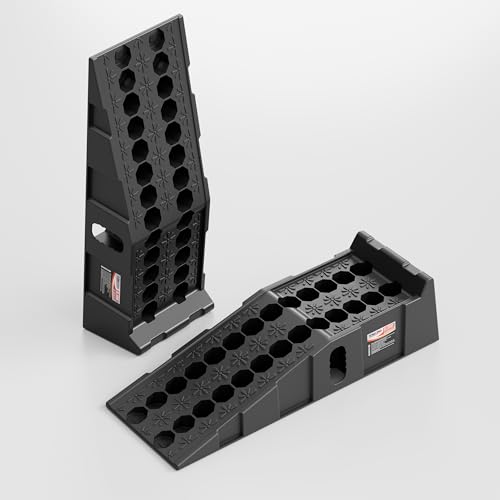
TOWKING 16,000-Pound Poly Ramps is a lighter poly alternative to the steel pairs, weighing 21.1 pounds according to its specifications. The maker rates the pair for 16,000 pounds and says it provides up to 7.1 inches of lift, with a textured surface and a 17-degree incline. That lower rating and lift make it a different fit from the 20-ton steel ramps intended for larger trucks. Check the vehicle’s load and clearance needs before choosing it; the maker’s warning says not to exceed the rated capacity.
Bottom line: Choose it for a vehicle within its 16,000-pound rating when poly ramps suit your needs.
ROBLOCK 8-Inch Poly Ramps

ROBLOCK 8-Inch Poly Ramps offers an 8-inch lift and a 43.3-inch length, placing it between the shorter poly option and the longer steel ramps. The maker gives the pair a 20,000-pound combined maximum and describes a 13.58-inch width, 17-degree angle, raised rails, wheel stops, textured tread and rubber pads. It is a poly ramp set rather than a 20-ton steel pair, so its capacity is the deciding limit for heavier trucks. Confirm the vehicle’s load is within 20,000 pounds and that the tire fits the ramp surface.
Bottom line: Pick it for an eight-inch lift when the vehicle stays within the pair’s 20,000-pound rating.
Ironton 12,000-Pound Poly Ramps

Ironton 12,000-Pound Poly Ramps is rated for 12,000 pounds per pair, the lowest capacity among these options, and its dimensions are 35.5 inches long by 12 inches wide with an 8.5-inch height. The maker describes high-impact poly construction with a honeycomb structure and names cars, SUVs, vans and trucks among suitable vehicle types. This is a smaller-capacity alternative, not a substitute for a 20-ton truck ramp when the vehicle exceeds its rating. Verify that the vehicle is within the pair limit before using it for underbody access.
Bottom line: Choose it only for a vehicle whose load is within the 12,000-pound pair rating.
How to choose heavy duty truck ramps
Start with the vehicle’s load and tire width, not the ramp’s advertised lift alone. Pair ratings differ substantially here, from 12,000 to 40,000 pounds, and the width limit can be more restrictive than capacity: one steel pair accepts tires up to 15.4 inches wide, while another caps them at 10.63 inches. Measure the tire at its widest point and compare that with the maker’s tire limit. Also measure the approach clearance beneath the front bumper or air dam; a tall ramp can contact low bodywork before the tire climbs it. As a practical rule, if tire width exceeds 10.63 inches, don’t choose a ramp with that limit, even if its pair capacity is adequate. Match capacity to the vehicle and load, and don’t treat a vehicle’s gross rating as proof each ramp fits.
Ramp height and vehicle clearance
Lift height is not the same as usable clearance at every point beneath a truck. A ramp’s approach angle, the vehicle’s overhang, and its ground clearance affect whether the front end reaches the ramp without scraping. The options here range from 7.1 to 11 inches of stated lift, with ramp lengths from 35.5 to 54 inches; longer ramps generally provide a more gradual climb when the lift is similar. Before driving up, check that the tires can reach the ramp without contacting a bumper, valance or other low part. For a low-clearance vehicle, favor a longer, lower ramp over a shorter, taller one if its capacity and tire fit are suitable. Keep the vehicle aligned straight as it climbs, and stop if a tire does not sit centered on the ramp.
Steel and poly truck ramps compared
Steel and poly ramps differ in material, weight and the specific load ratings offered here. The steel options are much heavier, at 264.55 and 467 pounds, and each maker rates its pair at 40,000 pounds; the poly options range from 12,000 to 20,000 pounds except for the 16,000-pound pair. Those figures are product-specific, not universal limits for either material. Use this comparison to narrow the type, then verify the exact pair capacity and tire fit for your vehicle.
| Need | Option to consider | Trade-off |
|---|---|---|
| Wide tires with high pair rating | Steel pair rated 40,000 lb with 15.4-in tire limit | 467 lb pair weight |
| Narrower tires with high pair rating | Steel pair rated 40,000 lb with 10.63-in tire limit | 264.55 lb pair weight |
| Poly construction | Poly pairs rated 12,000–20,000 lb, or 16,000 lb | Lower ratings than the 40,000-lb steel pairs |
Safe setup for an oil change
Use ramps only on a firm, level surface, and keep both front tires centered as the vehicle climbs. Set the parking brake and place wheel chocks behind the tires that remain on the ground; an automatic transmission should be in Park, while a manual transmission should be in gear. After positioning the vehicle, shut off the engine and confirm both ramps are stable before approaching the underside. Never exceed the ramp’s pair rating, and remember that a pair rating does not make a ramp suitable for every axle load or tire width. Ramps support the vehicle at its tires, but they are not a reason to work beneath a vehicle that is moving or unstable. If the job requires lifting a wheel off a ramp, use properly rated jack stands on appropriate support points instead.
Frequently Asked Questions
How do I know whether truck tires fit a ramp?
Measure the tire at its widest point and compare it with the ramp’s maximum tire-width limit. For example, a ramp capped at 10.63 inches is not a fit for a tire wider than 10.63 inches, regardless of its capacity.
Can a 20-ton ramp pair hold any 20-ton truck?
No; the pair rating is not a guarantee of fit for every truck. Confirm the vehicle’s loaded weight, tire-width limit and how the load is supported across the pair before using ramps.
How much clearance do truck ramps provide?
The ramp lift figures in these options range from 7.1 to 11 inches. Actual access under a particular vehicle also depends on approach angle, overhang and ground clearance, so check for low bodywork before climbing.
Are poly ramps suitable for heavy duty trucks?
Some poly pairs are rated to 20,000 pounds, while the poly options here range from 12,000 to 20,000 pounds, with another rated 16,000 pounds. Use one only when the vehicle load is within its pair rating and the tires fit.
Should I use wheel chocks with truck ramps?
Yes; chock the tires that remain on the ground, set the parking brake and use a firm, level surface. Keep the vehicle in Park or in gear and confirm the ramps remain stable before going underneath.